

Ash Daniel wrote “The Divorce” as a breakup song. The relationship he wants to end is the one between church and state, and a heavier passage midway through the song contains the words that also name Bleak Gospel’s new EP: “One nation, under God, fill their coffers as they spill blood”.
That combination of music and political anger runs through “One Nation Under God“, a five-track release from Ash’s New York project. The songs are melodic punk rock with a post-punk edge, sometimes moving at a fairly relaxed pace, with occasional heavier passages and screams. Ash’s lyrics take aim at Donald Trump, Christian nationalism, American expansionism and the people he believes are allowing democratic institutions to weaken.
He even brings in American educational films from the 1940s and 1950s. Schoolchildren recite the Pledge of Allegiance as it existed before the words “under God” were added in 1954. A post-war film explains how a country can slide towards despotism. Ash uses those recordings between the songs, making the historical references part of the EP itself.
Bleak Gospel came about after Trump’s victory in the 2024 presidential election. Ash had been thinking about the political punk of the Reagan and George W. Bush years.
“I felt like political music had fallen by the wayside and even in the first Trump admin, you did not hear that same spirit as we saw in the early 2000’s for Bush or for Reagan in 1980. This was the moment to create the music to express the anger towards our US political system, its ineffectiveness, its design to hold us all down and the rise of fascism. Someone needed to speak out.”
The EP came out ahead of the November 3 midterm elections, and Ash has already written much more music addressing American politics.
For now, “One Nation Under God” gives Ash room to make five connected arguments about the country he’s living in. He walked us through the songs, explaining the historical references, the changes in the music and the events behind some of his angriest lyrics.
“Allegiance” begins with an old recording of American children saluting the flag. Their version of the Pledge of Allegiance is missing two words that have since become familiar to generations of schoolchildren.
The film is “School Safety Committee”, made by Sid Davis Productions in 1953. It follows children taking responsibility for safety around their school, with flag ceremonies and classroom routines among its scenes.
At the time, the pledge included the words “one nation, indivisible”. Congress added “under God” in 1954, and President Dwight D. Eisenhower signed the amendment on June 14. The change had strong Cold War associations, with American political and religious identity being set against the officially atheist Soviet system.
Ash finds that history useful when discussing Christian nationalism today. He believes the amendment helped establish a closer relationship between religious identity and American patriotism, one he now wants politicians to question.
Another recording comes from “American Day”, a 1941 Universal newsreel documenting a huge patriotic gathering in New York’s Central Park. It contains another recitation of the pledge, recorded more than a decade before the 1954 change.
Then there’s “Despotism”, a 1946 educational film from Encyclopaedia Britannica Films. It examines how concentrated political power, unequal treatment and restrictions on information can push a society towards authoritarian government. The film asks viewers to judge their own communities by how power is shared and how much respect is extended to individuals.
Ash said: “The older voice that sounds like they are giving a lecture on fascism and despotism towards the end is from a video post world war II that is explaining how fascism grips a country and people. It is a sobering video that still rings true today.”
He also used guitar parts from the next song in “Allegiance”. “This sets the foundation for the EP and is specific to the EP. It samples The Grabber and its riffs follow that progression that leads to The Grabber. The goal is linkage.”
“The Grabber” was Bleak Gospel’s first single earlier in 2026, and Ash remixed the recording for the EP. He’d written it towards the end of 2024, when Trump had just won another presidential election.
The song refers to Trump’s rallies, claims of economic competence, the 2016 Access Hollywood recording with Billy Bush, allegations of sexual misconduct and political ambitions abroad.
“This song is 100% about Donald Trump. The title The Grabber refers to his need to grab all he can from money to politics to women (sexual abuse) to countries (Iran, Greenland etc…).”
Ash wrote the chorus before some of the events he later associated with it. He reads its references to statues as a criticism of a politician he believes wants his name on everything, and the image of economies of sand as a dig at Trump’s economic policies. The words “forgetting this is not your land” have a double meaning, referring to immigration and the history of land taken from Indigenous peoples, as well as public ownership of the country’s democratic institutions.
“This is stolen land that does not belong to Trump, but also has a double meaning of saying the idea of American Democracy does not belong to a wannabe Fascist like Trump.”
The music moves from a more direct punk opening into melodic sections, pulling back and building towards the chorus. There are screams in the middle and towards the end. Ash is especially fond of the chorus and wanted the song to close with a call to resist Trump’s lies.
“He only has power because we allow him to.”
“The Divorce” takes the separation of church and state as its starting point.
“In the US, we believe in religious freedom, so folks should practice what they want, but our founding fathers specifically founded this nation so the government was not influenced by religion. This was to avoid external influence from players with high power in Europe like the pope but also so policy could be created for the benefit of the nation, not a specific religious group. This wall has started eroding since 1954 with the pledge change and the influence of Christianity in the 70’s and beyond.”
The lyrics present this as a marriage whose old vows no longer meet the needs of the people bound by them. They also refer to mass shootings and the familiar political response of offering thoughts and prayers.
“We need lawmakers that don’t just pray but take action. Its not an anti-gun song and the second amendment is important (different topic on keeping the government in check), but its about keeping the influence out of politicians and pushing them to act.”
Ash singles out another lyric about a hymn being used to silence people and connects it to the amount of control politicians exercise over the public. The music is among the more subdued on the EP, with synths and a change of pace in the bridge.
“The song was designed to feel post punk with the gloominess and the synths, but that bridge is a hardcore drop into a post punk song.”
The EP title comes from the bridge. Ash returns to the breakup metaphor in the outro, repeatedly calling for the separation of religious and political authority.
“Break it up directly calls for the removal of religion in politics, but its the nation’s soul lyric that gives the contrast. In a government system that has become overly religious, the soul of democracy has gotten lost in that noise.”
A short passage leads into “Manifest Insanity”.
“Manifest Insanity” picks up the pace. Its title comes from Manifest Destiny, the nineteenth-century belief that American territorial expansion was justified by a special national mission, often understood in religious terms. It helped justify westward expansion and the dispossession of Indigenous peoples.
“This was inspired by Trump’s Greenland talk at the end of 2024 and early 2025 and his continued demonstration of thinking he can just conquer countries. This is a play on the old Manifest Destiny doctrine from early in history where the US was destined by God to own certain territories and land. This is obviously a twist on that to call out the more chaotic and lack of strategy in how the Trump administration runs their foreign policy.”
The chorus deals with accepting lies and losing a sense of where political boundaries ought to be. Halfway through the song, the arrangement drops back for an almost spoken passage which ends with a demand that Trump be held accountable.
In his commentary, Ash connects that demand to January 6, the Epstein files and allegations concerning American military actions in Iran, including the deaths of children. He believes Trump and people who support him have avoided accountability for actions and decisions that deserve much closer scrutiny. These are Ash’s political accusations, and the events he groups together carry different factual and legal circumstances.
When “Manifest Insanity” finishes, another excerpt from “Despotism” takes over. Ash chose a passage about the weakening of representative institutions under authoritarian governments. In the film’s explanation, a country may retain a parliament or legislative body while concentrating meaningful power in the hands of a small number of people.
He also points to a Nazi chant in the archival material. The historical recording prepares the next song, where Ash accuses American lawmakers of allowing presidential power to go unchecked.
“Dog Whistle Symphony” is aimed at the people Ash believes have enabled Trump’s administration, including politicians who support it and citizens who recognise troubling behaviour but do little to oppose it.
The lyrics are packed with references to fascist symbolism, propaganda, racial prejudice and public displays of loyalty to political leaders. Ash draws comparisons with Nazi Germany, arguing that the early stages of authoritarian movements can become normalised when people excuse them or stop paying attention.
References to raised hands and salutes include Elon Musk’s gestures during a celebration of Trump’s inauguration in January 2025. Those gestures caused widespread controversy. Critics compared them to Nazi salutes, while Musk rejected that interpretation, and others described them as an awkward expression of enthusiasm. Ash considers them fascist symbolism and writes about them accordingly.
Other lyrics turn towards Trump’s border-wall politics and attitudes towards immigration. Ash attacks what he sees as racial hostility within sections of the MAGA movement and the willingness of some supporters to defend discrimination as patriotism.
Christian nationalism comes back into the chorus, where Ash pictures a political leader being treated like a king and followers expressing their loyalty through songs, symbols and gestures. He sees those displays as part of the same problem he addressed in “The Divorce”.
The references to 1944 and the Third Reich are part of Ash’s argument about how authoritarian ideas become acceptable. “Even if you did not support Trump, if you do not resist him, you are complicit. The parallel is to those that did not support Hitler, but did not stop him. This is the question, who is going to stop him? We have seen sparks from some.”
The later verses refer to rewriting history, burning books, Confederate imagery and hateful messages defended in the name of free speech. Ash uses the term “antichrist” before calling for collective resistance.
“This is where everything drops out but bass, its something that when you listen for the first time it catches you off guard. Folks told me, oh yeah we were grooving to an otherwise straightforward song, then the whole thing changes.”
The guitars return with a screamed vocal, a moment Ash is especially fond of. “I feel something every time I hear that…. I feel power, rage, energy and a belief that we can change things.”
He finishes with the same question of ownership that appeared in “The Grabber”. For Ash, democracy depends on people being willing to protect it, especially when elected representatives fail to do so. The closing words leave little room for confusion: “This isn’t freedom, it’s their command. DON’T LET THEM TAKE YOUR LAND.”
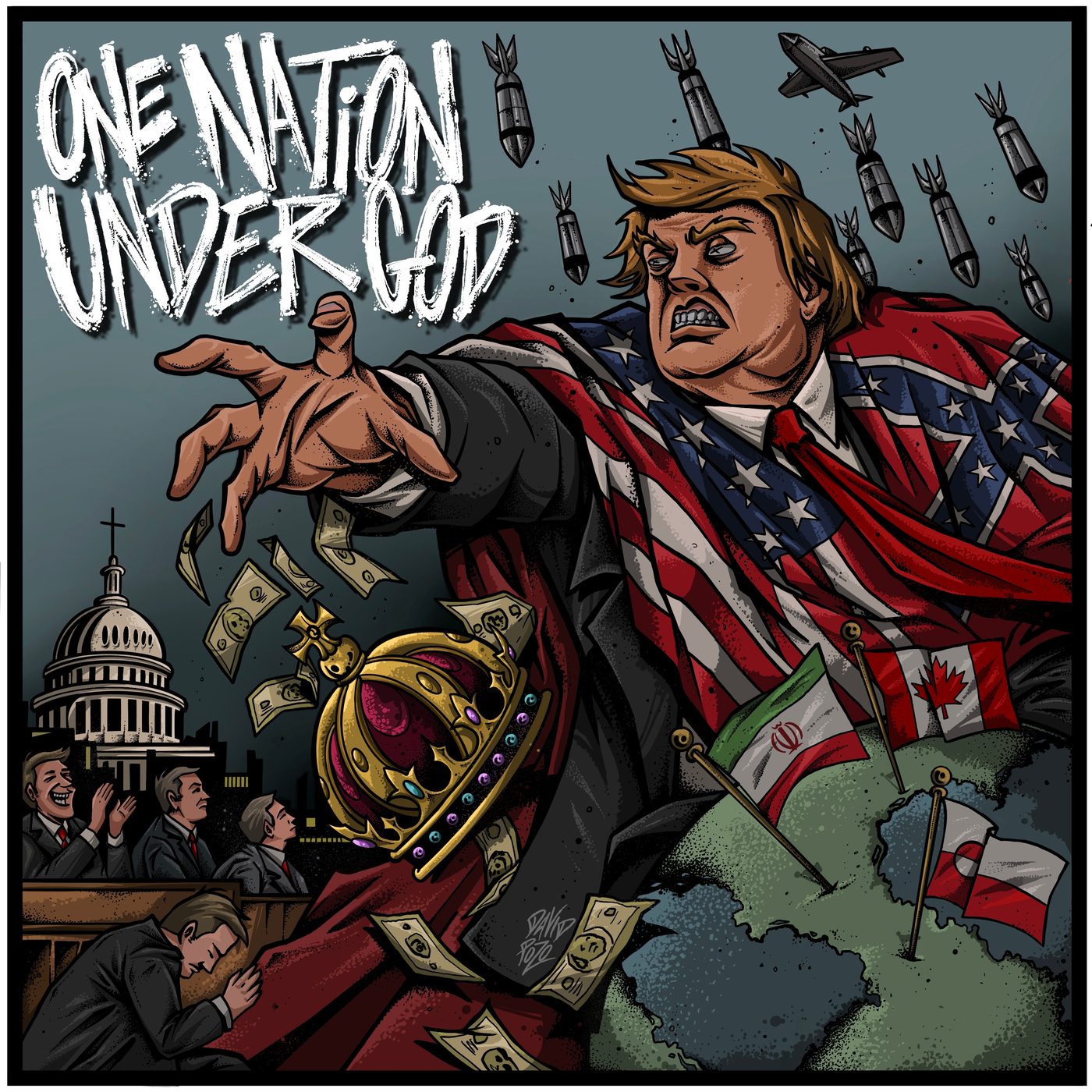
The artwork by David Pozo takes the EP’s political arguments into a single cartoon. Trump is shown in a suit wrapped in the American flag, reaching forward as dollar bills fall around him. Bombs descend from above, the Capitol stands behind him and a crown appears in the foreground. A globe carries flags associated with countries that have figured in disputes over American foreign policy and territorial ambitions.
Pozo is an independent illustrator, and Ash wanted to work with somebody outside the usual corporate music-business arrangements. He has negotiated reproduction rights for the artwork and maintains control of how it is used. Brat Kid created the Bleak Gospel logo, with its rough red lettering against a black background.
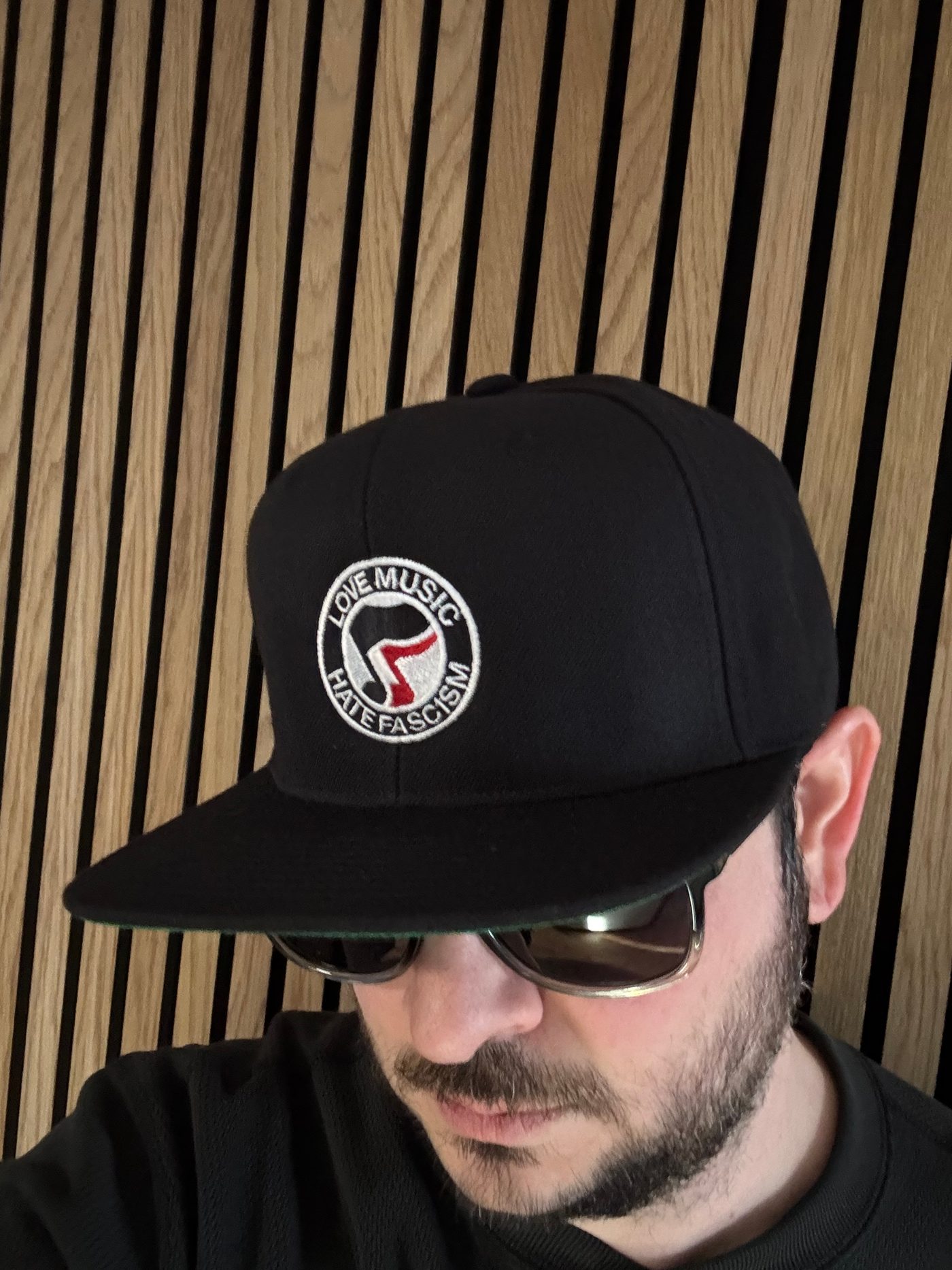
Ash has continued collaborating with Brat Kid. Artwork for the next EP is already finished, and the two have been working on further designs alongside plans to update the Bleak Gospel website.
The recordings are handled in much the same independent way. Bleak Gospel take care of recording, mixing and mastering themselves, and the music comes out through Dead Ledger Records, an imprint Ash created for the project. For now, Bleak Gospel are its only act, although he hasn’t ruled out working with other artists through the label someday.
“On collaboration, we strive to work with independent creators. For example, the artwork is from independent artist David Pozo and we are working with another artist for the next EP and website rebrand. We want to support independent artists and maintain freedom in our message.”
“The goal is community and doing our best to avoid influence of big corporations. Not totally unavoidable as streaming platforms like Spotify still dominate.”
That independence gives him control over the releases, although doing everything himself takes time. Ash remains the main songwriter and only permanent member of Bleak Gospel. He’s also working a full-time job, which has made recording the amount of music he’s written a slow process.
Wyświetl ten post na Instagramie
“On the EP, it is a subsection of the first album release with some bonus content added. For example Allegiance is EP only while the other tracks will end up on Album 1.”
The next step is another EP with more songs from the same full-length, which Ash is calling “Trump’s In”. “After EP 2, comes album 1. Figured putting out two supporting EPs in a drip method helps get the songs out while we work the larger project.”
“Four albums is still the goal and 3 out of 4 are written. Recording is taking much longer than expected, especially balancing a full time job!”
“One Nation Under God” was released independently on October 20, 2026, through Bleak Gospel and Dead Ledger Records. The EP is available to stream on Spotify, with more information and future releases through the Bleak Gospel website. Ash is currently working towards the second EP and the full-length “Trump’s In”, with the four-album project still ahead of him.
🔔 IDIOTEQ is ad-free, independent, and runs on one person’s time. If you want it to stay that way: DONATE via PayPal or SUPPORT via Patreon.
NEW: IDIOTEQ Explore 🗺️ Browse 15+ years of our archive by city, country, and style. Find artists on the world map or trace related sounds through the styles map.
Stay connected via Newsletter · Instagram · Facebook · X (Twitter) · Threads · Bluesky · Messenger · WhatsApp.