
There is a particular kind of rock record that feels almost displaced now: guitars up front, choruses with no apology, a little glam in the bones, a little Britpop in the walk, enough post-punk tension to keep it from turning soft. For listeners who came to heavier music through the doorway of big melodic rock songs, The Magic City’s self-titled debut has a strange homecoming quality. No strain. No posture. Just a Boston band playing the kind of album that once filled whole afternoons and probably helped point a few people toward louder rooms later.
The Magic City release the full album today, May 22, on digital, vinyl, and CD, with the whole thing available to stream now. The record lands with a release party tonight at The Burren in Somerville, where the band plays alongside Lonely Leesa and the Lost Cowboys.
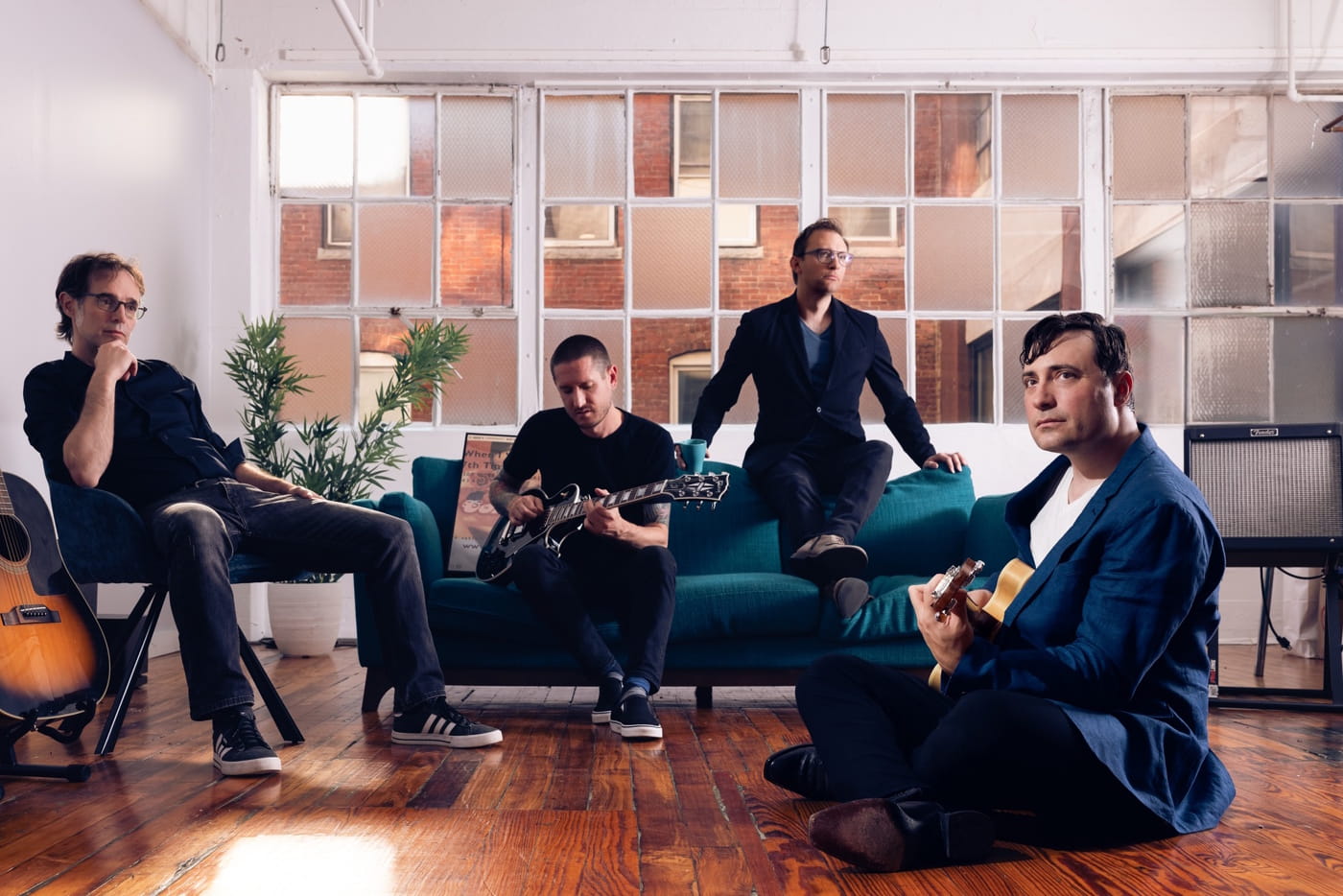
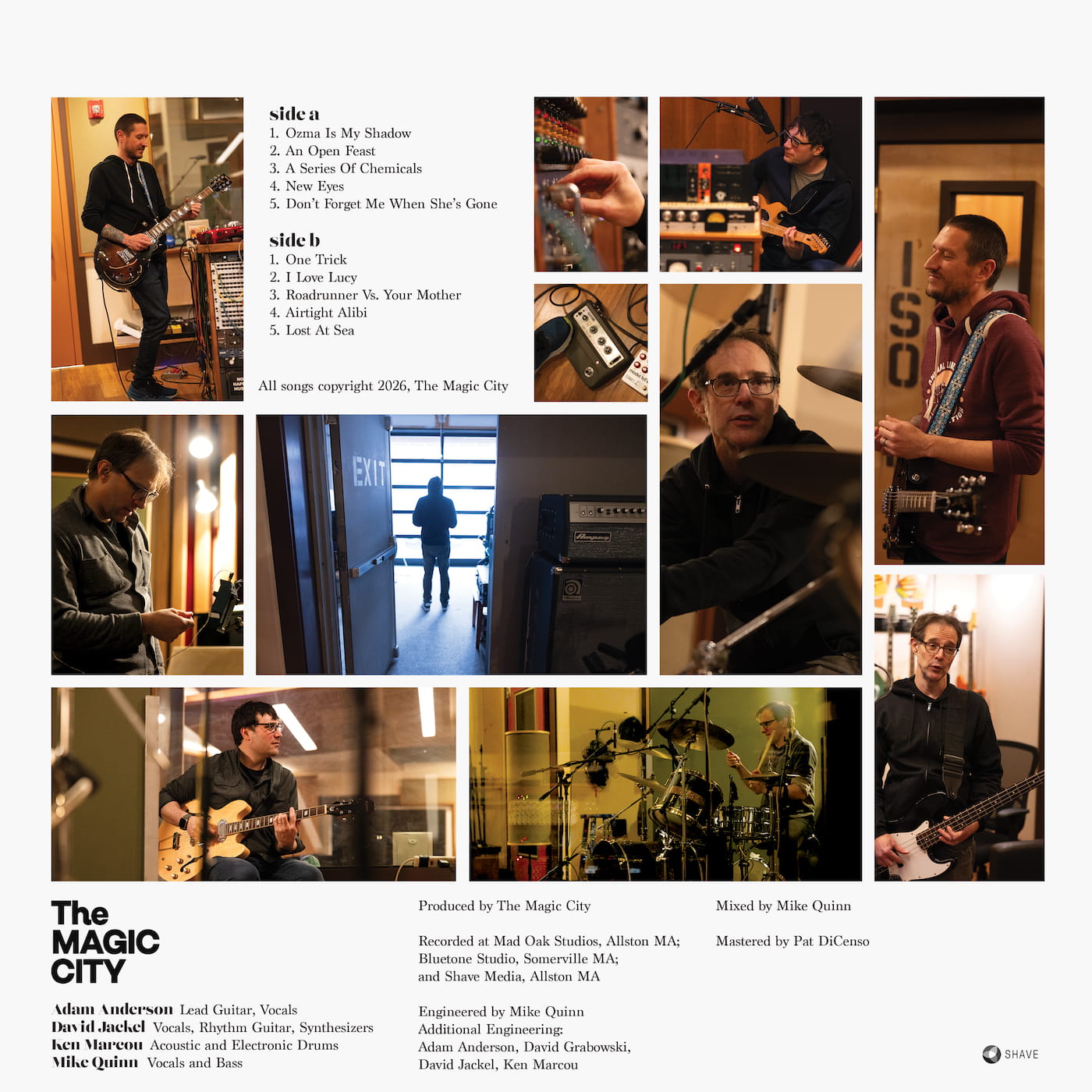
The band is Adam Anderson on lead guitar and vocals, David Jackel on vocals, guitar, and synth, Ken Marcou on acoustic and electric drums, and Mike Quinn on vocals and bass. They take their name from an imagined city where Boston and London overlap — a private map made out of local rooms, imported records, old bands, and the idea that geography can be emotional as much as physical.
“We want to find our people,” says Jackel. “It’s that family tree of music culture that began with the Beatles and Stones, Bowie and Velvets, and then punk, post-punk, goth, new wave, Britpop. Angel Olsen channeling Serge Gainsbourg. Their random playlist could be Kate Bush, Bauhaus, Bat for Lashes, Pixies, and it would all make sense.”
Wyświetl ten post na Instagramie
The band’s early singles already pointed in different directions: “Roadrunner Vs Your Mother” arrived in 2023 with a British Invasion pull, Cool Britannia aftertaste, and Jackel’s voice sitting somewhere near David Bowie and Brett Anderson; “A Series of Chemicals” followed with Quinn on vocals and a sharper power-pop charge.
Then the band disappeared back into the songs.
“I feel that any song I pitch to the band is solid enough to stand on its own already,” Quinn says, “but I encourage the others to make it their own. Adam, Ken, and Dave arrange, rearrange, and sculpt it with their own ideas, and the result is often very different from and way cooler than what I originally pictured. Each of us has also contributed engineering on this record: Ken with his electronic drums, Adam with guitars, and Dave and I recording each other’s vocals. I love the collaborative process, and these guys are outstanding collaborators.”
The Magic City produced the album themselves. It was recorded at Mad Oak Studios and Shave Media in Allston, and Bluetone Studio in Somerville. Quinn engineered and mixed the record, with additional engineering from Anderson, David Grabowski, Jackel, and Marcou. Pat DiCenso mastered it. The band gives special thanks to Benny Grotto, Craig Riggs, and Grabowski.
“I now feel confident and energized,” Jackel says. “We took our time finessing the details of these songs, exploring them from every angle, and found ourselves as a band in the process. We could have released a viable version of the album two years ago, but we were meticulous in our writing and recording.”
The album opens with “Ozma Is My Shadow,” a glam-rock push built from an old acoustic demo that once had a Lou Reed-meets-’60s girl group feel. The song’s title goes back to a childhood reading of “The Land of Oz,” and to a detail Jackel never really shook.
“I read this book around the time I turned ten,” he says. “The big twist at the end of the story is that the hero, who is a boy, discovers he is in fact a princess who was hidden as a baby by being transformed into a boy. The spell is reversed and he returns to being Ozma. Same character, same memories, different body. This started me on a course of wondering what aspects of our souls are linked to our bodies, and what is independent. And also, are our souls multidimensional to the point where you could at least metaphorically be multiple people?”
That memory became one of the album’s entry points, but not its only one. “Ozma Is My Shadow” is not a retelling of the book. It comes from the moment after the reveal, the part where the body changes and the person remains.
“When I was 9 or 10, I read ‘The Land of Oz,’ in which spoiler alert! the boy protagonist discovers he was actually a princess at birth, magically transformed and hidden as a boy,” Jackel says. “When he transforms back, he or she is still essentially the same character – the body is where the soul lives, but it’s not the soul. This concept stayed with me. The song isn’t a retelling of that story, but it springs from that revelation.”
The record keeps returning to that kind of escape: from a body, from a role, from a fixed idea of taste, from cultural pressure, from whatever older self keeps trying to take over. Jackel hears it most clearly in the first and last songs.
“I’m drawn to lyrical themes like spiritual liberation, rejuvenation, and rebirth,” he says. “The opening song, ‘Ozma Is My Shadow’, culminates in a mantra of ‘we’re gonna break out’, and the closing track, ‘Lost at Sea’, is built around the line ‘now I’m free’. I generally steer away from politics and social commentary in my lyrics, but ‘New Eyes’ deals with the impulse to retreat into cultural assimilation during menacing times. For my part, there’s no unifying theme to the lyrics, other than what seems to occupy my mind these days.”
Quinn sees the album’s depth in the songs that are not as immediate on paper. “These were not necessarily the ‘obvious’ singles,” he says of “Airtight Alibi” and “New Eyes,” “but they are melodically interesting and have powerful instrumental arrangements. I think the record is pretty deep; and it’s my hope that people are inclined to avoid the ‘skip’ button when they put it on.”
Anderson’s lead guitar on “Don’t Forget Me When She’s Gone” pulls toward the leather-jacket side of Britpop, while “Airtight Alibi” nods closer to the tracksuit end. Marcou’s hybrid percussion on “An Open Feast” opens a different lane, mixing acoustic and electronic drumming. “Lost At Sea” closes the album with big-room ’90s alternative lift and enough “la la la” glow to keep the Suede connection close.
That connection matters. “Dog Man Star” was Jackel’s songwriter shock.
“Hearing this album was my aha moment as a songwriter,” he says. “How do you merge the Sex Pistols, guitar virtuoso heroic hard rock, melodramatic musical theater, pop hooks, and make it work? ‘Dog Man Star.’ Musical theater, when I can stand it, has been one of my guiltier pleasures. I remember a big deal being made out of ‘Phantom of the Opera’ having rock and roll elements — and I loved it when I was 9 — but ‘Dog Man Star’ is how it’s done right.”
Brett Anderson gave him another version of masculinity, one that could hold traits usually marked as feminine without sanding them down.
“Listen to ‘Heroine’. That says it better than I can,” Jackel says.
Reading that Anderson had cited Kate Bush and Cocteau Twins as influences pushed Jackel toward Bush long before “Stranger Things” turned her into a streaming-era event.
He hears “Lily” and “Song of Solomon” close to the spirit of “Dog Man Star,” and puts Marc and the Mambas’ “Catch a Fallen Star” in a similar place: a voice and spirit moving across gendered expectations without asking permission.
Pixies hit earlier, around age thirteen, after a childhood soundtrack dominated by suburban top 40 pop rock and guitar-hero bands.
“GNR was my favorite of the bunch, because they were actually really good,” Jackel says. “I remember when ‘Use Your Illusion’ came out, and enjoyed its energy, but I felt like something was missing. I found the character of the band and the lyrics to be completely unrelatable.”
“This was the first time I had heard a band that had both male and female sides to it, without moving towards some sort of compromised middle ground,” Jackel says. “It was more like they operated on the extremes. Black Francis brought frenzy and violence, then there was the spacious wistful quality of Kim’s voice. The same sort of yin-yang dynamic was in the instruments: a driving rhythm section, simple in the best way, set against spastic angular guitars. The loud quiet loud dynamic. I know Nirvana listed Pixies as a huge influence, but Nirvana could only deliver half of the formula. They needed a Kim Deal.”
He spent most of eighth grade in headphones, cycling through Pixies and Red Hot Chili Peppers. “Doolittle” is usually treated as the classic, but his favorite Pixies song — maybe his favorite song — is “Velouria.” Years later, he filmed Black Francis in his studio for a Pixies video and found out that meeting a hero did not have to ruin anything.
He still loves plenty of ’80s hair metal. He comes from “the land of Bon Jovi,” knows most of “Appetite for Destruction” and “Dr. Feelgood” by heart, and hears how Guns N’ Roses were closer to a richer push and pull than they sometimes allowed themselves to be.
“They had big hair and makeup,” he says. “Axl was into Elton John, and these guys were really as much punk rock as they were blues rock. I think if they had fully embraced all that, and ditched the homophobia and misogyny that was unfortunately part of mainstream ’80s culture — which to their credit, they have since done — they could have been so much more.”
At sixteen, Jackel was alone in New York City for the first time, living on the Columbia campus for a summer program. “Good God’s Urge” had just come out, still one of his favorite albums of the ’90s. He bought a ticket from someone in the quad and took the subway to Irving Plaza to see Porno For Pyros, his first club show.
“Perry Farrell. At his peak, he was brilliantly supernatural,” Jackel says. “A vibrant spirit animating a vampire body. Nurturing, malevolent, serene, livid. No middle of the road for that guy. If his tastes were more mainstream, he could have been a demagogue, maybe president.”
The band opened with “Porpoise Head.” The room was aggressive and loaded with testosterone — shoving, shouting, smoke, a full ’90s mosh pit.
“Perry could rock a dress and duet with Ice T,” Jackel says. “Perry — part-satyr, part-diva — runs the circus. He can play aggressively with the worst of them, but he takes that energy and redirects it into sunshine. There was definitely a ‘Where The Wild Things Are’ vibe with Perry as Max, simultaneously taming the crowd and egging on a wild rumpus.”
The title track from “Good God’s Urge” still marks that range for him, starting like a hippie singalong before turning into streets on fire. The show closed with an acoustic singalong with Sean Lennon and Martina from Tricky.
Antony and the Johnsons’ “I Fell In Love With A Dead Boy” gave Jackel another kind of recognition.
“The first time I heard this song I thought Antony was a woman,” he says. “Antony has since transitioned to female. In the song Antony asks, ‘Are you boy, are you girl?’ I think hearing this song gave me a new empathy for people who ask themselves that question. I’ve never questioned my gender, but I’m also not particularly interested in it.”
Over time, the gender of a singing voice has mattered less to him. He thinks of vocal music as a kind of Cyrano de Bergerac: someone else expressing what you feel, only better.
“There was a point a few years back when I realized I was truly getting older, and Marianne Faithfull was the voice I wanted as my proxy,” he says. “She did an album in the mid-nineties with Angelo Badalamenti called ‘A Secret Life,’ and its whole essence felt in line with my state of mind. Her sandpaper voice, Badalamenti’s lush, sensual orchestration. It’s similar to the album Badalamenti made with Tim Booth, who also exists outside of gender.”
Faithfull’s “Why’d Ya Do It,” from “Broken English,” moves back and forth between male and female perspective. “She gets it,” Jackel says.
Siouxsie Sioux sits in that same private archive. Jackel thinks of her silent cinema vamp presence, the Theda Bara quality, as the direction he might have gone if he were female. Years ago, while recording with The Crush at 7A West, engineer Mike Caglianone gave him “Hyaena” for inspiration.
“I think he heard me wanting to go there with my voice,” Jackel says. “I was transfixed. It was the right environment too — the studio was a cave in this old industrial building in Charlestown, and we were recording all night, sleeping all day. I’d love to cover ‘Belladonna’ or ‘Night Shift’.”
For Jackel, identity is not the soul. It is a label, a set of designations that can be sorted, sold, and fed back through social media until a person’s tastes and opinions begin to match their assigned group.
“I don’t think it’s a coincidence that our societal interest in identity intensified to the point of obsession at the same time that everyone got on social media,” he says. “We used to have a common culture here in the US, at least for the most part, but now we’re siloed, and almost everything we absorb is either on demand or catered to us. So we’re challenged less, we learn less, and we grow increasingly tribal, dumber, and angrier.”
Several months ago, he wrote a new song called “She’s American” and worked through multiple demos. Something kept missing. Eventually he realized the voice on the recording was not the voice he heard when the song first appeared in his head.
“I was envisioning Nancy Sinatra backed by a huge orchestra, drenched in reverb,” he says.
He ran a fully structured demo through Suno, with prompts for how the song might sound if he were not limited to a male vocal range and his own guitar-and-synth setup. Some of the motivation came from the anger around AI in music in his social circle. Jackel is cautious about artificial intelligence in the humanities, and thinks people have moved far too fast with it. He also does not like being told what to do.
“The Suno output was stunningly close to what I had envisioned but could never create,” he says. “What I heard was my voice coming back to me as I wanted it to be.”
The result left him sitting with a problem he does not flatten into an easy position.
“Is this inauthentic, because it’s AI? Or is it more authentic, because it’s the voice I wanted to create?” he asks. “Suno’s version of the song has my lyrics, my melody, and most of my arrangements. This is my song. Is it nevertheless rendered inauthentic by a synthetic voice when that voice more closely delivers my vision than the voice I was born with?”
Then the question gets closer to the body.
“Is it wrong to use technology to make what you present on the outside more like what you feel on the inside?” Jackel asks. “What’s more authentic: ourselves as we want to be, or the parts of ourselves that we can’t change? And why is authenticity assumed to be a virtue? What if someone’s authentic trait is crippling, dangerously impulsivity, and they use medication to temper it?”
He is not an AI booster. Under the right conditions, he thinks it might help people find and expand their humanity.
The artists around “The Magic City” share that sense of crossing borders. Marianne Faithfull recorded a spoken word version of “She Walks In Beauty Like The Night.” Suede backed Siouxsie Sioux singing Lou Reed and recorded “Poor Little Rich Girl,” a song made famous by Judy Garland. Jackel was listening to Shakespears Sister recently when the bridge of “Stay” came in — “you better hope and pray that you make it safe back to your own world” — and heard something closer to the inside of himself than Eddie Vedder ever offered.
“The idea of personality traits being masculine and feminine, I think, can veer into sexism,” he says. “It’s fair to say that certain physical features are male or female. And certainly our experiences often differ by gender, because we live in these bodies. They drive us on a primal level, and they play a substantial role in how other people treat us. But our emotions, our outlooks, our interests — why should these be tied to gender?”
Now that he has daughters, the question looks even clearer.
“All of us guys, we’re as much our mothers’ sons as our fathers’,” Jackel says. “Now that I have daughters I see this so clearly. I see my eyes in their eyes. Their quirks and their joys, the arc of their emotions, are so relatable to me. Not because I have a feminine side — but because this is what it means to be an honest human with open eyes.”
“The Magic City” is out now on digital, limited edition 180 gram 12-inch vinyl, and limited edition CD in a four-panel digipack, with downloads available in 24-bit/96kHz. The band plays its record release party tonight, May 22, at The Burren in Somerville with Lonely Leesa and the Lost Cowboys.
A kid at summer camp had a tape of “Doolittle,” and they listened to it almost every day.
🔔 IDIOTEQ is ad-free, independent, and runs on one person’s time. If you want it to stay that way: DONATE via PayPal 𝗈𝗋 SUPPORT via Patreon.
Stay connected via Newsletter · Instagram · Facebook · X (Twitter) · Threads · Bluesky · Messenger · WhatsApp.