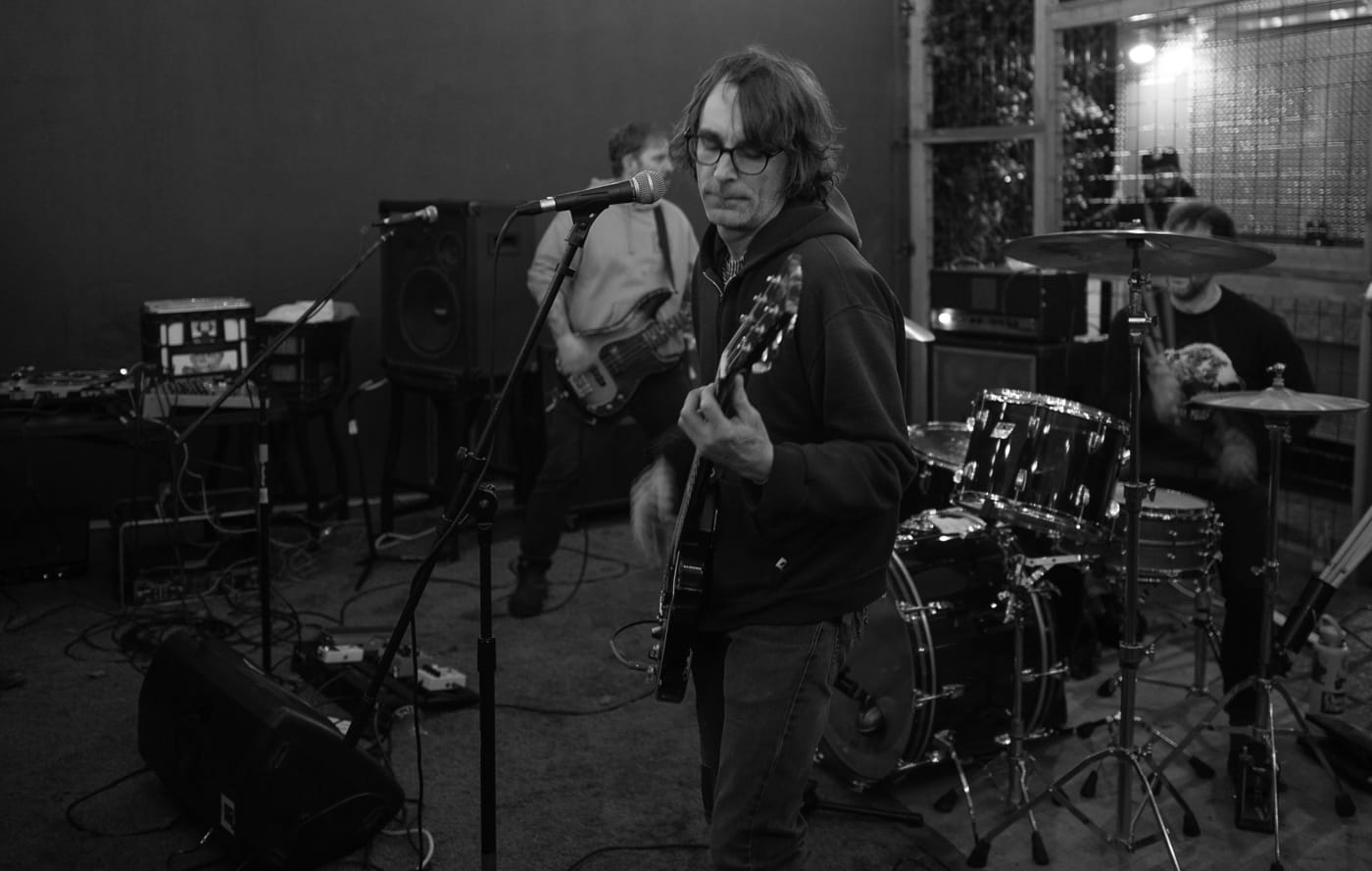



When a French screamo band drifts back from years of silence and opens soft, with a slow lead-in and melody before it turns, we always find room for it. That’s the version of this scene we keep coming back to. And Rijeka are back, 6 years after our last feature here on IDIOTEQ.
The Toulon trio (no connection to the Croatian city, everyone asks) have released a new song. “Et que le monde nous entende.” And let the world hear us. It’s their first new material since 2024’s “Regards,” and the title lands with some tension against everything Nicolas says next.
No tour attached, no follow-up promised. Nicolas, on guitar and vocals, sent the song with one line: “We are still alive, we’ve released a short song between our boring jobs and our lovely children, we have no plan to tour or play live again, sad time for little bands like us, share it if you think it deserves.”
That message tells you most of what’s going on around the record. The rest, Nicolas explained at length, and it’s worth hearing.
Rijeka started in 2014 as a side project between existing commitments. Clément Jeunet and Nicolas were both tied to Bökanövsky and Child Meadow in different ways, with Nicolas joining Child Meadow a little later as second guitarist after recording them many times. The earliest version of Rijeka was more outlet than plan.
“A small outlet between rehearsals with those bands, just the desire to play together with Clément and Julien (drummer in Boka and Third Memory),” Nicolas wrote. That first version didn’t stick. It shifted in 2018, when Hugues, a childhood friend and one of the drummers of Marseille’s Wake the Dead, moved back to Toulon.
That’s when Rijeka became a proper band, “with a few touring plans and recording ideas.” The demo followed, tracked in Nicolas’ children’s bedroom over two days.
Marseille label Bus Stop Press later put it out on cassette.
Then came the standstill everyone knows.
“Then came the period we all know: locked at home for a long stretch, venues shut down,” Nicolas said. “From there, a radical shift happened in the musical landscape, both for audiences and for bands. Personally, we never really managed to bounce back in terms of how to approach making and sharing music. It’s probably a generational thing. It’s clear that we don’t really know how to use new media, likely because it doesn’t really suit us. We’re more comfortable with phones and email, already outdated nowadays.”
Then came the string of cancelled shows. “We had several concerts planned for 2023 and 2024, and almost all of them were cancelled due to administrative closures, just before our slot. As a result, we were unable to maintain the remaining dates on tours or weekend runs.”
Nicolas has a word for what came next.
“We were also caught up by our respective lives, which led to a loss of motivation, multiplied by the lack of online communication, divided by the absence of concert prospects, resulting in, if you can call it that, the gradual ‘ghostification’ of the band.”
Ghostification. And yet weekly rehearsals never stopped. Around fifteen songs recorded, sitting. Two full records on a hard drive going back four years. The band still shows up. It just hasn’t put anything out.
The question that stops them isn’t the making. It’s what the making is for.
“This way of circulating music has, for years now, always come back to the same question: what do we actually have to offer beyond our passion? Does our music really deserve to exist? Others do it so much better than we do.”
Nicolas describes the standstill in personal terms. The costume of being in a band getting harder to wear. The inner fire competing with helping kids with homework, getting them into sports, making sure they eat properly. “Our youthful ideals as musicians have taken a hit. Gone are the days when we only had to take care of ourselves, when music filled all our free time.”
Around them, Toulon has gone quiet too. Nicolas points out that the city is about 200,000 people, roughly double that including the surrounding towns. Rijeka spent months looking for another band to share their rehearsal space with. In the end, the only interested party was a cover band playing Iron Maiden. “Haha,” he wrote.
He and his older projects were active between 1998 and 2013. They always hoped younger bands would pick up the torch in punk rock, noise, hardcore. “It has to be said that these styles don’t really interest people anymore, or at least not in the same way.” The venues that used to host touring bands are mostly gone. Gentrification, dropping attendance, decreasing musician interest across styles. DJ nights, he notes, have gradually become the cultural centre of gravity.
He doesn’t want to reopen the whole sociological argument about French alternative music. But he wanted to name one exception. Marseille. Despite the recent closure of venues like La Salle Gueule, the city’s associations and bands have regrouped. “You can hear distortion almost every night there, and the audience shows up. Marseille people like to shake their heads and sweat.”
He’s aware of how the whole thing sounds. “Sorry, I realise I’m probably just stating obvious things. I even find it a bit pathetic myself, it sounds like the rant of some bitter old dinosaur despited of everythings.”
So why release a song now, after all this lost time. “I honestly don’t think I have the answer.”
Then, why this one specifically. Recorded in a single afternoon during a two-hour rehearsal, while two full records have been sitting for four years.
“Maybe it’s because of how naturally it came together. The riff was written while we were changing a drumhead, and for once we didn’t overthink anything. We just let ourselves be carried by it, the same way the riff carried us through that quick recording session. We simply didn’t want to let this one end up gathering dust like all the others, the songs we’ve spent countless hours working on, and that may eventually see the light of day.”
Those other unreleased songs, he notes, have drifted from where Rijeka started. They move between emo, punk rock, indie punk, math rock, Midwest emo. Part of the standstill has been figuring out how to bring those threads together.
The last stretch of his note reads as much like an unsent letter as a press message.
“Sometimes I think that, personally, the only reason I keep playing, recording and making music is probably because of my old bandmates from Bökanövsky and Mikey Randall, the bands I spent so much time recording like Grand Détour, or distant friends like Coven and my favourite Mexicans, Maladie.
Every time I finish a recording, I send it to them. I guess it’s my unspoken way of telling them that I love them, and that I miss all those moments we shared together: motorway service stations, leaning on the bar in some filthy dive, sleeping bags soaked with beer after a show in a self-managed squat.”
Then the sign-off. “The bohemian life, I guess. Too emo, right?”
“Et que le monde nous entende” is out. Nicolas’ one line about it works as its own release note: share it if you think it deserves.
🔔 IDIOTEQ is ad-free, independent, and runs on one person’s time. If you want it to stay that way: DONATE via PayPal or SUPPORT via Patreon.
NEW: IDIOTEQ Explore 🗺️ Browse 15+ years of our archive by city, country, and style. Find artists on the world map or trace related sounds through the styles map.
Stay connected via Newsletter · Instagram · Facebook · X (Twitter) · Threads · Bluesky · Messenger · WhatsApp.