

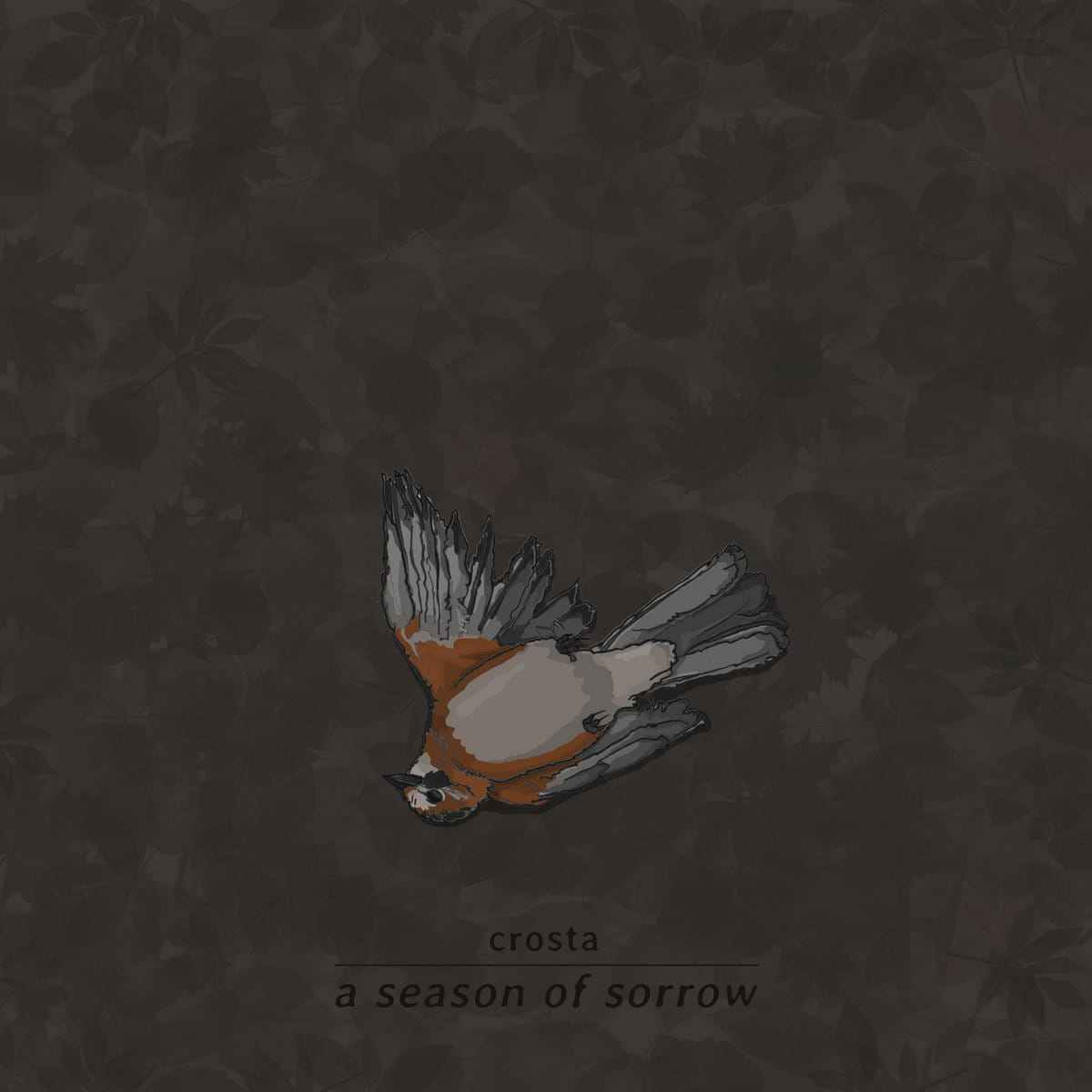
crosta have spent ten years making records alone, and Paulo Guerreiro still starts most songs on a beaten-up acoustic guitar that he says is falling to pieces. Ideas he hears in his head go onto paper before memory can lose them. From there come the guitar, bass, drums, synth patches, vocals, mixing, mastering and artwork, all handled by the same person under three different names. On “a season of sorrow”, that process ended with a pencil drawing of a dead jay over fallen leaves.
Paulo is the person behind crosta and prefers to keep the project name in front. He is happy to be named, joking that he is “not hidden in a cave or part of a secret sect”, then asks that the focus return to crosta. He is a mechanical engineer by day. “I don’t like talking about myself; I don’t consider it a subject of interest,” he said. He prefers discussing the music, the process and the ideas. Paulo also has no high-resolution band photos and says pictures of himself or a “band” are not part of crosta’s image.
The sixth crosta album was released on 28 August 2026, ten years after the project began. Paulo described those ten years in two sentences: “Yep, that’s 10 years. And in between, life in its beauty and cruelty.”
crosta are a studio project with no commercial goal and no plan to play live. Paulo calls it a vessel for registering music, intentions and words at a particular point in his life, “a Polaroid of the mind at that time”. If album sales cover new strings, gear and software updates, he considers that enough. He also admits that ego is part of putting music into the world, including the wish to be heard and known, and that somebody listening and liking it is “very, very rewarding”. He wants that impulse to stop there.
“a season of sorrow” came out of less than a year in which Paulo went through loss while people close to him dealt with mental and physical health problems. The state of the world added another source of anxiety. “So the lyrics had really no other way to go,” he said. The album title comes from the closing line of its first song, “a season of sorrow”: “on the horizon, a season of sorrow.”
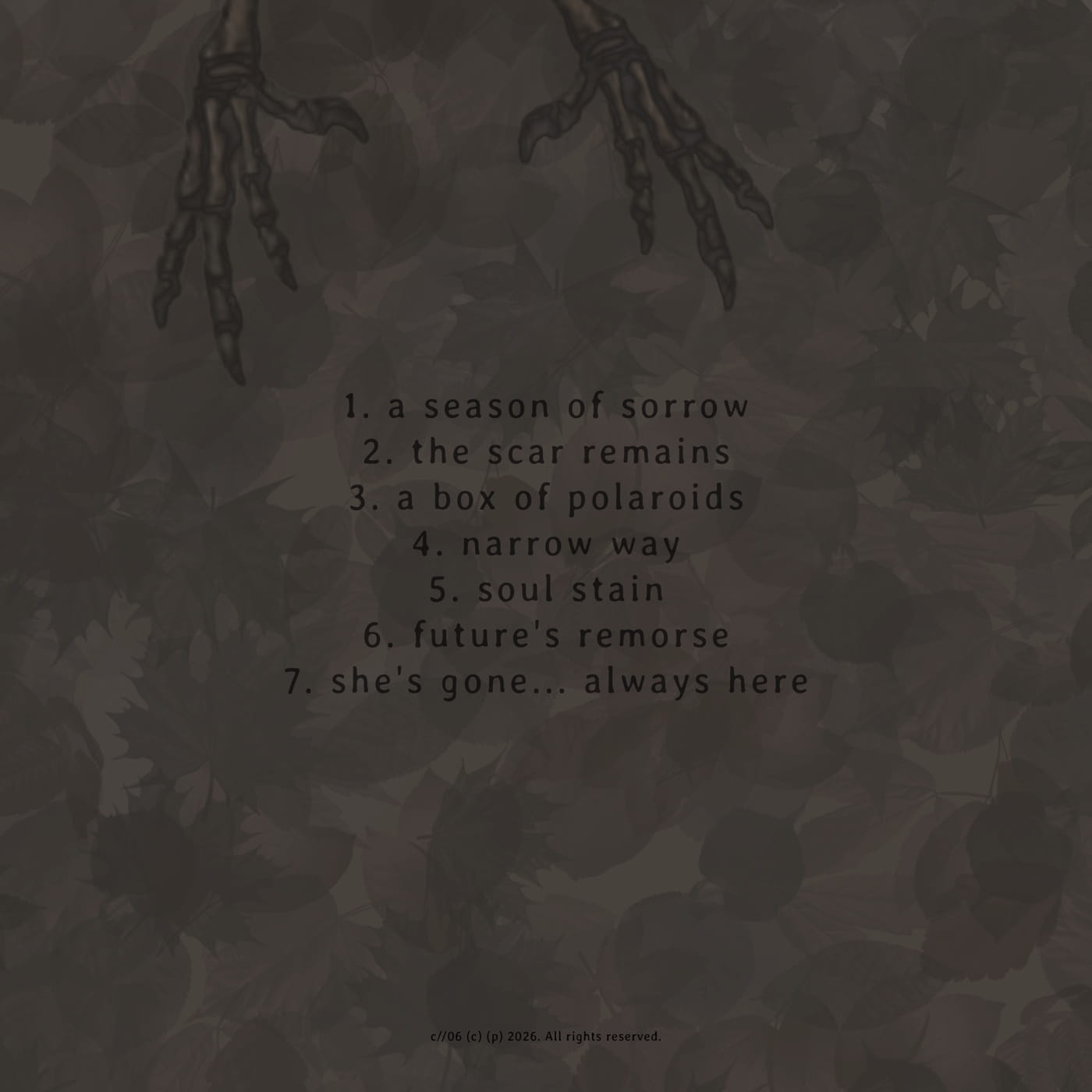
Across the five songs with lyrics, those events stay partly unnamed. The title track starts with time and change, moves through joy, pain, hope and fear, then reaches the repeated instruction to “shield your heart and cover your soul” as a storm approaches. In “the scar remains”, a body is prepared for burial, arrangements still have to be made, and “the soil will take her frail bones / but not our sorrow”. The words end with pain fading into numbness while the scar stays.
In “narrow way“, old habits, fear, rage, doubt and pain keep returning. “the same leads back to the same” is followed by a push to break the chain and make a difficult choice before it is too late. “soul stain” stays with failure, missed time and things left undone. Memories survive, old urgency loses its value, and the last words are plain: “all I wanted to say / is that I’m sorry.” In “future’s remorse”, somebody has stayed in the same cycle for too long, caught by “the illusion of more” and “intermittent rewards”, aware of the regret ahead and still willing to try the same thing again.
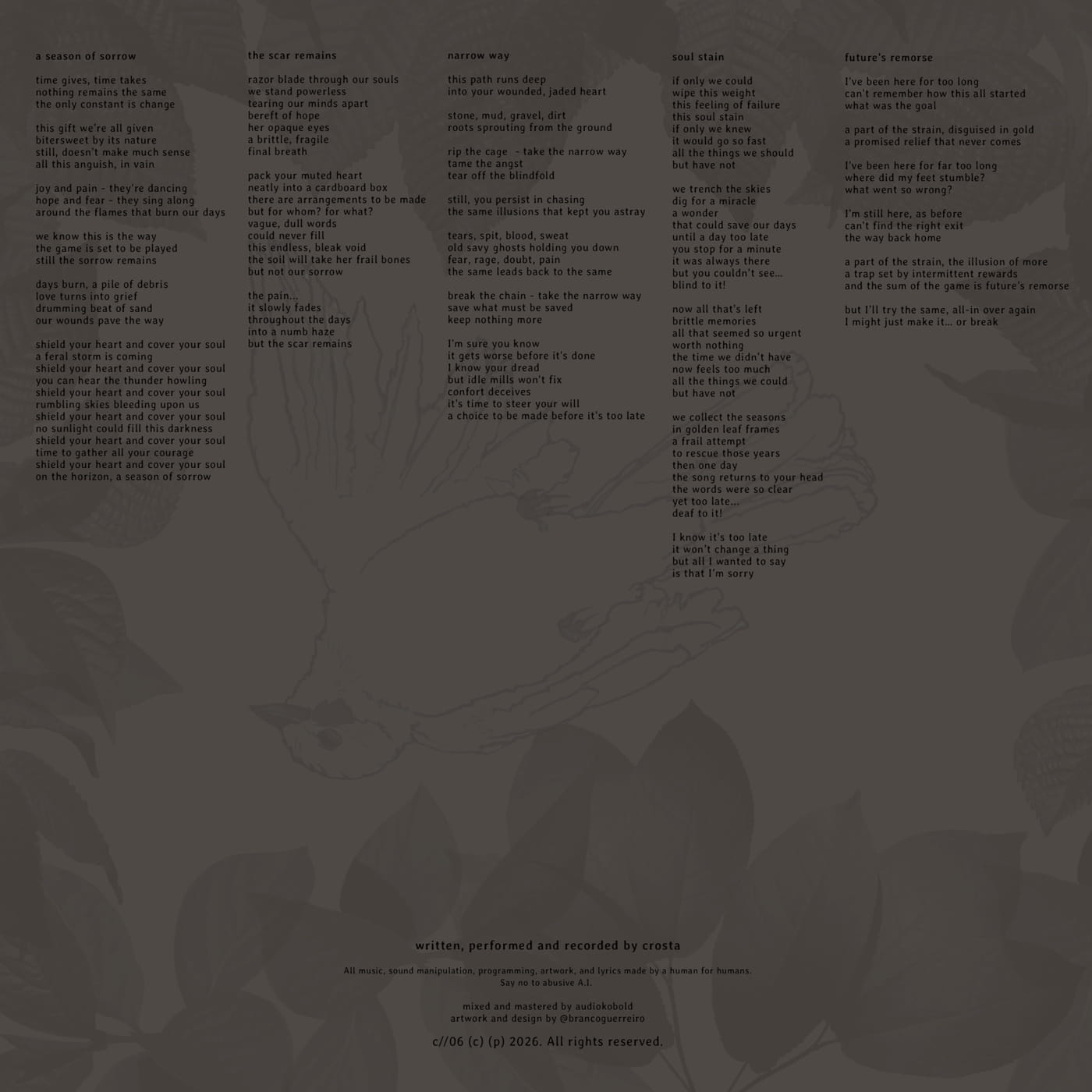
Tracks three and seven, “a box of polaroids” and “she’s gone… always here”, are instrumental. The other five songs carry the record’s words, returning to grief, time, guilt, regret, mortality, memory, fear and difficult choices.
Paulo says lyrics are the least linear part of making a crosta record. Music develops for him in layers, closer to painting. Words require repeated rewriting and rearranging, closer to sculpture, until they say enough without becoming too obvious or too obscure. His day job also affects what enters from books. Mechanical engineering takes up much of his reading time with technical work, though he finished a handful of books during this period. Tolstoy’s “How Much Land Does a Man Need?” stayed with him, and he was finishing Albert Camus’ “The Stranger” when he answered our questions.
Wyświetl ten post na Instagramie
Metal and other heavy-guitar music accounted for roughly 30 per cent of Paulo’s listening over the previous year, with a bias towards sludge, post-metal and doom. He called the rest “a weird mixed salad of sorts”, naming Boards of Canada, Niño de Elche, Low, Lorn, Puscifer and Chelsea Wolfe. Paulo sees years of listening feeding the work in ways he cannot isolate to one source.
The writing method has changed little across the decade. Most early drafts begin on that old acoustic guitar, sometimes on keys, while Paulo tries to catch something already playing in his head. Writing the idea down became a rule after the first crosta album taught him that, as he puts it, “your memory is a faulty device.”
Sound design takes a lot of time. Paulo works on synth patches, bass tone, drum tone and guitar tone before recording, then usually keeps the instrumental parts to two or three takes. Vocals take longer. He avoids leaning on pitch correction, especially on screamed parts, and says tuning sung vocals can sound bad as well. A take can also come out too aggressive or too soft, so he keeps going until the performance itself works without “magic tricks”. Even then, he says the first two takes are usually the best.
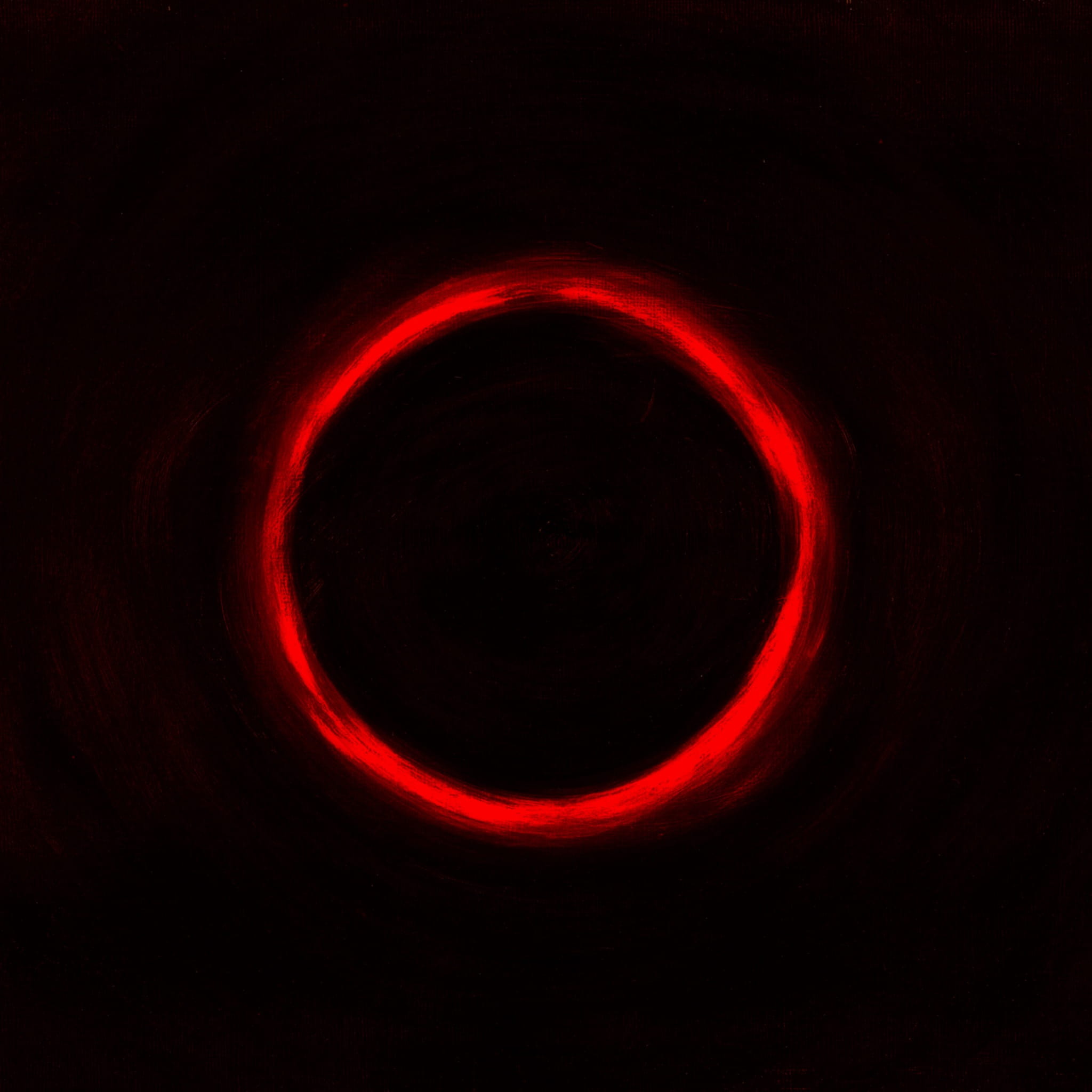
The arrangements use guitars, bass, drums, synths and both screamed and sung vocals. Paulo keeps tempo variation in the performances, avoids quantisation and leaves small imperfections in the final mix. He wants the timing and movement that would be normal when a full band plays together.
For the first time, mixing also meant going back through earlier crosta records and listening for “mistakes”. One thing Paulo noticed was the vocal level. He thinks impostor syndrome may have led him to keep the voice too far back in earlier mixes, so he had already started bringing it forward on “an endless wave of waves”. “a season of sorrow” continues with that stronger vocal presence. He also tries to give each album its own set of tones while keeping it recognisably crosta.
The songs ended up with clearer, more conventional structures as well. Paulo says that was never planned. The writing simply went that way.
Wyświetl ten post na Instagramie
crosta’s earlier covers moved through abstract and photographic approaches. The first three albums leaned towards abstraction. “I” began with a photograph of tree bark changed to look like a cracked crust, tied to its earthquake idea. “the scab of days” and “an endless wave of waves” started from photographs Paulo had taken himself and that had a special meaning for him.
Wyświetl ten post na Instagramie
For “a season of sorrow”, he went back to pencil and paper. The drawing was scanned and edited in Photopea, which he calls free, simple and efficient. He wanted the image softer and sad. While he was recording vocals, the picture of a dead jay lying over fallen leaves gradually came together.
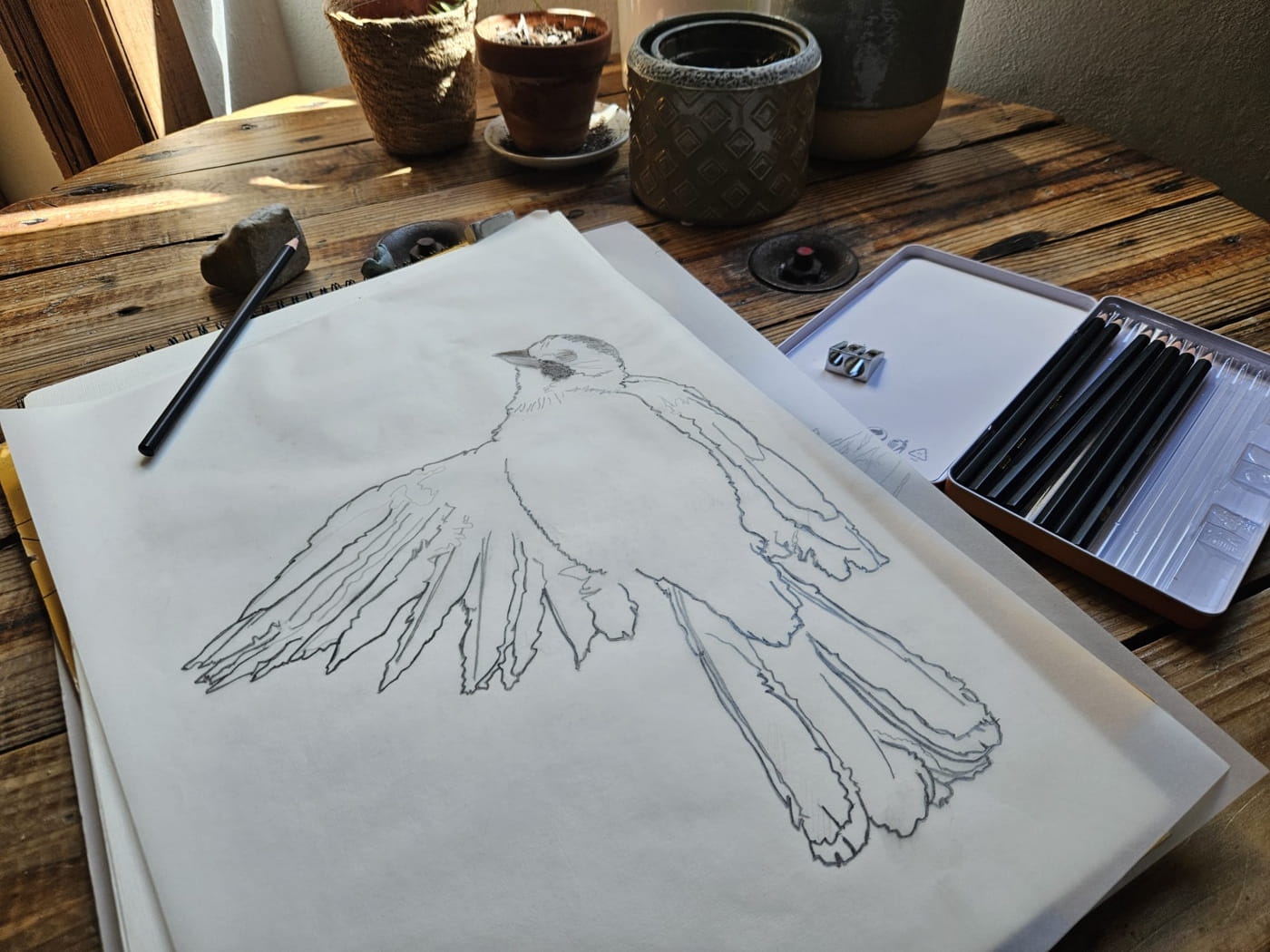
Paulo sees cover art as an extension of the record. “I think it should complement the music in the best way possible, not illustrating it but expanding it,” he said. He calls the current moment an age of “Artificial Ignorance” and says this album deserved the work of drawing, erasing, redrawing, scanning and editing with traditional software.
On the sleeve he states it outright: “All music, sound manipulation, programming, artwork, and lyrics made by a human for humans. Say no to abusive A.I.” The album was written, performed and recorded by crosta. Mixing and mastering are credited to audiokobold, Paulo’s alias for production work he has also done for other people and projects, paid and unpaid. Design and artwork are credited to @branco.guerreiro, the Instagram account he uses for painting. He keeps that work separate so people interested in the paintings have somewhere to find it, and some of his guitars appear there too.
He calls learning to record, mix and find the right tones “a big chunk of the fun”. His own line on that work is blunter: “I don’t care what suno’s idiot might think, musicians actually like the struggle of making music.”
🔔 IDIOTEQ is ad-free, independent, and runs on one person’s time. If you want it to stay that way: DONATE via PayPal or SUPPORT via Patreon.
NEW: IDIOTEQ Explore 🗺️ Browse 15+ years of our archive by city, country, and style. Find artists on the world map or trace related sounds through the styles map.
Stay connected via Newsletter · Instagram · Facebook · X (Twitter) · Threads · Bluesky · Messenger · WhatsApp.