

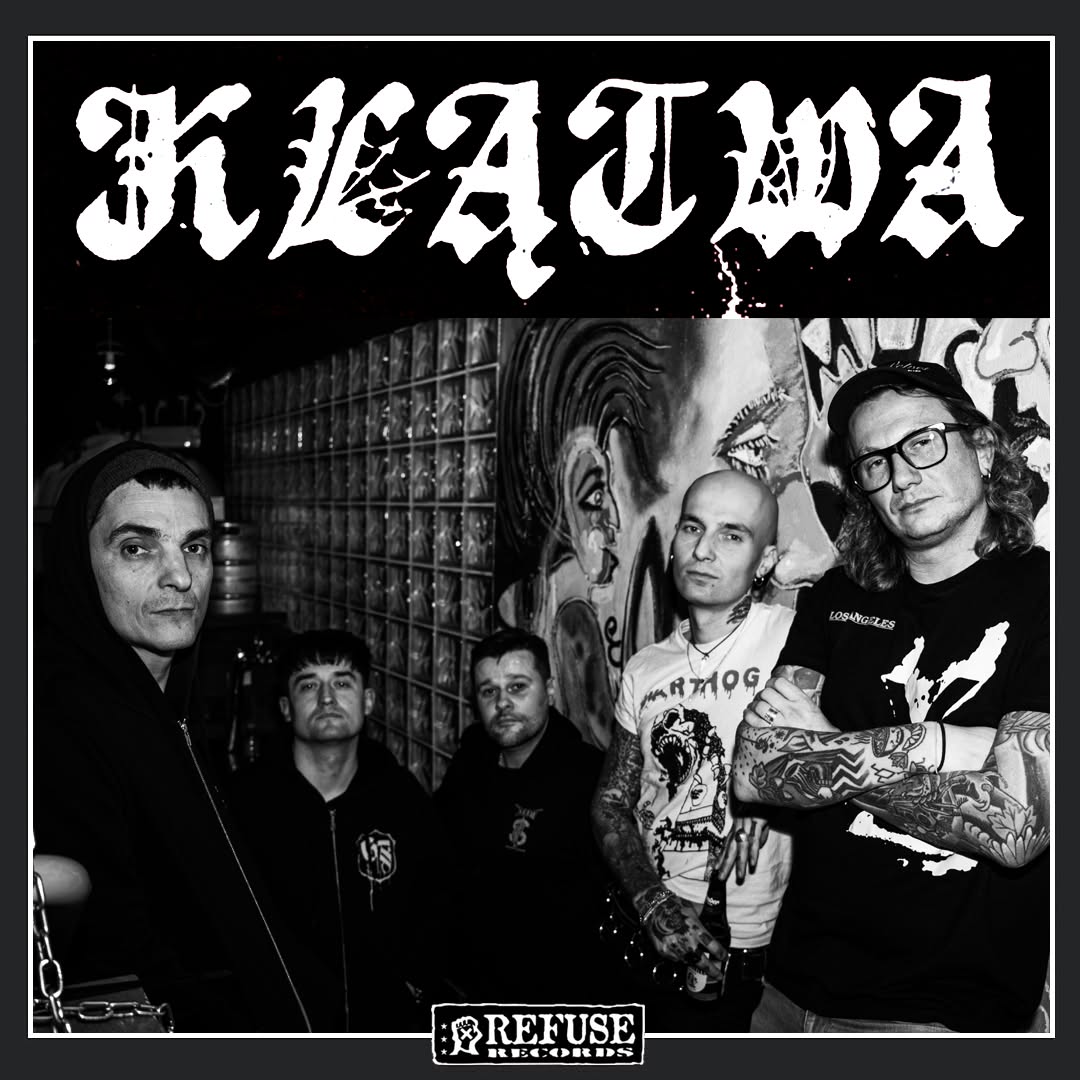
KLĄTWA came together in Warsaw in spring 2025 and played their first show that December. By September 2026, the band already had a self-released cassette behind them, the same four songs pressed to 7-inch by Refuse Records, another three-song cassette called “KLĄTWA II” out in the world, and work underway on a debut LP they hope to record in spring or summer 2027.
From the first note, KLĄTWA sound locked in. The production is twisted just enough to keep everything ugly and physical without smearing the detail, and the band squeeze real fury out of every tempo change, stop and sudden push forward. Two minutes in, you are already fully wound up, with three tracks still waiting. It is the kind of record that makes the lineup instantly make sense. They sound tight, mean and completely natural together, and before the EP is even over, you are already checking when they play next.
The current lineup is Ralf Punchline on vocals, Mortal VVorx on guitar, Paweł on guitar, Dima on bass and Koza on drums. Collectively, their history runs through Government Flu, Moron’s Morons, Sanity Control, Calm The Fire, Bagna, Contra La Contra, Moral Implant and a much longer list that, as Dima jokes, could probably supply a three-day festival.
That history explains some things about KLĄTWA, but it also creates an easy trap.
Refuse Records introduced the band through comparisons with Siekiera and Abaddon around the time of Jarocin 1984, Anti Cimex and Warthog. Those references make sense from outside. Put Polish vocals over hardcore punk powered by d-beat, heavy breakdowns and blunt, physical riffs and several familiar genealogies immediately appear.
Inside the band, the picture is far less orderly.
Wyświetl ten post na Instagramie
Polish punk from the 1980s genuinely runs deep for Ralf. Siekiera and Abaddon are part of it, but so are Moskwa and Dezerter, especially once the language and vocal phrasing enter the picture. “Polish punk is a huge inspiration for me,” he says. “These bands have always been with me, so naturally you can hear all of them somewhere in KLĄTWA.”
Anti Cimex connects for a slightly different reason. Ralf points specifically to Scandinavian Jawbreaker, where hardcore and d-beat already coexist in a way that comes close to what KLĄTWA want from their own songs. Warthog is the more contemporary reference, but he is careful not to close the band inside those few names. What they take from hardcore punk is broader: “energy, momentum, a bit of metal and a brutal racket without unnecessary decoration.”
Mortal VVorx starts somewhere else. When he brings the first skeletons of songs into rehearsal, there is no conscious attempt to calculate a ratio of Polish punk, Scandinavian d-beat and current American hardcore. “The idea was simply to make aggressive, raw hardcore punk with a clear dose of d-beat.” The references tend to appear afterwards. As he puts it, “you can’t really avoid Discharge when you talk about d-beat music,” but that does not mean anyone entered the room trying to write a Discharge song.
Dima came to the same history from another direction. Born and raised east of Poland, he discovered much of the Polish punk canon of the 1980s relatively late. “Jarocin ’84 had absolutely no influence on me,” he says. “From the old Polish bands I always liked Post Regiment, and I still listen to them often.” Anti Cimex and Warthog make more sense as reference points, though even there he adds that they are only “the tip of our iceberg.”
Paweł sits further away again. Heavy music is not what he reaches for most often, and his own listening tends to move toward punk with more rock’n’roll in it. Plenty of the heavier bands circulated by the others as inspirations were initially things he knew only by name or from a single listen.
The route into KLĄTWA came after the end of Scum Trail, where some of the future members had already played together. Continuing in a direction loosely informed by Warthog and Anti Cimex appealed to Paweł precisely because it meant doing something unfamiliar. “I have fun playing music I hadn’t played before, I’m learning to write songs differently and I feel like I’m moving forward because of it.” His somewhat different taste may actually be useful here, giving him a chance to bring in something that would not necessarily appear in a more orthodox d-beat band.
The older Polish references do not bother him either, but nostalgia only goes so far. Those bands were among his own starting points and he still returns to them. “But I treat the mythology of Jarocin in the eighties as veteran stories now. More than forty years have passed, and I haven’t even been alive that long.”
Koza is probably the closest to the band’s basic rhythmic proposition. D-beat has followed him through different projects for years, especially from behind the drum kit. “I think the idea for this band was to combine d-beat with simple hardcore punk,” he explains. The different tastes inside KLĄTWA then start rubbing against each other in rehearsal, and the first EP already shows the result: plenty of d-beat, deliberately primitive punk motifs, slowdowns and changes of tempo, with Warthog remaining one of the clearest examples for him of how those ingredients can coexist.
The songs usually begin with Mortal VVorx.
He brings a central idea, riff or rough structure into rehearsal. From there, everybody starts working around it. Parts are added, removed or reshaped. The band plays the material until they can decide whether the song already has its form or still needs more work. All four tracks on the first release came together through that process.
Paweł had to unlearn something along the way.
The riffs Mortal VVorx was bringing were put together differently from music he had written before. His own instinct was to search for a stronger sense of conventional songwriting, something more immediately song-like. In KLĄTWA, that instinct often had to be suppressed. He had to learn how the others wanted these riffs to move and how to build a complete piece without falling back on habits that worked in his previous bands.
The result was “Sam”, “Rzeź”, “Zew” and “Symulacja”.
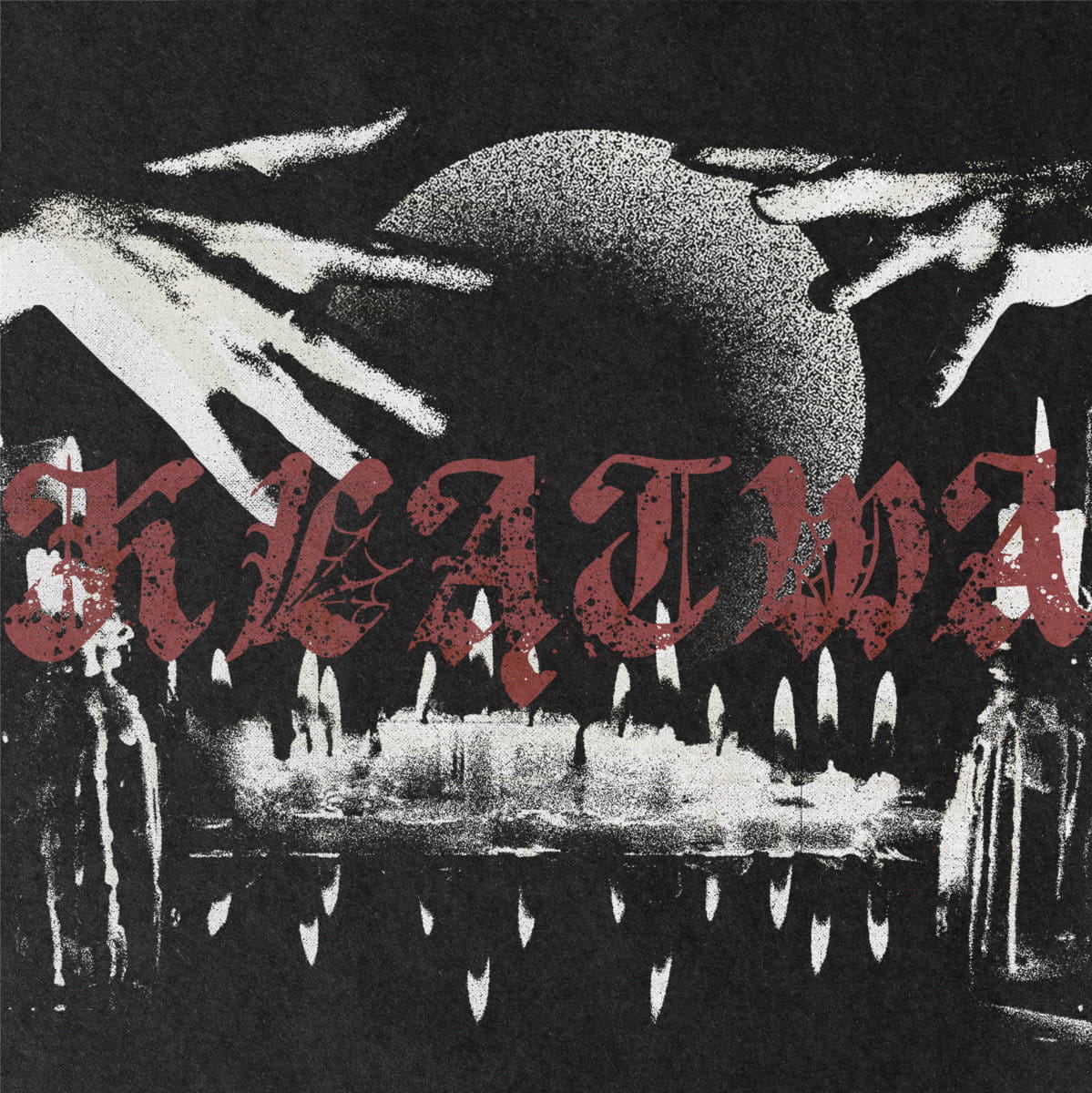
KLĄTWA recorded the four songs at Wieloślad Studio in Warsaw in autumn 2025 after roughly half a year of working in the rehearsal room. Paweł made the artwork, and the band handled the first physical edition themselves, ordering 50 cassettes.
Wyświetl ten post na Instagramie
The tapes immediately produced one of those stories that becomes funny only after the problem has been solved.
“The first batch of cassettes that arrived contained recordings by some other band,” Ralf recalls. They caught it immediately and sent the tapes back, but the replacement did not leave them much margin. “In the end we got the correct recording one day before the planned premiere.”
The fifty copies still disappeared fairly quickly. Once the full material was sitting on Bandcamp as well, Robert from Refuse Records contacted them with an offer to put exactly the same four songs on a 7-inch.
View this post on Instagram
Nothing was re-recorded along the way. The cassette and the Refuse EP contain the same session and the same central artwork. The vinyl edition expanded the package with printed lyrics, English translations and more live photography, and received its premiere at DIY Hardcore Punk Fest vol. 18 in Gdynia.
For Mortal VVorx, Robert’s invitation carried personal weight beyond simply getting another format manufactured. The band had spent hours shaping those songs in rehearsal, and having Refuse hear enough in them to propose a release was its own form of confirmation. He also points to Robert’s long contribution to hardcore punk and the promotion of straight edge ideas in Poland and beyond. “It’s hard to imagine a better label.”
Paweł took satisfaction from something more basic. KLĄTWA had existed for only a short time and already had a physical object to show for it. “The fact that we managed to do something more with this band than just upload music to Bandcamp convinced me that the energy and time we put into it made sense.” Refuse picking up the material added another layer to that, and making the artwork for both versions gave him another piece of the release he could physically point to as his own work.
The four songs also opened a new area for Ralf. KLĄTWA is the first band where he writes his own lyrics in Polish.
He had sung Polish punk covers before, including during his time with Government Flu, but original writing in the language proved unexpectedly difficult. “For some reason, both writing and singing in Polish seemed harder to me than doing it in English.” There was also a stylistic line he wanted to avoid. “I didn’t want the lyrics to sound like some jabol-punk anthems or chants,” while still keeping enough clarity for people to understand what he was screaming.
Paweł arrives at the language question from almost the opposite side. Language has never mattered much to what he listens to, yet KLĄTWA is also the first band he has played in where the lyrics are not in English. Ralf’s writing made him pay attention. “They’re really good lyrics and, in my opinion, they distinguish us on the Polish scene. Their content fits our music perfectly, and their form and vocabulary make it something more than just another Polish punk band.”
Mortal VVorx hears the Polish words almost physically. Their precision and the way they land inside the songs give the vocals extra force, but he also sees something wider running through all four tracks: frustration inside society, people thrown through their hardest emotions and personal collapse turning into behavior that can become barely human under “the hypnosis called the crowd.”
Dima cuts the whole method down to hardcore essentials: “Fast, hard and specific. Like hitting a sensitive point.”
“Sam” deals with the daily struggle to keep your head above water, learning to depend on yourself and turning setbacks into fuel for whatever comes next. Ralf describes it as trying, even when things are difficult, “to see FUTURE inside the omnipresent NO FUTURE.”
“Rzeź” is more openly confrontational. “Brutal and crushing, like the actions of cowards deciding our fate,” is how Ralf describes it, aimed at people who reduce others to bodies expected to kill and destroy on command. The question underneath the violence remains deliberately unresolved: in the name of what?
“Zew” is built around ugliness, survival and the lowest instincts people carry with them. “Sometimes you have to give in to them, sometimes you have to fight so they don’t take control of us.”
“Symulacja” turns toward mortality and the insignificance of an individual life inside a much larger continuum. Its starting proposition is close to nihilism: everything passes, nothing lasts, perhaps none of it ultimately matters. Then comes the contradiction Ralf was interested in. “If everything passes and nothing makes sense, why are there sadness and tears at the end?” The song leaves nihilistic logic facing something harder to reason away, the human desire to mean more than that.
Dorka from TRÄUME appears on the track.
There is no elaborate mythology behind Dorka’s appearance on “Symulacja”. Ralf has known her for years, stayed in regular contact and followed her work from Bliss into TRÄUME. They had already recorded together once during the Bliss period. “I really like guest appearances. I think they’re always a cool little detail at shows or on recordings,” he explains, so asking her to join the demo came naturally.
At rehearsal, the idea surfaced that a section of “Symulacja” could carry another voice and everybody immediately agreed. Mortal VVorx already valued Dorka both as a vocalist and lyricist. “TRÄUME won me over from the first show I saw them play.” Paweł knew her voice well too and had no hesitation about bringing it into KLĄTWA.
Why that particular song? There was no complicated explanation. Ralf simply heard one section and thought it was “the perfect moment for something like that.”
The finished EP carries another connection to the wider Polish heavy underground through Haldor Grunberg, who mixed and mastered the session.
For Ralf, Haldor was never exclusively a metal name. Calm The Fire and Drip of Lies had already shown that he understood hardcore punk as well. More importantly, he understood what KLĄTWA were trying to preserve. “You can hear the energy, weight, dirt and noise in what he does with our songs. That’s exactly what we’re going for in KLĄTWA.”
Mortal VVorx was initially less certain. Haldor’s reputation in extreme metal made him wonder whether the finished production might be “too fancy” for what a raw punk band needed. One early sample was enough to kill that concern. “He completely caught our intentions and needs,” and the finished sound convinced him that the roughness had survived.
Koza already had that confidence. He had worked with Haldor three times through Calm The Fire and wanted him involved almost from the moment the EP material existed. “He understood very well what kind of sound we wanted.”
Paweł cared less about choosing the producer than about the songs themselves. The others had more experience with this type of recording, so he was comfortable leaving the decision largely in their hands. Between Haldor and Michał at Wieloślad, he got the result he needed.
The same relationship continued once KLĄTWA moved beyond the original four songs.
“KLĄTWA II” appeared on September 2, 2026.
The three-song promo, including “Żywiciel”, was recorded in May at Wieloślad Studio and again mixed and mastered by Haldor. The band released it themselves on cassette, available through Bandcamp and at the autumn shows, with artwork by Paweł Ivanuke.
The band describe “KLĄTWA II” as a marker for the direction of the full-length they are currently writing, with recording planned for spring or summer 2027.
The speed with which KLĄTWA have moved does not mean the members simply carried their previous bands into a new lineup.
Mortal VVorx sees virtually nothing from Moral Implant being transferred directly into KLĄTWA. “They’re completely different musical worlds.” The connection sits deeper, in a general attraction to aggressive and uncompromising music. Raw punk is part of that, although his own taste pulls even harder toward “raw black metal or death metal.”
Koza sees less distance between KLĄTWA and his years in Calm The Fire. Both bands touch some of the same territory, although KLĄTWA is deliberately slower and simpler. At the moment it is also his only active project.
Paweł had to make a more substantial adjustment. Mortal VVorx’s riffs required a different way of assembling songs from the one he instinctively used before. “I basically had to get rid of what I look for in music, which is songiness.” The others had to steer him toward the structures they wanted, and that process became part of what made KLĄTWA interesting for him in the first place.
Moron’s Morons, meanwhile, remain very much alive. Paweł hopes to release another 7-inch and record their third album before the end of 2026, then return to international touring in 2027.
Dima is less interested in drawing neat lines between all those histories. “We’ve all been playing in bands for a long time and that list is far from complete. With a little effort you could probably make a three-day festival out of the bands we’ve played in.” What matters to him is that every band becomes the result of the particular people working together at that moment. KLĄTWA is another such combination rather than the arithmetic sum of five discographies.
For Ralf, the sharpest break with his previous work remains the most obvious one every time he takes the microphone: Polish. Government Flu occasionally covered Polish punk songs, but KLĄTWA is where he finally started writing his own lyrics in the language, something he now gets a lot of pleasure from despite how difficult it initially felt.
All of those histories are now operating inside a Polish hardcore punk scene that most of KLĄTWA describe as healthy, busy and visibly younger at floor level.
Ralf notices it constantly at shows, particularly around gigs organized by Constant East. New bands keep appearing and many of the people starting them are much younger than KLĄTWA. “You go to different cities and share the stage with people who have always been here, but also with people who have only just been pulled into hardcore punk.” He likes seeing new bands debut and checking fresh demos, and sees real freshness returning to the scene. “You can feel the freshness and the energy of young blood.”
His current Polish recommendations run through Ohyda, TRÄUME, Jad, Energy Jar, Deathknell, Flor-o, Taren, Pisuar, User, Laxity and Heatseeker.
He also singles out DISCOVERY, a project initiated by Constant East. After weeks of rehearsals, a larger group of people gets together to perform a fixed set packed with punk classics, ranging from The Analogs to Dead Kennedys, with the audience joining in. “Nothing brings people together like the annual shared screaming of songs everybody knows.”
Mortal VVorx is more open about not following the current Polish scene particularly closely. It would be easier for him to list foreign hardcore bands he listens to, although Ohyda remains a favorite, TRÄUME have made a major recent impression and Jad still sits close to his own taste. What he does appreciate is seeing younger people continuing to start hardcore punk bands at all.
Dima reaches much the same conclusion through the amount of material that keeps appearing around him. “There are loads of new bands, lots of people go to shows and you can see plenty of young people.” New releases and demos keep coming. Some connect with him and others do not, but there is rarely a shortage of good local bands appearing on bills.
Paweł sees Warsaw in much the same way. Another band always seems to be forming and another gig always seems to be happening. The harder part is finding money for tickets and enough time to actually go. The Chained have made the strongest recent impression on him, with Prorva and Violent Youth also worth checking.
Koza is slightly more cautious about claiming that the scene is producing more bands than before. “I don’t think there are necessarily more new ones than ten or fifteen years ago.” What he does notice is a younger average age at shows and unfamiliar faces entering the room. For him, that suggests hardcore punk still has something to offer younger people as an alternative to things like rap. Regular promoters such as Constant East help keep those rooms active, while TRÄUME are his clearest example of a newer band that has made significant progress over the last few years.
KLĄTWA are now taking all of this into a dense autumn run.
Wyświetl ten post na Instagramie
September 11 puts them in Berlin with Vitamin X, Nerve Center and Alison Walks. A day later they play the 32nd anniversary of Rozbrat in Poznań. September 25 brings them back to Warsaw for the Refuse Records Showcase.
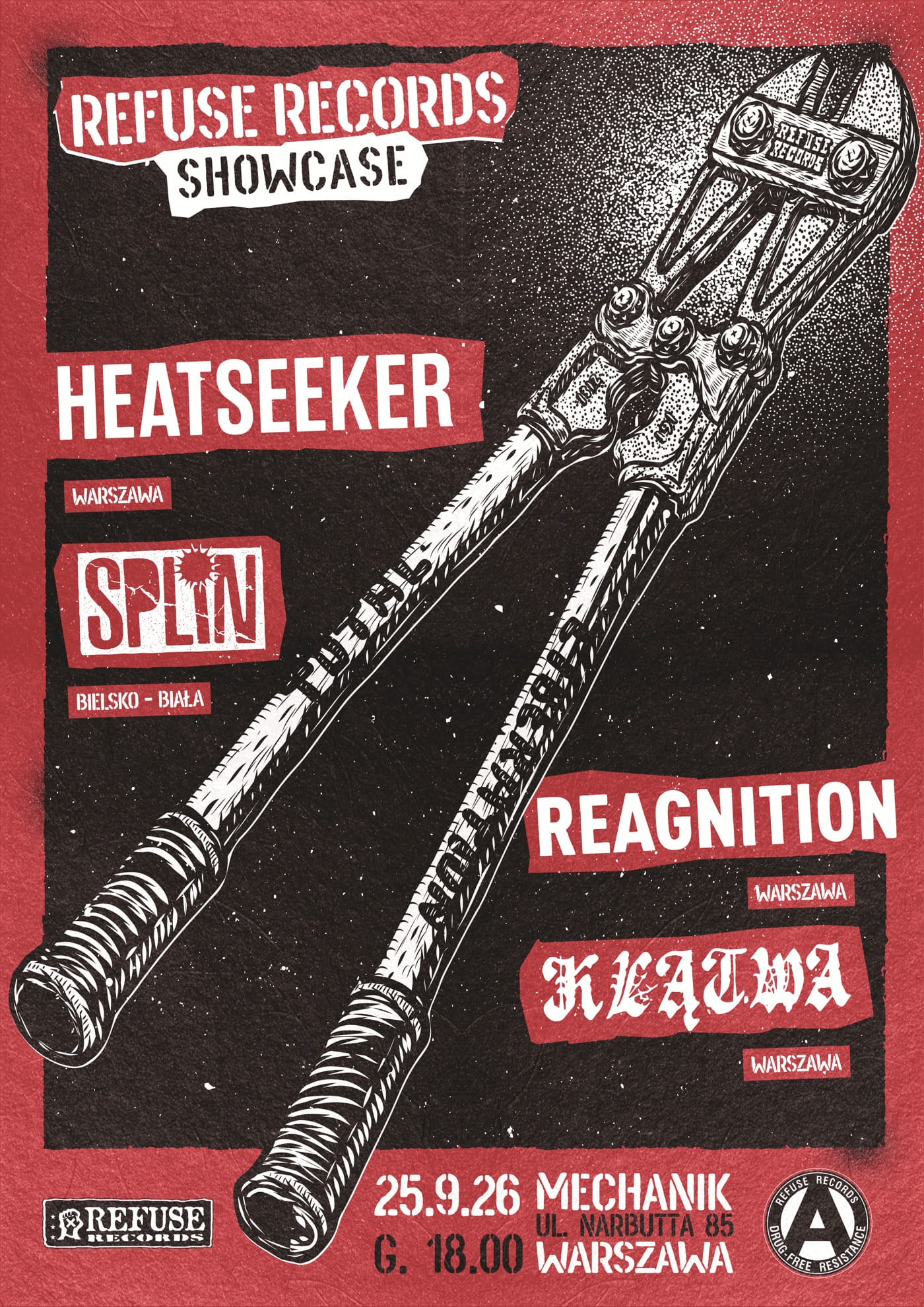
On October 7 they play Chmury in Warsaw with Flor-o and Death Gasp, followed by Lublin with Sanctus Iuda and Hiatus on October 18. October 23 takes them to Concrete Jungle Fest in Burghausen, with Jelenia Góra following on October 24.
Wyświetl ten post na Instagramie
The current year closes with a December 5 Warsaw appearance at Zróbmy Disorder vol. 8 alongside SuperPotwór and Profanacja.
Wyświetl ten post na Instagramie
By then, the band will be carrying two small physical releases representing two stages of the same first stretch of activity.
The original four-song cassette documented half a year of figuring out what could happen when five people with different ideas of punk entered the same rehearsal room. Its accidental wrong-band pressing, last-minute corrected tapes and eventual move onto Refuse Records already gave it a life much longer than its four songs suggest.
“KLĄTWA II” arrives with fewer questions about whether the formula works. It points toward what comes next.
There is still d-beat at the centre. There are still primitive punk parts, breakdowns, changes of pace, Polish words and enough metal in the bloodstream to make the whole thing land harder. Around that centre sit old Polish punk records that deeply shaped one member and reached another only much later, rock’n’roll instincts somebody had to partially suppress, raw black and death metal listening habits, old bands that remain active, others that have ended, and a Warsaw scene filling up with younger faces.
That friction is probably the most accurate description of KLĄTWA available right now.