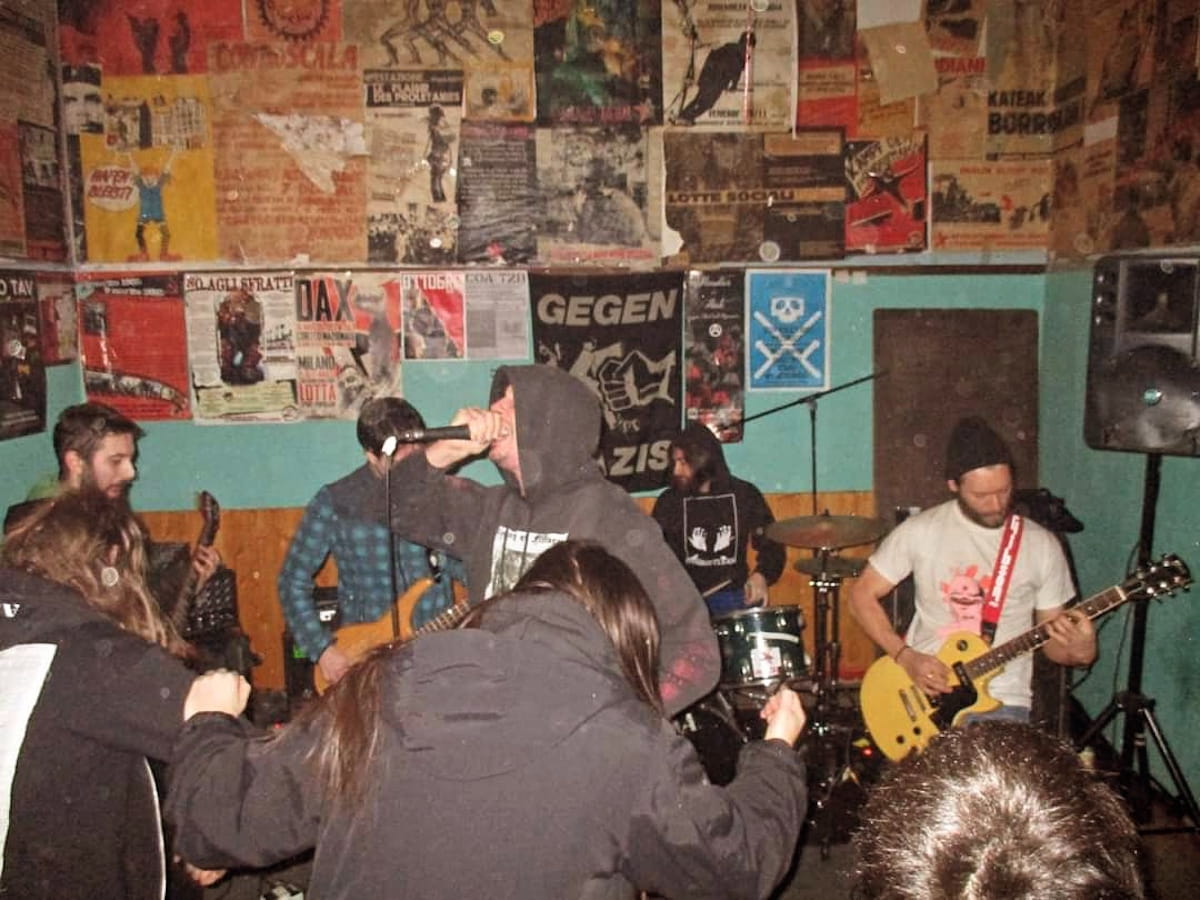



The Arrivals have been gone long enough that a return record could’ve easily turned into a nostalgia lap. “Payload” doesn’t bother with that. The band’s first new album in more than 15 years is too busy staring down colonization, environmental ruin, nationalism, class power, and the slow collapse people keep getting told to accept like it’s weather.
That tension makes sense for a band with deep roots in Chicago punk but no real interest in acting like a museum piece. The Arrivals came up through a city where places like Metro and the Fireside Bowl were part of the bloodstream, sharing bills in the orbit of Naked Raygun and Pegboy, and alongside bands that would later get much bigger, including Alkaline Trio.
This version of The Arrivals is Paddy Costello on bass, Isaac Thotz on vocals and guitar, Ronnie DiCola on drums, and Little Dave Merriman on vocals and guitar. Between them, there are ties to Dillinger Four, Treasure Fleet, Dangerous Chairs, and Local H, but “Payload” lands like a band reactivating its own chemistry rather than cashing in on résumé lines.
Wyświetl ten post na Instagramie
The record is out April 17 through Recess Records, with pre-orders up now, and the rollout has already included “Just Like My Brother,” “Drill Baby Drill,” and “January 7th,” the last of those paired with a video built from recent protest images from around the US.
Wyświetl ten post na Instagramie
The Arrivals are also set to play Recess Romp 5 at The Sardine in San Pedro, California, running August 13–16, alongside Dillinger Four, Off With Their Heads, Toys That Kill, Alice Bag, Jumpstarted Plowhards, The Bananas, Scared Of Chaka, WIFE, Dauber, Shell Shag, Fleshies, Lenguas Largas, and Middle Aged Queers, with more still to be announced.
As for the record itself, Thotz and Merriman split the writing here, and the songs they’ve chosen to talk through tell you pretty quickly what kind of album this is: big-picture stuff, but written from street level, where politics isn’t an abstract topic and history keeps turning up in daily life like a fresh bruise.
Thotz’s “The Wretched of the Earth” is the clearest mission statement on the record, and he built it as a three-part suite. The title and subtitles are borrowed from Franz Fanon’s “The Wretched of the Earth” and Jared Diamond’s “Guns, Germs and Steel: The Fates of Human Societies,” two books dealing with colonization from very different positions. Fanon writes from the perspective of revolutionary political theory, centered on dehumanization, violent revolt, and the trouble of building nationhood out of colonial wreckage. Diamond comes at it as a scientific anthropologist trying to explain why Western Europeans colonized so much of the world rather than the reverse.
Thotz didn’t want to adapt either one so much as argue with them in song. He describes the piece the way Woody Guthrie used “Tom Joad” as a companion and counterweight to Steinbeck. The core idea, he says, is “destruction and dehumanization through colonization.”
Part one, “Guns,” introduces two figures: Mother Gundstrum, who can no longer farm because mining pollution has wrecked the land, and General Tartan, who profits from the whole shift away from subsistence and toward extraction. Farming can’t compete with the mine economy. Young villagers get hired as guards. Civil war becomes another business opportunity. Anti-colonial struggle gets kneecapped because the colonized are pushed into fighting each other. By the end, the trap is complete: once people can’t provide for themselves anymore, they end up dependent on the same roads, fuel, and industrial products that helped put them under in the first place.
“Germs” pushes that logic wider. Thotz calls colonialism and industrialization “a two headed monster,” with each side feeding the other. Productivity rises. Resource demand rises with it. The whole system starts to resemble addiction, where people keep feeding the machine that’s tearing up the ground beneath them because dependence has already set in. His blunt summary of the song is hard to shake: humanity is destroying the earth that feeds it.
Then “Steel” cuts the words entirely. Thotz sees it as “a musical portrait of an all out war where there is nothing left to say,” a point where resources are so depleted that the only thing left is genocide. For him, it also connects back to the rest of “Payload,” where scarcity, power, and violence keep feeding each other until language itself stops being useful.
“Drill Baby Drill” hits similar concerns from a more direct angle, taking on environmental destruction, economic colonialism, and wars fought over resources. “Iron Curtain” stays in the same universe but shifts the focus onto the refugee experience, whether somebody is running from war, poverty, or some other version of forced displacement. Thotz sees that one as carrying a lot of the album’s bigger concerns in condensed form.
Merriman’s songs work differently. They’re less like essays blown up into punk songs and more like arguments with himself, trying to figure out how not to get swallowed by cynicism.
“When It’s Gone” started about ten years ago as a phone demo he sent around to the band while The Arrivals weren’t really active. It still felt like an Arrivals song to him, which was enough reason to make sure the others heard it. Lyrically, it follows a pattern he says he’s returned to by accident more than once: three verses, each coming at the same theme from a different side.
Here the first disappearing thing is the will to learn, grow, and look for truth. The second is possessions. The third is the lowering of “the bar,” which Merriman describes as a drop in the collective level of give-a-fuck. Then the bridge opens out into something bigger, and probably more useful than another doom-scroll anthem. Looking back, Merriman realized that all the songs he brought to “Payload” circle the same idea: “We can be the change we want to see. We’re the ones we’ve been looking for.” He puts it even more plainly after that: “Yeah, shit’s hard. What do you want to do about it? Be a black hole, abysmally sucking the energy out of anything near you; or a star, bringing light to the dark?” He says he hopes people choose the light.
“Motivation” had a messier path in. Merriman says it was probably the second-newest song written for the album, and early on he had a melody and lyric but couldn’t actually sing it the way he heard it in his head. The original words weren’t helping either. At first the song was built around a character sketch of a “get off my lawn,” xenophobic backwoods type, somebody wrapped in the flag but indifferent to most of the people supposedly represented by it. Once the band got into recording, he still wasn’t happy with the vocals or the lyric.
The fix came from older stuff. Merriman found a set of lines he’d jotted down years before, and they happened to lock into the rhythm of the riff. Suddenly the song clicked. The new version catches the helplessness and fear of living in a failing state, while also dealing with the split between taking care of your own people and finding enough energy to fight for everyone else too. His line about White Christian Nationalists “bringin’ on the end times!” gives the song its sneer, but there’s panic in there too. He re-recorded the vocal with Joe Gac at Gac’s practice spot, and Gac also shows up in the break as one of the voices yelling “GO!”
Then there’s “January 7th,” which may be the most stripped-down statement on the record and probably the sharpest. Merriman says he’s been increasingly drawn to songwriters like Shel Silverstein and Dan Reeder, people who can carry large ideas in very simple phrasing. That was the target here: say exactly what needs saying, make it stick, and don’t waste the whole song luxuriating in complaint.
For him, “January 7th” is about trying to make something that lifts people up instead of just venting. “I think people need to understand that we all have more in common with each other than not,” he says. The song points anger, fear, and frustration upward, toward the ruling class, and away from the usual distractions. Merriman doesn’t soften where it came from, either. He was furious that the closest thing he’d seen in his lifetime to an attack on the Capitol came from “authoritarian, cultist shitkickers trying to install a fascist bag of turds.” In his mind, if that building was ever going to be stormed, it should have been in the name of people, not one person. The song follows that idea straight through to its last line: “Together against all their power we’re stronger. We can’t live under their rule any longer.”
That push and pull runs all through “Payload.” Some of these songs zoom way out, into war, extraction, empire, and collapse. Others stay right in the daily grind of trying not to turn bitter while everything around you gets meaner and stupider. The Arrivals don’t pretend those are separate subjects.
“Payload” is out April 17 via Recess Records. The videos for “Just Like My Brother,” “Drill Baby Drill,” and “January 7th” are all out now, and the band’s next announced date is Recess Romp 5 at The Sardine in San Pedro. Tickets go on sale Friday, April 10 at 10:00 AM PT via Recess.
🔔 IDIOTEQ is ad-free, independent, and runs on one person’s time. If you want it to stay that way: DONATE via PayPal 𝗈𝗋 SUPPORT via Patreon.
Stay connected via Newsletter · Instagram · Facebook · X (Twitter) · Threads · Bluesky · Messenger · WhatsApp.