
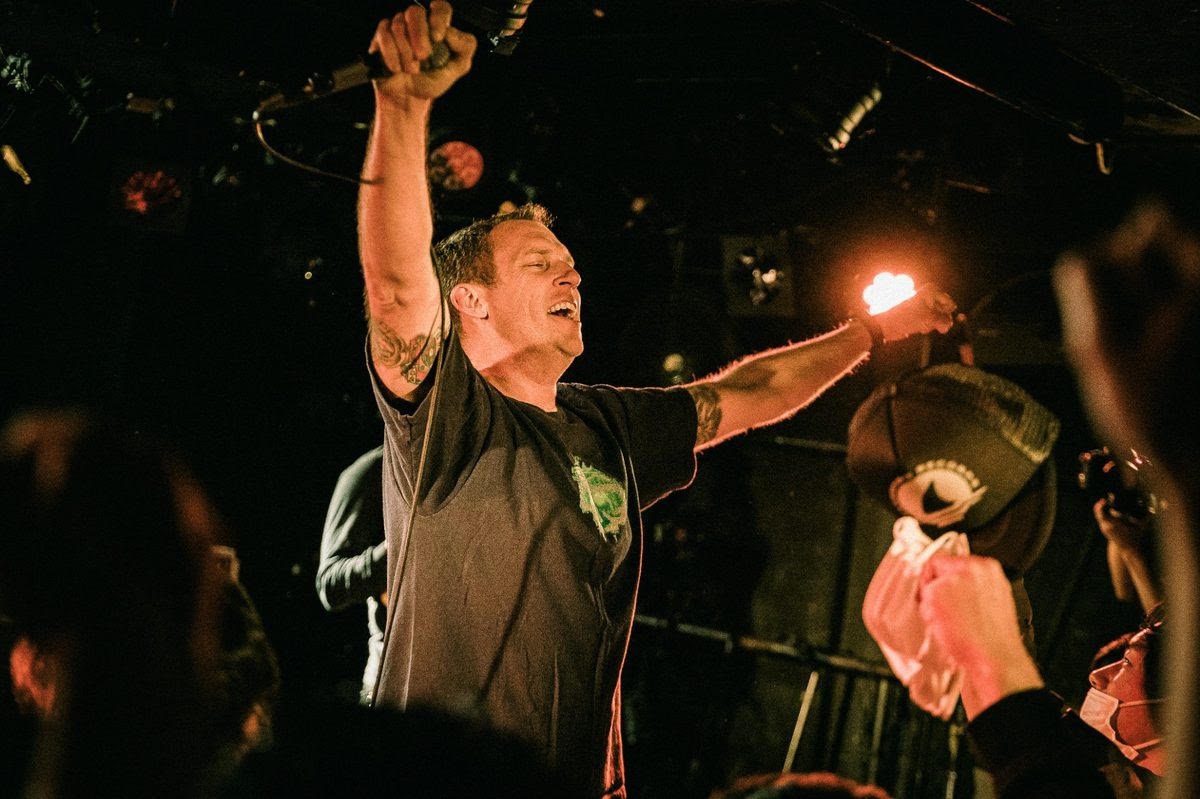
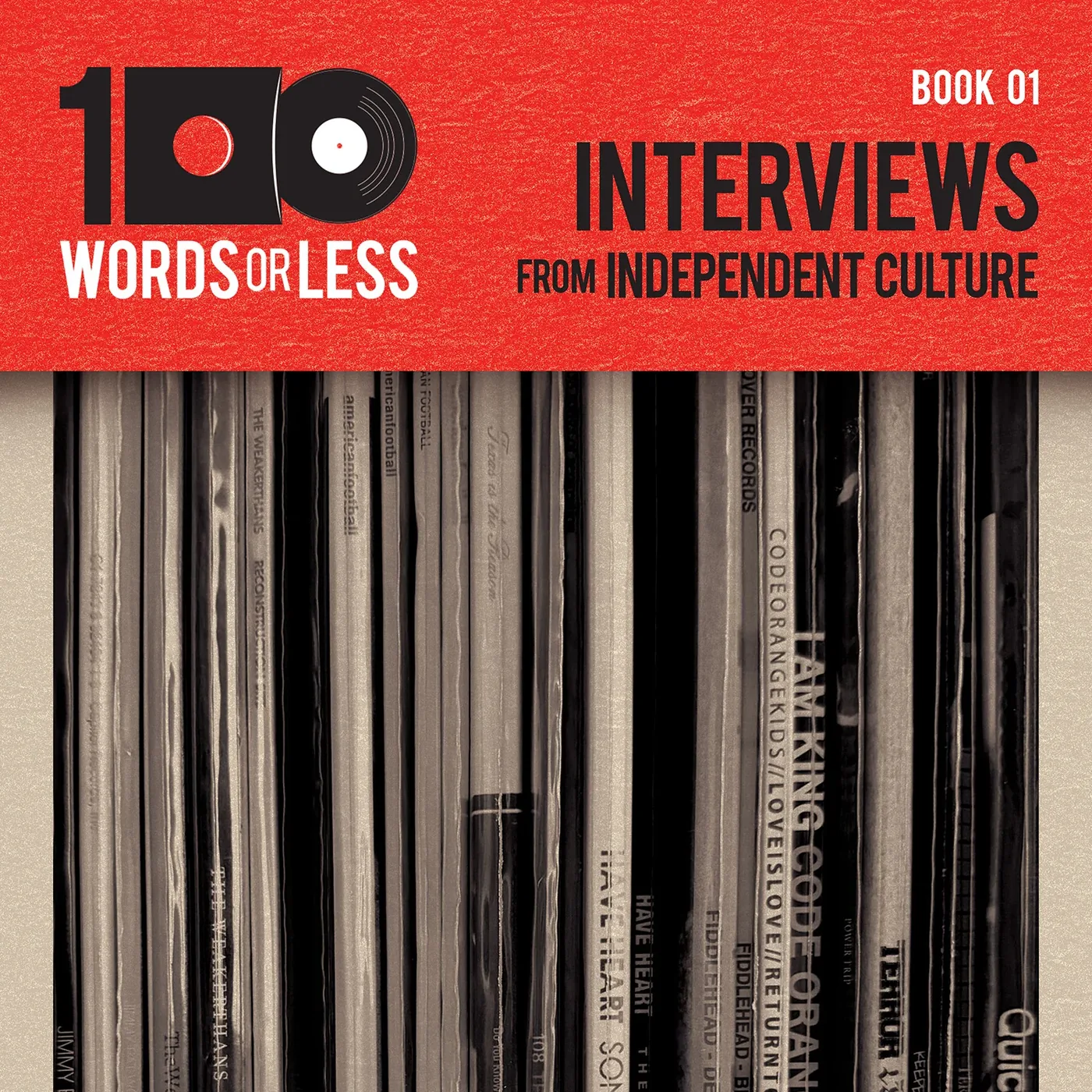
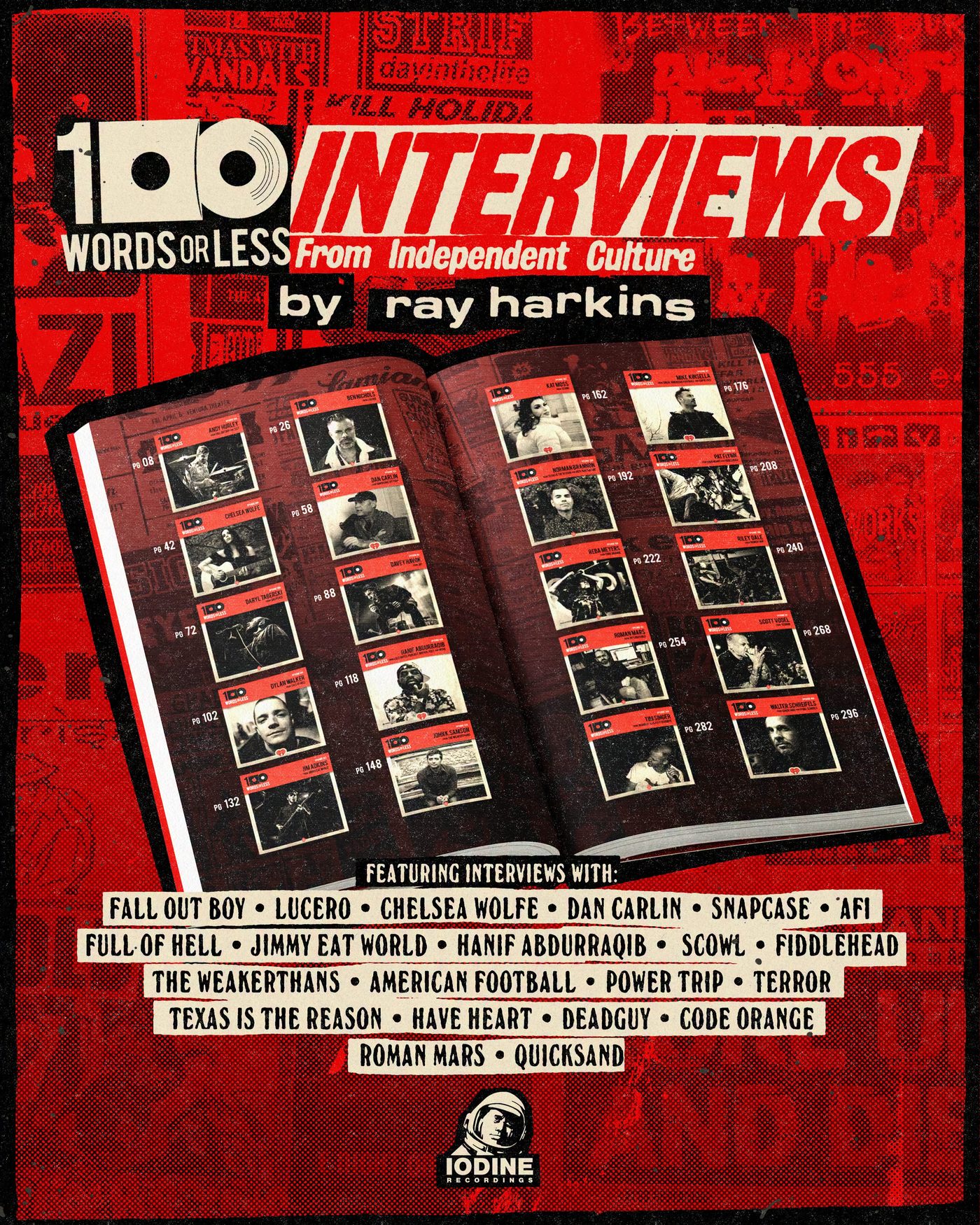
Ray Harkins has spent years asking other people to tell their stories, and his first book ends up revealing a good deal of his own. He sang in the Southern California hardcore band Taken, wrote reviews and interviews for zines including Status, Law of Inertia and Wonka Vision, and found work behind the scenes in record labels, A&R and artist management.
For over fifteen years, his “100 Words or Less” podcast has given him a place to talk with musicians, writers and people who have carried their independent music experiences into other professions. He doesn’t call himself a journalist. With Iodine Recordings now publishing twenty of those conversations as “100 Words or Less: Interviews from Independent Culture (Book 1)”, he’s also had to look back at the person asking the questions.
Norman Brannon makes a point in the book that seems to explain a lot about Ray’s method: the interviewer changes a conversation simply by being there. Ray agrees, and in our new exchange he readily admits that he follows his own memories, interests and experiences once a guest gets past the usual promotional talking points. The interviews tell you who Ray was when he recorded them, including what he failed to notice or didn’t yet know how to ask. Reading his earlier conversation with Reba Meyers against a later one with Kat Moss, he acknowledges that he wasn’t prepared to get into certain questions about women and gender in hardcore. Hanif Abdurraqib challenged one of his assumptions about belonging, and a more recent conversation with Jennifer Finch took off in a direction Ray hadn’t anticipated. He now catches himself offering guests ready-made answers inside his questions.
Wyświetl ten post na Instagramie
The passing of time has also changed some of these interviews in ways nobody could have planned. Ray nearly excluded his conversation with Power Trip’s Riley Gale. Riley was discussing touring, what might come next and how to make a life in music sustainable. Ray’s handwritten introduction was written after his death.
It leaves the old exchange intact as a conversation with someone making ordinary plans for his future. Since then, more people who spoke to Ray have died, including Gared O’Donnell, Tom Searle, Andy Williams and Jennifer Finch. Finch died in July 2026 and Williams in September. Ray talks about returning to those recordings in much the same way people revisit a saved voicemail from someone they miss.
There is plenty here about the less sentimental business of staying in music. Ray grew up when playing hardcore full-time wasn’t a realistic career plan for most of the people around him, so he made a living in supporting roles and remained close to the bands. His “Be Specific” podcast series dealt directly with what musicians, labels and sponsors actually earn.
That view extends to community. He points to benefit shows, mutual aid and political organising, then remembers listeners and hardcore friends offering help when his wife was diagnosed with cancer. For Ray, the word community comes with actual obligations, and he has been on the receiving end of that care.
He is equally clear that hardcore belongs to the younger people building it now. Older participants can preserve stories, share resources and get their egos out of the way; they don’t get to decide what a sixteen-year-old’s scene must be.
That sits beside his interest in following independent culture into less visible lives, including public defenders, city workers and filmmakers. Oscar-winning writer and director Cord Jefferson, who once spent a summer on the road with The Bled, is one example. The book and this conversation move freely between those lives and Ray’s own memories of shows, bands and people he has known for decades.
In your handwritten introduction, you say the podcast changed your life. You also describe writing for zines, mostly unpaid, long before you had this platform. Looking at the book now, what did those early years of writing and interviewing teach you that you couldn’t have learned through the music industry? And what did the podcast eventually give you that playing in bands never quite could?
Ray Harkins: Writing for zines was absolutely foundational for me. I was so glad to jump in and write “professionally” in the early 2000s for zines like Status, Law of Inertia, Wonka Vision and others that had an audience and circulation. That work taught me how much time I needed with a band to write a one-page feature versus a more in-depth piece.
I also wrote a lot of music reviews, which helped me think about music critically and not immediately write something off because of a preconceived idea of the band. I viewed my work as a curious individual (I will never call myself a journalist, that’s a bridge too far) as dovetailing very well with playing in a band and working at a record label.
They’re all different flavors of the same thing. The podcast was a launching point into owning my own thing and owning the means to distribute it with very little friction. While it may be hyperbolic to say the podcast changed my life, the decision to get involved with the industry brought me into the next phase of my professional life. It also made me an anomaly: I not only work in the podcast industry, I host my own show as well, which again means both sides dovetail and work for each other.
You had hundreds of conversations to choose from, yet this first volume contains twenty, arranged alphabetically by first name. I’m interested in the actual selection process. Were you choosing the conversations that worked best on paper, the people who had the greatest personal impact on you, or the interviews that documented something important about independent music? Was there a conversation you desperately wanted to include that ultimately didn’t make the cut?
Ray Harkins: The process started with me looking at the interviews that were the most popular episodes. It’s so interesting to me, because there are some episodes I think people will have a vested interest in and others that are more outliers, but more often than not, I’m wrong.
Validating that data against my memory of the conversations helped situate me as I started to think about what I wanted this first volume to accomplish, which was ultimately a variety of sounds and bands while also bringing in people from other industries. Another factor was when I had the person on the show, since sometimes I caught people at a very interesting moment as they reflected on their success or looked back on their art with hindsight. It truly felt like throwing a few ideas in a blender and seeing what came out. I did need to limit myself to a page count, so that helped me land on an ideal number to target.
Your conversation with Norman Brannon stopped me for a while. On pages 194-195, he talks about rejecting the idea of the journalist as an invisible observer. He believes the interviewer is part of the story because their presence changes what gets said. Looking back through these twenty conversations, how much of the book do you recognize as your own story? Have there been moments when your familiarity with an artist opened a door that a conventional journalist might never have reached, or perhaps prevented you from seeing something outside your own experience?
Ray Harkins: A personal relationship isn’t crucial when I start a conversation, but establishing that I’ve personally been through similar experiences is, in my mind, absolutely crucial. Anyone who’s ever talked with an artist on a press tour knows you get to hear all of their greatest hits. In our fractured media environment that works well, but for my purposes I don’t really care about it. As much as I appreciate the recent output, or the reason the person is coming on my show to promote, that’s the least interesting thing to me in that moment.
Most of the conversations I have on the show are filtered through my prism and what I find interesting or am curious about, because it’s on those side quests that an artist starts to settle in and treat it like a back-and-forth rather than a Q&A. My favorite part is when I present two possible answers and the guest either disagrees or takes another path. I love being challenged in a friendly way so I don’t box someone in. Norm was influential in showing me that the interviewer HAS to bring themselves to the conversation. Otherwise, it’s simply a very on-the-rails conversation.
There’s a revealing exchange early in the Hanif Abdurraqib interview. You describe him as a sort of “secret punk,” and he immediately points out that people’s assumptions about his relationship with the scene are racialized. Did that answer change the way you thought about who gets recognized as belonging to hardcore? More broadly, has someone ever challenged an assumption built into one of your questions so effectively that it changed how you approached future interviews?
Ray Harkins: Oh, it totally helps inform my position and my understanding of how people are labeled. When I use “secret punk” to describe people, I’m simply focused on people who aren’t specifically playing in a band or running a record label. It gives a person a less public-facing way to display their allegiance to a scene or style. I’m reflecting on a conversation I had not too long ago with Jennifer Finch from L7 (rest in peace). She seemed so entertained by the way I was framing the questions that she veered away from the premise, which pulled us in a whole other direction. It made it clearer to me that I need to stop presenting off-ramps that answer the question for people. I may not remember it past that conversation, but I really appreciate every time one of my questions or assumptions gets challenged on the show.
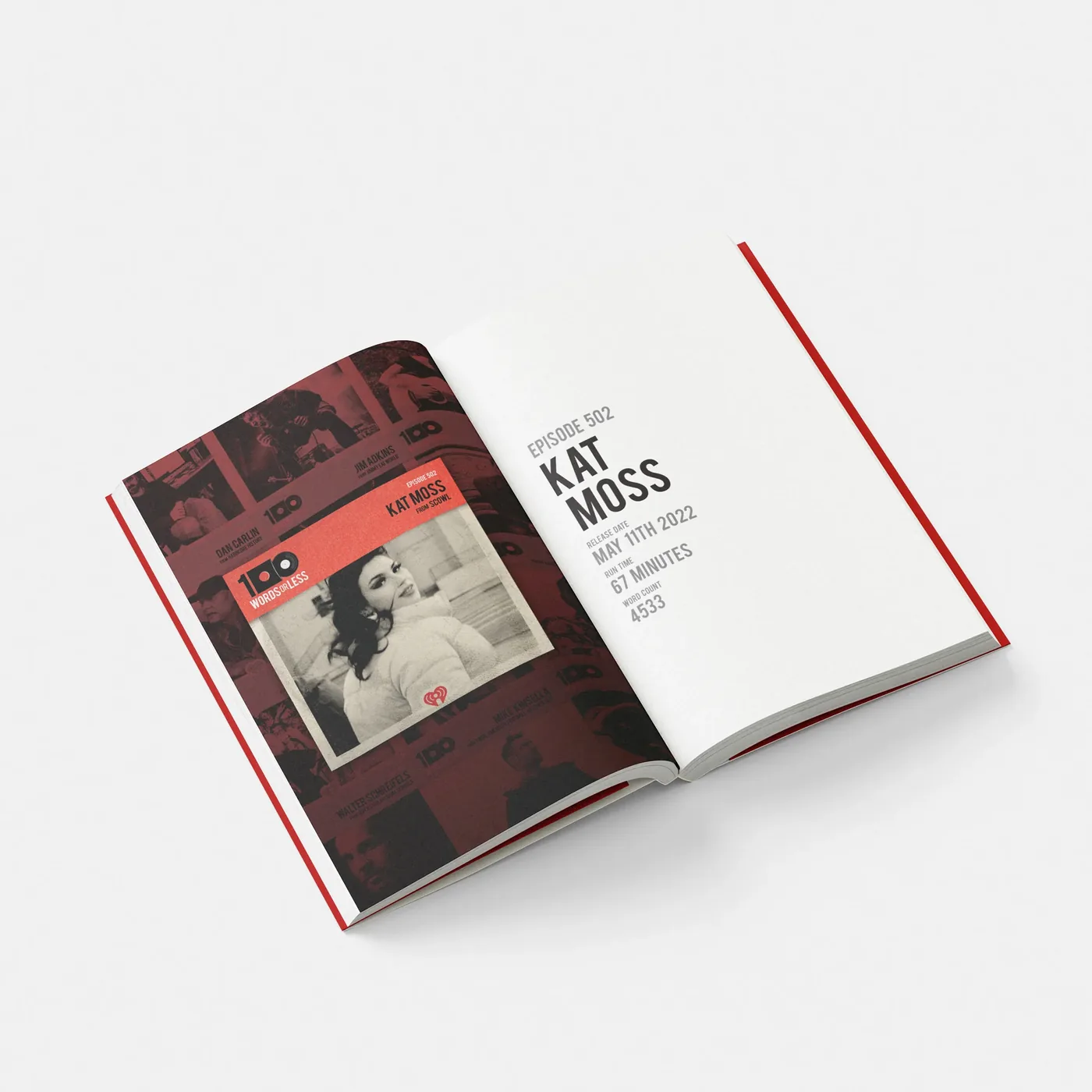
I was also comparing your 2015 conversation with Reba Meyers to the later interview with Kat Moss. In the Reba conversation, there’s a question about whether she sees herself as a businesswoman, while the Kat interview gets into visibility, performance, fashion and the expectations placed on women in hardcore. When you revisit interviews separated by seven years, do you recognize changes in your own interviewing habits? Are there questions in this book you’d approach differently today?
Ray Harkins: Most definitely. As the cultural conversation has evolved, not only within our scene but in the world in general, I’ve learned to approach these conversations differently than I did six years ago, let alone six months ago. I appreciate you pointing out those two, because Reba was one of the first women I had on the show. I remember thinking that harping on gender with her wasn’t going to lead to an interesting conversation, and frankly, I probably wasn’t prepared to tackle something like that at the time. Understanding how people want to show up in their own bands, and in the scene more broadly, helps inform my questions as well. All of that to say, that’s also why I pulled interviews from a long time ago, so we can timestamp them and appreciate the detail with hindsight, myself included.
The Riley Gale chapter carries a different weight now. In the conversation, Riley is thinking about the future, wanting a more sustainable life, and imagining what he might do beyond years of relentless touring. Your handwritten introduction, written after his passing, is deeply personal, yet the original conversation ends with him talking about the exhausting practicalities of traveling in a band. What was it like working on that chapter? Was there anything you consciously decided to leave untouched because you wanted readers to hear Riley as he was in that moment, with his whole future still ahead of him?
Ray Harkins: It was heavy, and at one point I wasn’t sure I wanted to include it. But I’ve now had a few people on the show who have passed (Gared from Planes Mistaken for Stars, Tom Searle from Architects, Andy Williams from ETID and Jennifer Finch, to name a few), and it feels so special to crystallize their voices, their stories and ultimately their mindset as they approached whatever was on the horizon. I only edited that chapter for clarity, since we went on certain tangents that didn’t lend themselves to the written form.
The way many people keep a voicemail or video of a loved one who’s no longer here, I feel so lucky to have these conversations that I can revisit and that others can tap into.
There’s an interesting connection between the Andy Hurley and Hanif Abdurraqib chapters. Andy discusses Racetraitor as part of his own history, while Hanif talks about how the band was sometimes remembered for its confrontational politics at the expense of the actual music.
Did putting these conversations together reveal relationships between stories that you hadn’t noticed when you originally recorded them? I’d love to hear about a connection between two seemingly separate guests that surprised you during the editing process.
Ray Harkins: That’s a great call-out. There are often reflections or echoes of previous conversations that only come to light when someone mentions them to me, and some are PAINFULLY obvious.
For example, I never made the connection on how important and active the Merrimack Valley scene in Massachusetts was, since most people immediately run to Boston. It wasn’t until I started to see the origins of Cave In, Piebald, Overcast and so many others that it dawned on me you can’t just lump it all into the major city. I also enjoy bringing a little cheekiness into the conversations and reflecting on silly memories, or actual issues, from my own past.
For example, I put Brett Detar from The Juliana Theory on the spot for wearing a headset mic at Hellfest 1999 (he says he didn’t, but he most ABSOLUTELY did). Or Andy Williams and Jordan Buckley from ETID: I once asked them nicely to go on at their intended set time to give my band, Taken, a few minutes before everyone wandered over to their stage for an inevitable BANGER of a set…but they didn’t, and it hurt my feelings. Putting it to them to see what they remembered was a fun, full-circle moment to reflect on.
The book contains several almost contradictory approaches to DIY economics. Dylan Walker genuinely enjoys the business and resource-management side of Full of Hell. Norman Brannon describes the pressure that earning a living from art can place on creativity. Walter Schreifels reflects on the days when even charging a few extra dollars for a ticket raised ethical questions. John K. Samson talks about equal pay within a band.
You’ve been a musician, worked in A&R and managed artists yourself. Which of your earlier beliefs about money and independence have survived those experiences, and which have you had to reconsider?
Ray Harkins: The age-old conflict between art and commerce. Considering I’ve made much of my living off music, doing something that many view as a hobby, I feel incredibly lucky. However, I also recognize that it’s a huge sacrifice to pursue your creativity and try to make a living from it. I came from an era when playing in a hardcore band was never a real aspiration, beyond the few who made it into full-time touring bands and worked at bagel shops between tours.
So I always had an alternative path that led me to the support side behind the scenes, at labels, in management and in other roles, to support my life as a father and husband. Even when I didn’t have those obligations, I always had a “backup” plan so I could still exist in the world I’m passionate about, while making a living. These conversations haven’t changed my perspective, but they’ve sharpened the need to share unvarnished conversations about it.
I did an entire series on my show called “Be Specific” focused on the ACTUAL business outcomes of being in a band, working at a label and media sponsorships. I’m inspired by artists who build their infrastructure around being as self-sustaining as possible and create their own destiny. Talking about it, and shining a light for people who simply attend shows, will create more awareness of how far that t-shirt sale or ticket purchase really goes.
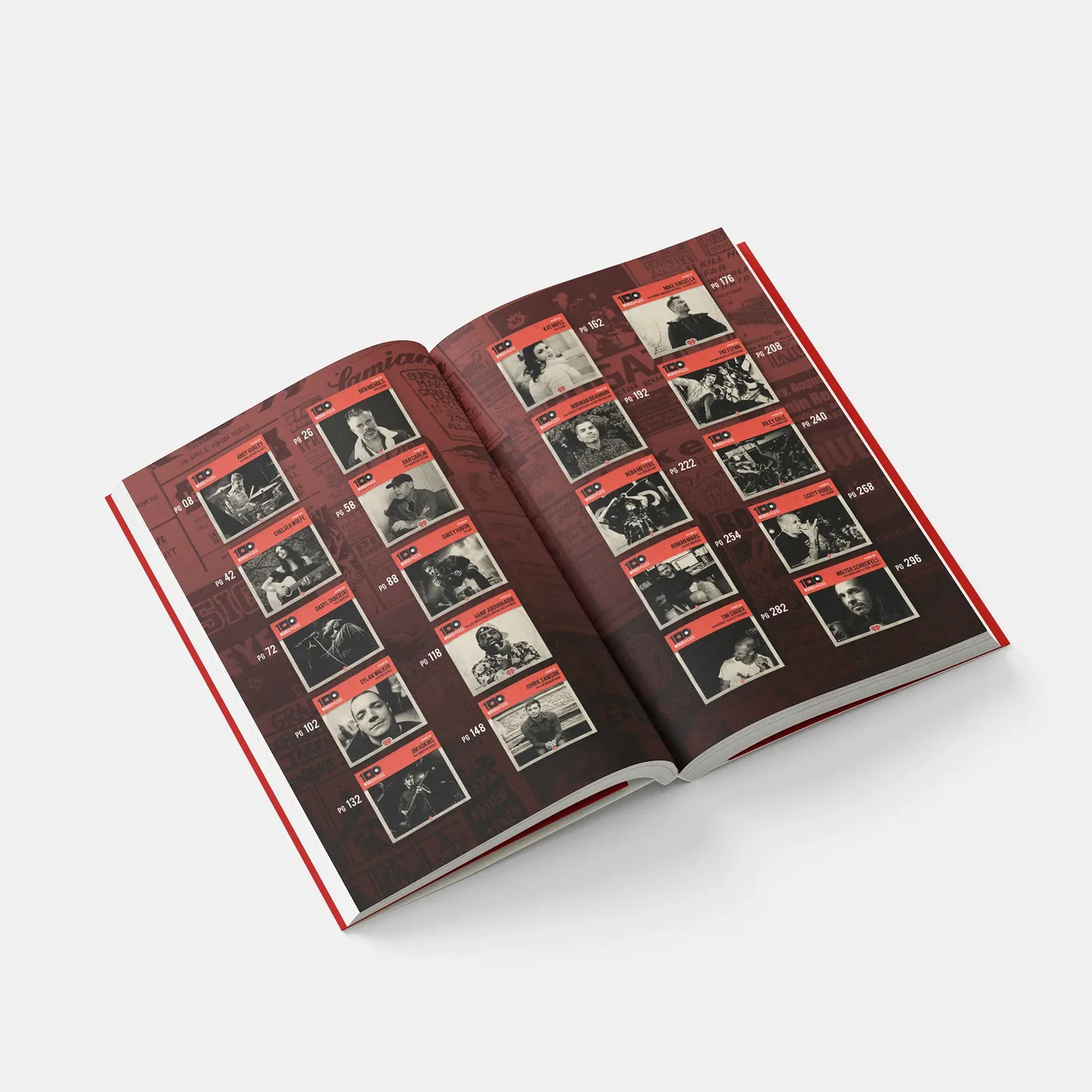
Norman tells a story near the end of his interview about Keith Burkhardt helping him through serious financial difficulties. Pat Flynn, meanwhile, talks about eventually stepping away from the stage to help younger people organize shows and build spaces of their own. Those are two very practical expressions of community.
When you hear people talk about hardcore as a family, what does that phrase actually require of them? Has the community ever supported you in a way that fundamentally changed your understanding of it?
Ray Harkins: It’s a very real question, as we see this thing expand in ways I couldn’t have fathomed a few years ago. Now we see how people show up for Lou Koller from Sick of It All, or in other fundraising efforts like what happened with Year of the Knife. I do think those tangible actions, along with actions against oppressive forces like ICE and in support of racial justice, gender equality and LGBTQ rights, whether through selling merch or throwing benefit shows, are all ways I see this community coming together.
I also have to mention the work SOS Booking does here in the greater Los Angeles area with their “For The Children” shows, which now span the world and are very unifying. All of this momentum echoes in my head from when I saw Greg Bennick and Trial speak back in the late ‘90s about how we don’t just want to have a great time at shows and learn, but take that action outward, even if it’s as simple as an interaction with a co-worker who now understands a little more about animal rights or immigrant rights, without pushing those people away.
The community has supported me in two very tangible ways. First, the support for this book has been really humbling: seeing people simply show up and invest their hard-earned money in it. Second, many years ago, when my wife was diagnosed with cancer, I shared the story and updates on the podcast with her approval. It was intense, but it was meaningful how many people, whether listeners of the show or part of our larger hardcore community, offered up anything they could for what I was going through. While it’s steeped in clichés, this weirdo music scene has shown nothing but real heart through all of this.
John Hill opens his preface by embracing the idea of being a poser because it means there’s always more to discover. Dan Carlin remembers early punk scenes becoming hostile to newcomers, and Davey Havok recalls being called a poser as a young skateboarder.
Reading those accounts together, I’m struck by how a culture built around finding somewhere to belong can also develop elaborate rules for excluding people. After all these years, what do you think hardcore still gets wrong about belonging? Is there something younger generations have already figured out that your generation struggled with?
Ray Harkins: The almighty gatekeeping conversation, which gets reignited every time people see ridiculous behavior at shows on social media. I think hardcore, by its sheer confrontational nature, is difficult to get into and stay into for a long period of time, because it’s clearly not for everyone. Every subculture wants to push people away with some sort of unspoken litmus test for newcomers, only because the core idea of protecting its most important elements still rings true.
I often think of the Chokehold lyric “The only music with a pulse is music that’s a threat” because it truly drove the point home for me. Generationally, and where the scene is at now, it’s far more permissive and expansive, including a lot of things that wouldn’t have been accepted many years ago. But applying my own experience in the “scene” is far too prescriptive, and it’s different from what a 16-year-old sees now.
I still think that, at its base level, this music needs to stand for something and have a point of view. Otherwise, there’s nothing that separates it from other music scenes. I’m not the one making the rules, and I don’t want to be, since it’s not my scene anymore. But I’m very happy to build context and a story around the people creating it, regardless of age or genre.
Roman Mars says something fascinating about the voice he uses on “99% Invisible.” It’s partly a performance and partly an aspirational version of himself, the person he wants to become through being curious about the world. You’ve been the recognizable voice of “100 Words or Less” for years.
How much of the Ray we hear on the podcast is a version of yourself that you’ve consciously developed? Have you ever listened back and realized you were performing the role of the encouraging interviewer when your actual reaction was much more complicated?
Ray Harkins: As a person who puts themselves out there (which we all do now with social media), you have to be aware of how you’re perceived and how you land with people. Through the podcast, though, I’ve been able to get a reflection of myself that’s less about how the audience perceives me and more about how guests react and dig into conversations with me. It’s less about playing a character or a version of myself and more about the experience someone has when they appear on my show, or simply have a conversation with me.
I want it to be warm and familiar, but to actually feel like you went somewhere, as opposed to just the “hang” that many podcasts enjoy sitting in. I know I’m not confrontational or tough by nature, so acting like I embody any of that would mean playing a character and trying on a new persona, rather than leaning into who I am. Doing this weekly for over 15 years has also been an outlet for me to find better ways to express myself and a home for the thoughts in my brain, so it’s not just me lighting up my friends on text.
Chelsea Wolfe talks about becoming increasingly selective about interviews, photographs and how much of herself she’s willing to expose publicly. That raises an interesting question about your side of the conversation.
How do you know when an interviewee has given you something they’re genuinely comfortable sharing? Have you ever left a revealing answer out of an episode because preserving the relationship or respecting the person’s privacy mattered more than publishing it?
Ray Harkins: Fortunately, for the most part I’ve left my conversations relatively untouched and lightly edited. I do have an instinct: if a person is saying things that could get them in trouble or affect their business, I verify with them that they want it left in. I’ve only had to pull down one episode in the history of the show, because the guest wasn’t comfortable having stories of light vandalism out there in the world.
Beyond that, I let the chips fall where they may. And because I’ve built this show around people sharing parts of their lives they typically don’t, sometimes people come to me with something heavy they want to get into: abuse, suicidal ideation or issues of sexuality. In those cases, I basically give the guest the floor to express themselves and try to help them lay out as much of it as they’re comfortable with.
In several interviews, the relationship between success and independence keeps returning. Andy Hurley can play enormous shows with Fall Out Boy and still be involved with Racetraitor. Scott Vogel talks about Terror playing a massive festival and then returning to a room with a hundred people. Walter Schreifels describes the creative paralysis he experienced while a major label kept him under contract.
Has talking to people across such different levels of success changed your understanding of what “selling out” even means? What has surprised you most about the people who managed to preserve their connection to underground music after entering much larger commercial structures?
Ray Harkins: My definition of success has really been reshaped by many of these conversations, because the goalposts change not only as the scene evolves and grows, but as people’s own metrics change. Some look at longevity as the holy grail, whereas others want to strike while the iron is hot.
What I’ve learned through these conversations, especially with people I hunted down because I have an emotional attachment to a record or band, is that any recognition of the art they’ve put out is really special.
One of the more important guests I hunted down and put in the book was John K. Samson from The Weakerthans and Propagandhi. He’s notoriously press-shy and averse to talking about himself, but hearing how nervous he was at the very beginning made me realize, “We are all just the same.” I also admire how people put their heads down and put out the work regardless of notoriety or recognition, as if it’s all part of a tapestry they have to breathe life into. In the face of that, any individual’s perception of selling out is irrelevant.
The older musicians in the book have very different relationships with the roles they once occupied. Pat Flynn imagines giving more of his time to helping the next generation build a scene. Mike Kinsella says he’s prouder of being a father than of being a musician. John K. Samson talks about making room for new voices. You’re now documenting a culture in which you’ve been an active participant for decades.
How do you see your own place in it changing? What should people of your generation be doing to make sure the next twenty years belong to the people who are just getting started?
Ray Harkins: Are you asking me if I’m a “chopped unc”? It’s a very important question that I often grapple with, because at the end of the day, this is a youth movement. Full stop. The only reason there are older people still caring about and investing in it is the length of time the scene has been around. When I first started going to shows at 15, I don’t think I ever thought about what my life would look like in my 40s, or that I’d still want to participate as deeply as I do.
What I do focus on is this: even though ego is at play in everything we do publicly, it has to be crushed and pushed aside so younger folks feel like they have the space to jump in and create. My mission with this show, this book and my involvement in the scene is to document as much of it as I can, with an unflinching eye and without favoring any particular music scene, since it’s all part of the same tree, just different branches.
The collection is also quite personal in its choices. It moves between hardcore musicians, writers and people who took DIY thinking into entirely different professions. Is there a part of independent culture that you think your podcast still hasn’t documented properly?
I’m especially interested in the people whose contributions are less visible than those of the musicians on stage. Who is missing from the historical record, and what would you like a future volume to preserve?
Ray Harkins: I definitely want to keep preserving the stories of people who have taken different paths in life and still connect deeply to independent music. Band people are easy to see and identify with, but there are also people who have applied their creativity to things that, on the surface, don’t seem creative. I’m thinking about corporate life or finance, as well as public service, like city workers or public defenders, and the list goes on. There is a limit, though.
I get a lot of pitches for people who seem interesting, but truthfully, if there isn’t enough of a hook to get my audience interested, it may not be right for this forum. I also want to dig more into the entertainment business and filmmakers. My conversation with Oscar-winning writer and director Cord Jefferson was so revealing, because he literally went on the road with the Arizona metalcore band The Bled for a summer, and he’s VERY steeped in that 2000s scene. I know there are probably many others who carry that passion but don’t get to highlight it and talk about it on a regular basis, and I’d love to send up the bat signal for them.
One final question. Hanif describes how a tiny moment in a song can remind him why he’s spent his life caring about music. I kept thinking about that answer while reading the rest of the book.
After hundreds of interviews, years in bands and so much professional involvement in music, what still catches you completely off guard as a listener? When was the last time something happened in a small room, on a record, or in a conversation that made you feel like the kid discovering this world for the first time?
Ray Harkins: Man, without sounding like a total blowhard, it’s moments like these. Sitting here at my computer and reflecting on the fact that YOU wanted to ask ME these questions is very humbling. It makes me feel like I’m 17 again, stepping off the stage at the Showcase Theatre in Corona, CA, after playing with Poison the Well with my band, Taken.
That exchange of interest and energy is what gives me life. Listening to nostalgic records, and then getting my mind blown when the new Neurosis drops, gives me different kinds of thrills. It’s really special to have any open dialogue with people about art and the way it impacts their lives.
So yes, while it may not happen as often as it did when I was younger, it still happens, and it gets me stoked to still be clocking in at the hardcore factory.
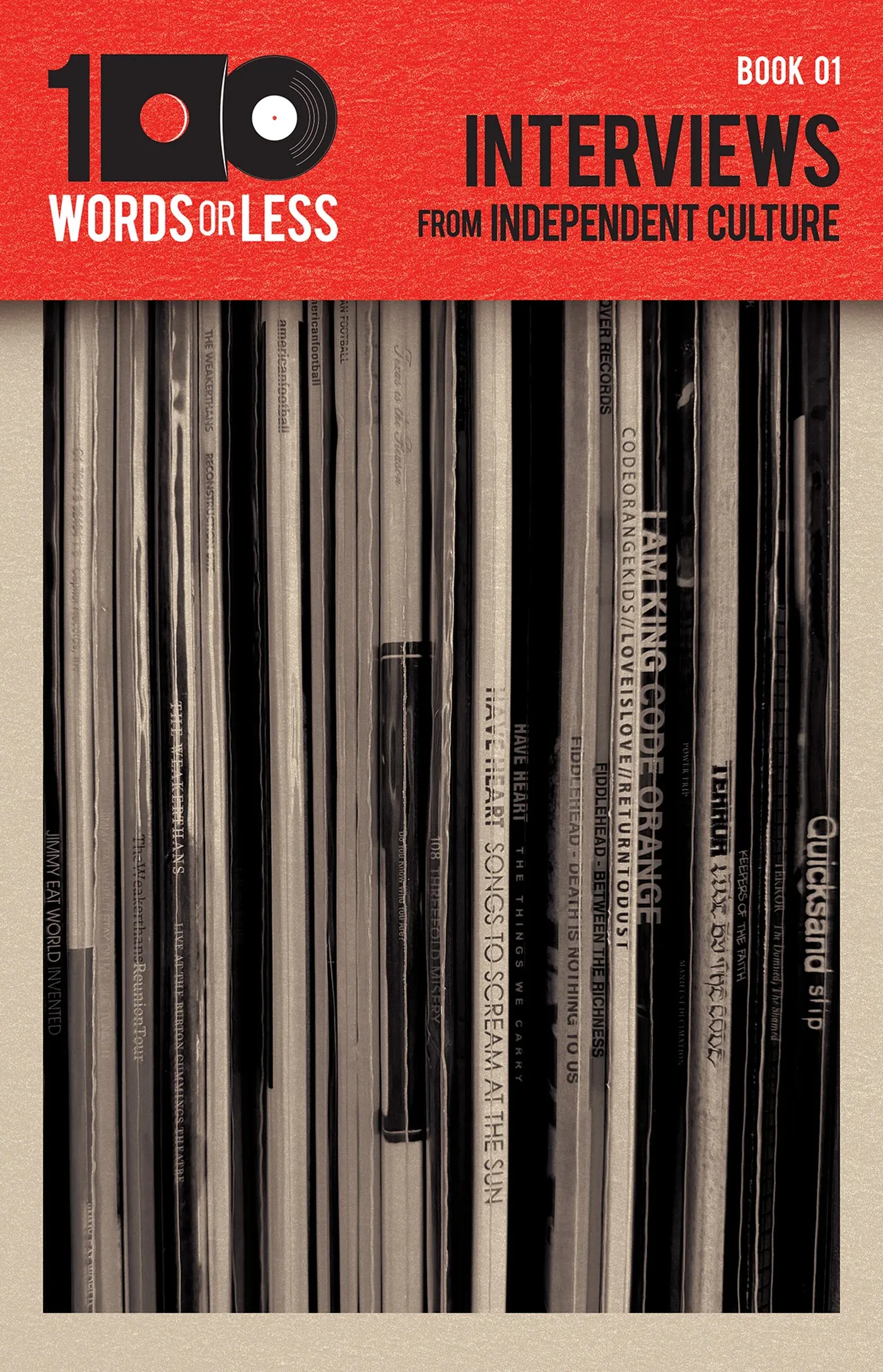
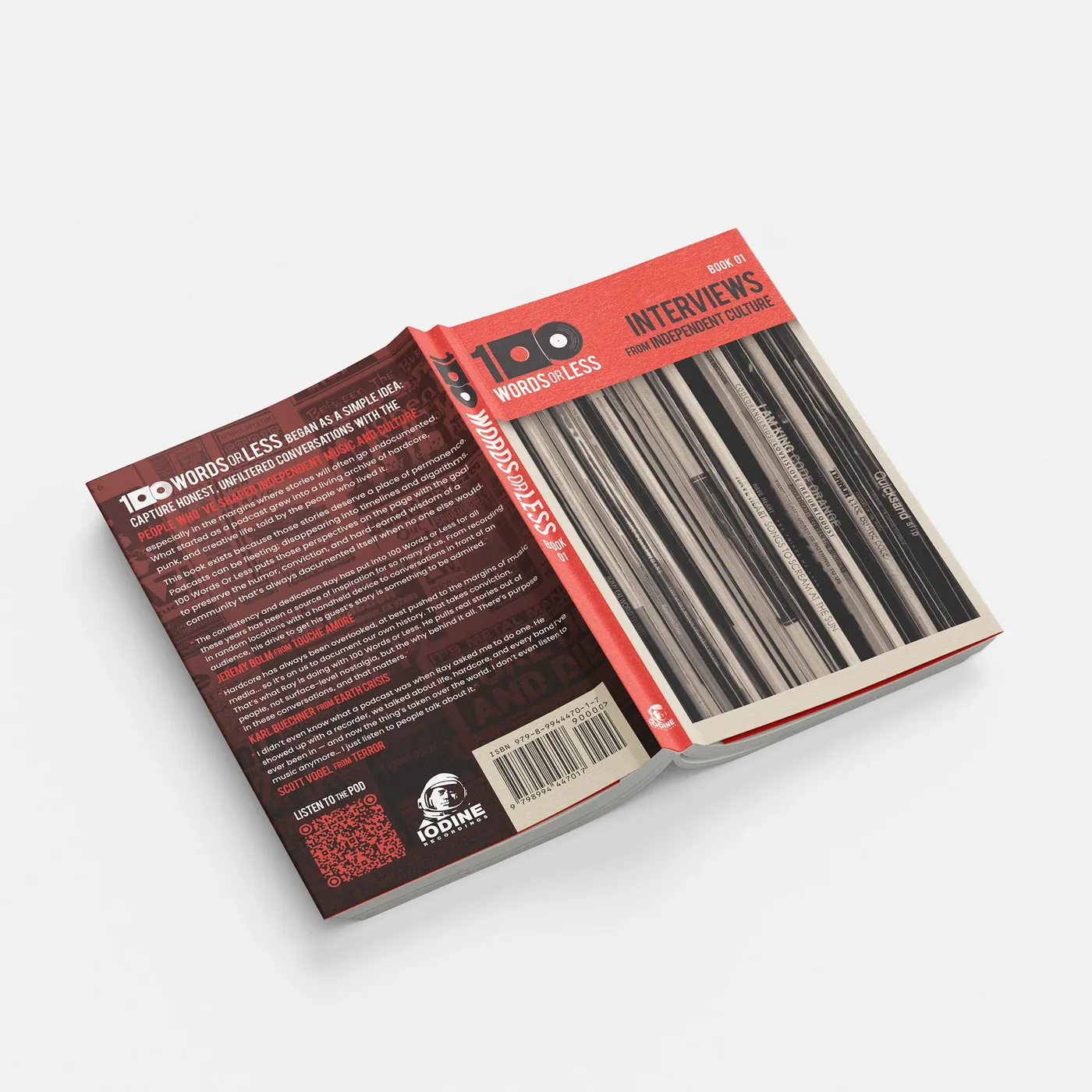
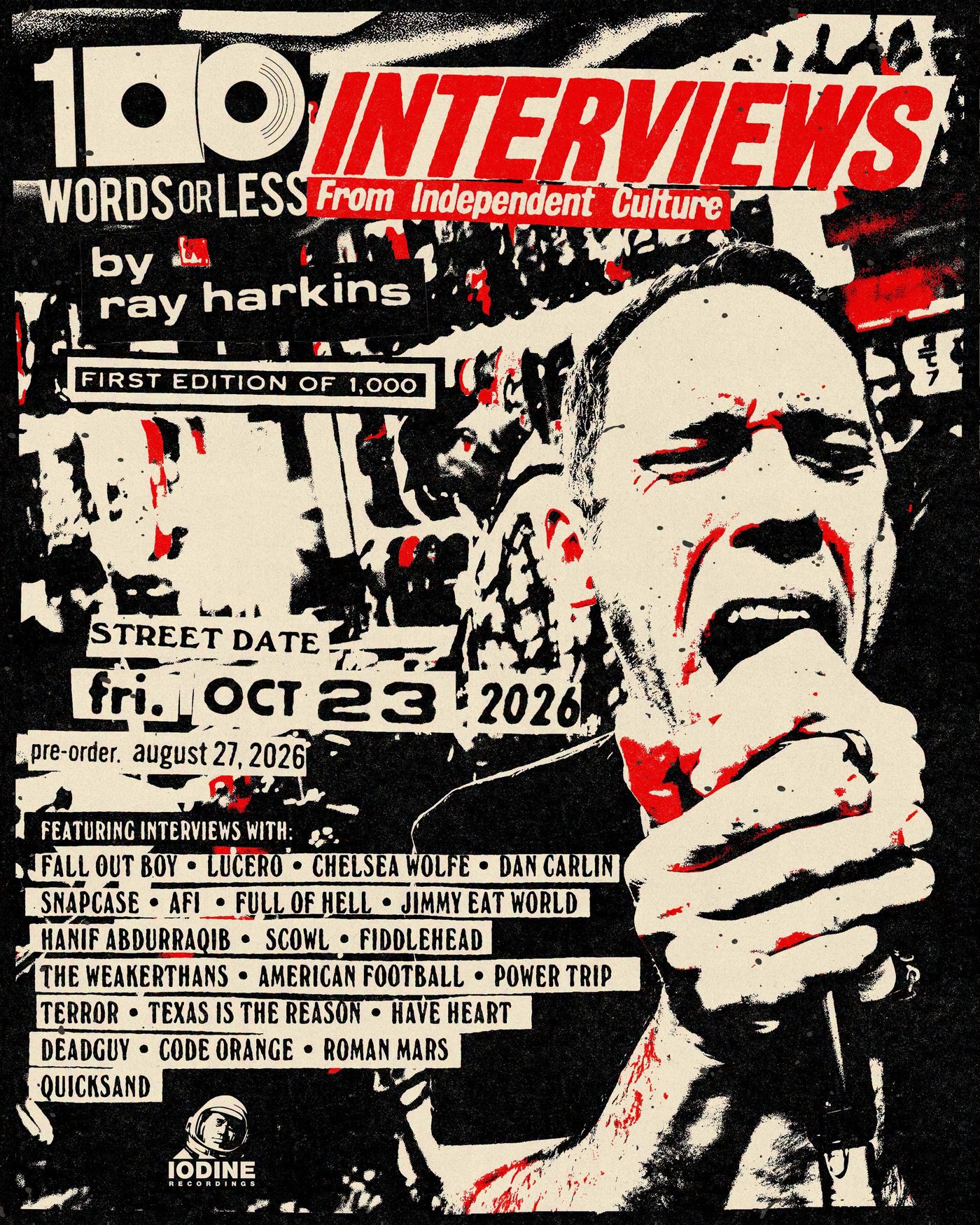
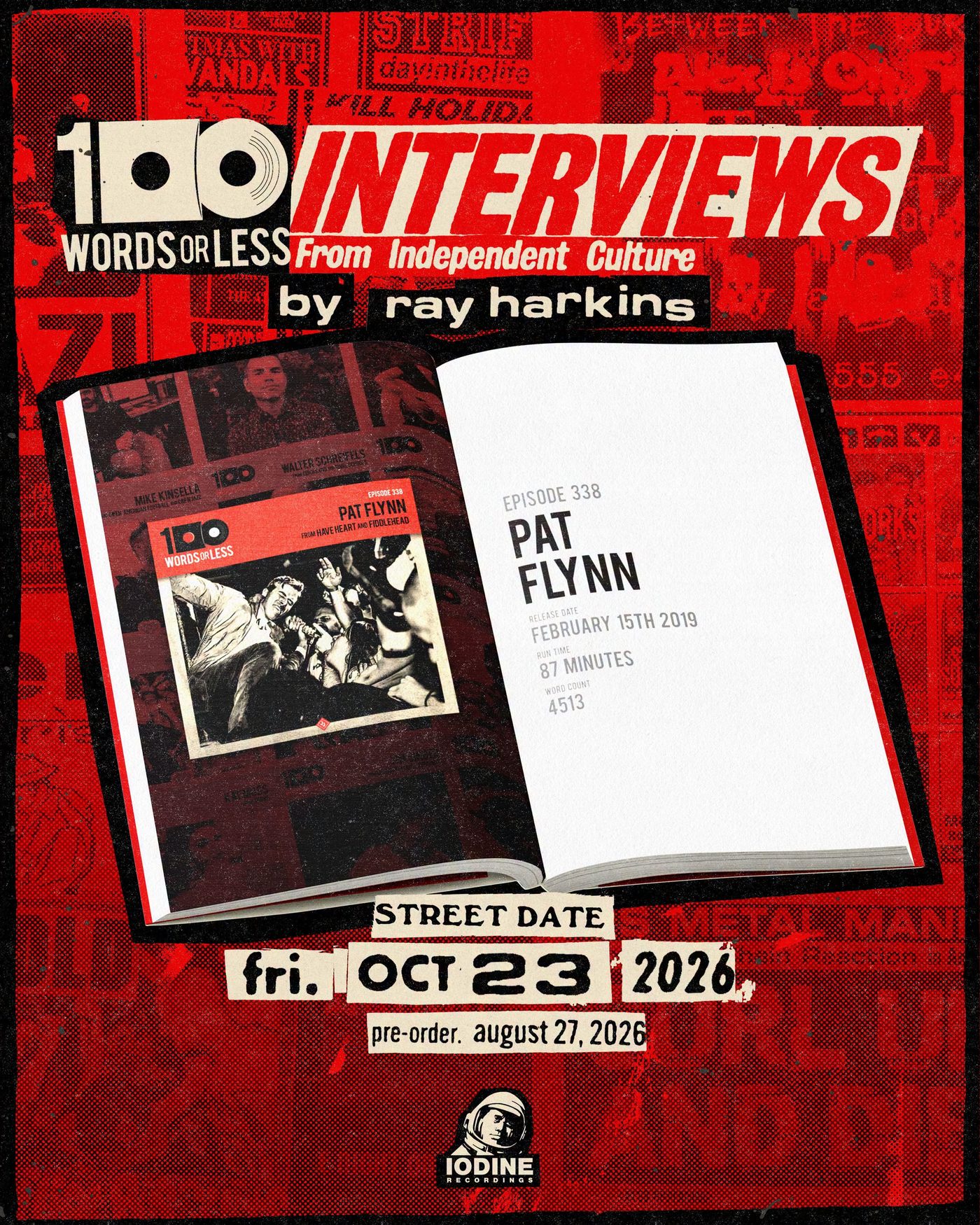
“100 Words or Less: Interviews from Independent Culture (Book 1)” is published by Iodine Recordings on 23 October 2026 in a first edition of 1,000 copies. Written by Ray Harkins, edited by John Hill and designed and laid out by David Defeo (ISBN 979-8-9944470-1-7), it is currently available to pre-order directly from Iodine Recordings for $25, with shipping estimated from release day.
🔔 IDIOTEQ is ad-free, independent, and runs on one person’s time. If you want it to stay that way: DONATE via PayPal or SUPPORT via Patreon.
NEW: IDIOTEQ Explore 🗺️ Browse 15+ years of our archive by city, country, and style. Find artists on the world map or trace related sounds through the styles map.
Stay connected via Newsletter · Instagram · Facebook · X (Twitter) · Threads · Bluesky · Messenger · WhatsApp.