


There is a small moment inside “Loss In Space” where Cluv Deego can be heard telling bassist Dudesblood Moonbear when to enter with the layered vocals. Sliimo were tracking the song themselves in their Providence practice space, playing the body of it live, and the instruction stayed on the finished record. You have to listen for it. Mike, Sliimo’s singer and guitarist who performs as Cluv Deego, likes that it stayed.
“I always love when I can hear that on records, any accident, and this is a case just like that,” he said. “We did all the tracking ourselves and I’m super proud of how it came out. I don’t think there’s a single thing I would change on the record.”
We are premiering “Loss In Space”, one of five connected songs from Sliimo’s forthcoming 10-inch EP.
The version on the record is close to the way Sliimo play it in a room, apart from one change that stuck after the session and now appears every time they perform the song. A riff-led build in the middle used to arrive as another thick wall of sludge. During recording, the band cleaned it up, soaked it in reverb and found an old blues shape inside it. The quieter passage cuts the song in half. Then the loud version returns, with a second descending part placed over it.
That practical studio discovery sits inside the record’s most personal song. Mike wrote “Loss In Space” for his wife, Katie Greenwood Ross, who died from breast cancer last year. She was an artist, a maker and, in his words, someone who always seemed otherworldly. The song recasts her as a spacefarer who becomes a moon goddess after technology and medicine fail her. “She lives on forever as a deity in my personal night sky,” Mike said.
Sliimo would not exist in its present form without Katie. She primarily made jewellery, but she was also a historical costumer. When the band began putting together their space-adventuring clothes, she helped Mike tatter and age his cape, Moonbear’s Cloak. She also worked on the first version of drummer Grogga Motta’s vest, adding a diamond-shaped pattern.
Her input reached well past the sewing table. Katie knew more about doom and stoner rock than Mike did, listened to the early riffs and helped the band work out what kind of mood they were chasing. She backed the whole strange idea at the point when encouragement mattered most.
“Providence has always been open to cool freaks dressing up and doing performance pieces, and she was such a supportive figure in us really diving into this head first,” Mike said. “Her encouragement really made me feel like I could do anything. If you think what you’re making is cool, then it is cool.”
Sliimo call themselves a sci-fi space metal band.
In practical terms, Cluv Deego, Pitt Prota, Grogga Motta and Dudesblood Moonbear dress for interstellar travel and play stoner sludge with long ambient-rock passages. The songs are sung in Galactic Basic, otherwise known as English. Their subjects include laser fire, radiation storms, sublight stasis and the workings of a frozen brain waiting inside an escape pod. Music, artwork and performance are treated as one shared experience, meant to show that goofy freaks have a place on Earth and beyond.
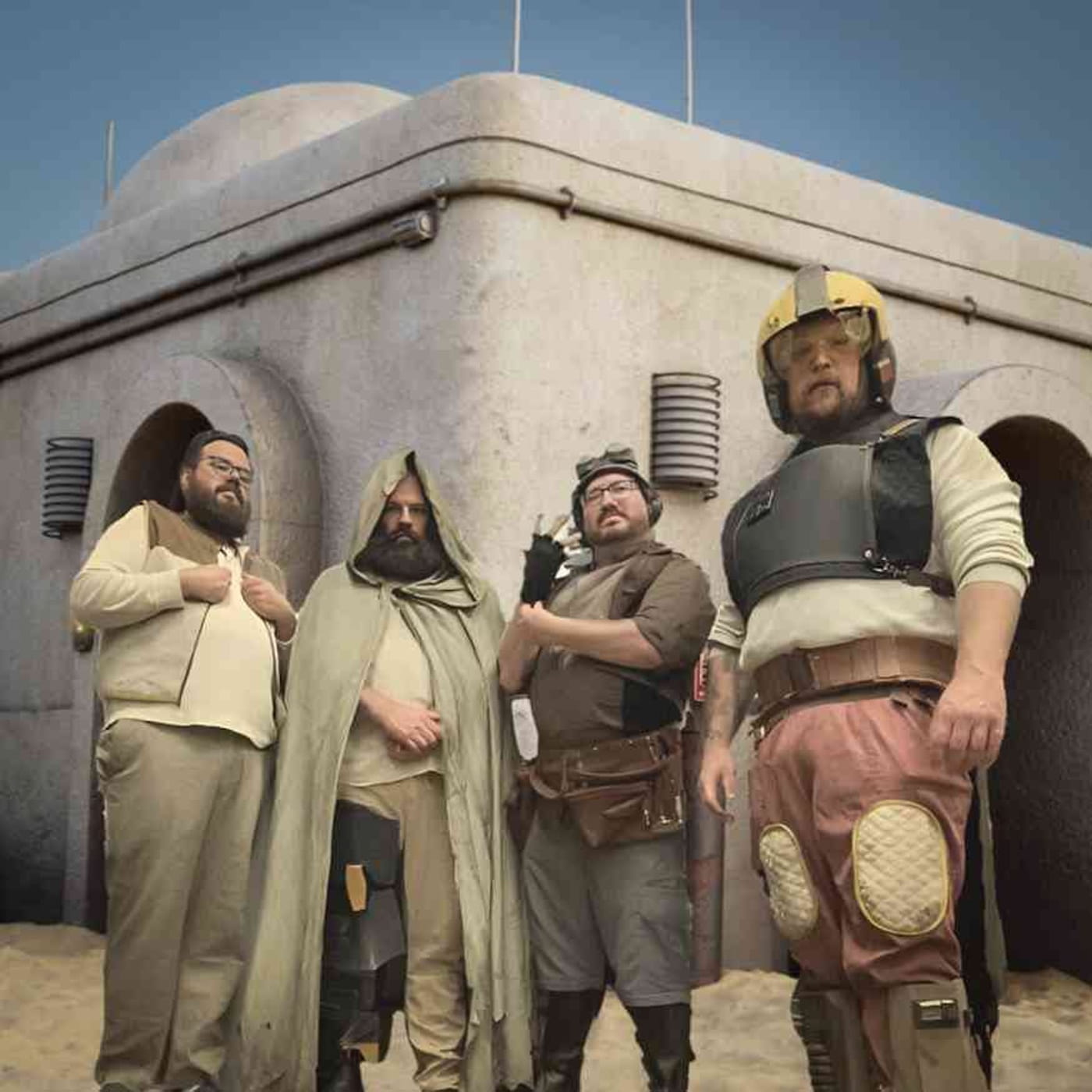
The costumes and names are already part of the band, though Sliimo are still deciding how completely the people on stage should disappear into the Kyper system. Mike says one challenge, whether self-imposed or not, is the narrow idea of what local punk, hardcore or metal are supposed to look like. Sliimo arrive dressed as space adventurers and sing about another galaxy. Jokes help them break the ice.
“It’s always about being fun for us, and that’s cool, if that makes sense,” he said. “I don’t think at any point we take ourselves seriously, but a band from space in character sounds like they’d be serious.”
The music still has to hold up. Mike believes the live playing is tight and the costumes already work, but the next stage is to blur the border between the venue and the fiction. Sliimo have established the band and its central gimmick. Now they want to turn the dial further and perform more fully inside the universe they have been writing.
Providence gives them room to try it.
The city’s history already includes Fort Thunder, Load Records, Lightning Bolt and Pink & Brown. The Big Nazo art collective used to appear without warning at punk shows and now works more broadly across city events. Lovecraft’s shadow still runs through local culture, alongside Fringe Fest’s focus on fringe theatre and performance art and the bi-yearly NecronomiCon celebration of weird horror and fiction.
Dirt Palace and the Wedding Cake House have pushed art and residency projects into unusual forms. AS220 began as a non-profit show space in 1985 and grew into live-work spaces, galleries, print shops, community classes, after-school programmes and more. Sliimo’s costumes are their own thing, but they do not come out of a city that asks strange performers to tone themselves down.
The 10-inch format came together without much debate. Sliimo had five strong songs that moved into one another while keeping their individual shapes. They recorded the main performances live in the practice room, all in one go. Extra instruments and walls of sound came later, but the body of the EP is the band playing together. Their goal was simple: the record should move the way one of their sets moves.
Its story starts in motion. “Radiation Sun Burst” follows a vessel escaping an exploding star while an enemy ship fires laser cannons behind it. Ships in the Kyper system may carry radiation shields, but a sunburst can strip away any defence and kill everyone inside within seconds. The other combatant is also trying to outrun the blast, which turns the song into a chase between two crews with the same disaster at their backs.
“Ice Diamond Rattlesnake” begins immediately afterwards. Faster-than-light travel exists in Sliimo’s fiction, but emergency escape pods do not have it. They freeze whoever is inside, send out a beacon and drift at sublight speed until they are found, crash or disappear into space.
Every traveller placed in that condition has the same dream. They wake on a frozen planet with no obvious escape. Some search for shelter and warmth. Others climb towards the peaks, looking for an answer inside themselves. Science cannot explain why the vision repeats from person to person. It can last for weeks or decades, though time inside it is shaped by what the dreamer chooses to do.
“Loss In Space” pulls the fiction back towards Mike’s own life. After that, “In the Winds of Kyper” closes the record by moving deep into the lore he and guitarist Pitt Prota have developed together. Ancient mechanical whales move through space carrying technologies that could produce unlimited energy and resources, enough to send civilisation farther across the galaxy. Pirates and privateers chase them, board them and strip them for their own use. Mike and Pitt had “Moby-Dick” in mind when they pictured the hunt.
There is another theory inside the song. Some people in the Kyper system believe the galaxy has been woven together by an infinitely strong, unseen spider. Nobody has proved it. People keep their theories anyway.
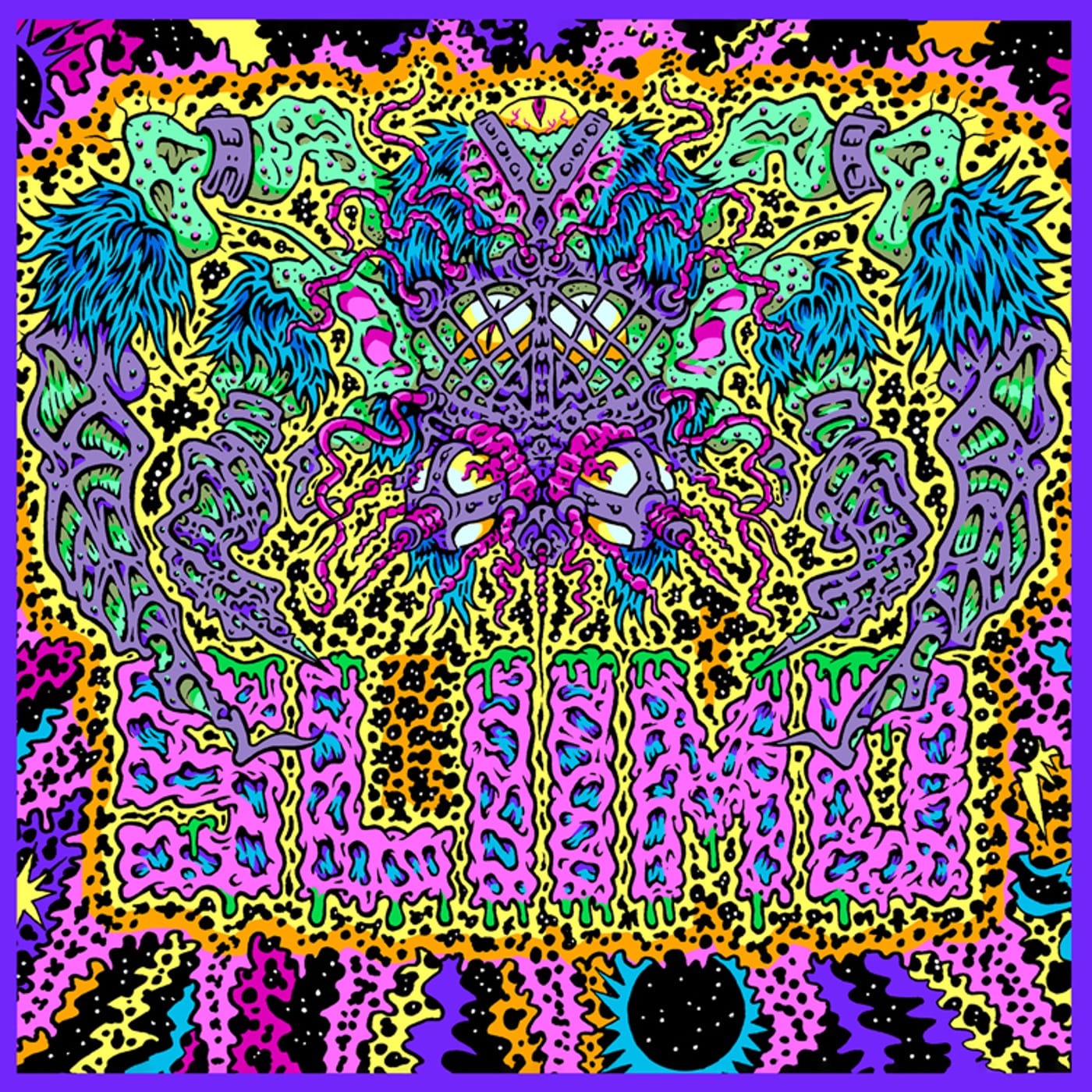
Gunsho handles the cover. His previous work includes Landed, Andrew W.K., Diplo and Malibu Ken/Aesop Rock. Sliimo had admired his work for years and felt that his colour choices and Kirby-style crackle suited their stories. The band knew that sludge lyrics and a dark science-fiction setting could easily lead to simple, shadow-heavy art. They wanted the opposite: an image a listener could stare into and use to imagine a group of adventurers moving through a galaxy much larger than the record itself.
Most of that galaxy still lives in lyrics, conversations between band members and notes that continue changing in their heads. Pitt has now written its first public prose document, a first-person account of someone finding one of the ancient mechanical whales. It will appear as a page in the record insert. Mike has ideas for a zine or a book later, but for now, the insert is the only place outside the songs where the wider story has been written down.
Below is Pitt Prota’s story in full, reproduced with his credit.
“It took me longer than I care to admit to even start to fathom what I was looking at. Right there in the middle of a decaying rank forest on a wasted world untrodden by a sapient being in hundreds and thousands and perhaps millions of years lay the decomposing remains of a gargantuan festering ichthyoid machine.
Well, I call it a machine, because that is the only word I can think of to use. But it was really only a machine in the same sense that the body is a machine, or the brain, or cells, or atoms. As I approached the massive thing I initially assumed that it was made of synthesized metallic elements, unnatural, constructed.
Despite the smooth wet forms and strange softness of the tissues that sprawled across the rotting woods like a dead animal, I couldn’t shake the gutbound assumption of artificiality. I approached with caution. In retrospect, how else does one even approach a fallen god of the cosmos? I steadied my shaking hands- why was I already shaking?- and grabbed my materials resonance apparatus from out of my backpack.
I very slowly, almost reverently pressed the cold buzzing tip against the eerily pliant side of this nigh-infinite corpse. The reading took longer than I would have liked, the flickering data on the HUD inside my helmet clipping and changing by the moment, exposing the indecisiveness of my feckless tools when faced with a monstrosity such as this.
Finally, though, it settled on its conclusions: Iron. Nickel. Carbon. Olivine. Phosphorous. Hydrogen. Oxygen. Silicon. Aluminum. Some sort of compound that kept flipping between three equally impossible options. Apparently Iridium-192, which I know has to be incorrect because my suit’s radiation alarm wasn’t triggering.
The broken deity did not react to my probing. It simply stayed there, mocking me, daring me to press on. I began to walk the perimeter, instinctually dragging my gloved fingers over its surface, listening to the dull scraping against its rough scale-like calcified skin, jerking slightly at the occasional drag against something less organic and familiar.
The mass bore no eyes that I could readily identify, but was speckled with inset glassy deep red dots that seemed to reflect the setting orange sun of this planet back at me like a burning gaze. It felt unsettlingly alive for something so mechanical, and so dead. The false beast had no mouth either, merely a crevice like a small cave located at what I can only refer to as its head.
Instead of teeth as I had expected, the opening was filled with concentric shiny black rings of increasing thickness, marbled with cracks of silver, ridged and folded into bladelike sections like some kind of biologically-coded turbine. The smell of the cavernous front was especially salty and mineral, like a quarry or a sea bed, but strangely in this area alone there was no stench of death.
As I finally circumnavigated the expansive being in full, I came to conclude that before it had collapsed here it was likely comprised of a clear frontal cephalized sensory section, a relatively short trunk section from which a collection of bizarre twisted locomotive and manipulatory appendages emerged, and finally a winding flagellar collection of tails which were by far the most organic part of the organism. Many of the tails were actively decomposing. And in this decomposition, I saw it: Life. Not questionable life like the great confusing entity I had been recording and analyzing for the past two clocks, but real identifiable life. It came in the form of wriggling black worms with slick pulsing flesh and hideous radulated mouths about a quarter of the way down their bodies, scraping bits of flesh and moisture from the dead tails.
Honestly, I was inappropriately thrilled to see these worms with their familiar shapes and understandable physiologies. I was so distracted by my elation that at first I didn’t see, well, all the rest. Dozens of species, hundreds perhaps, were all camouflaged and feeding. Some crawled on fourteen legs, others hopped from section to section licking the surface with rough tongues, some pierced meat with long retractable spires. Root systems burrowed into the body, using it as nutrients. As this holy, desecrated thing was sucked dry slowly by the creatures on this burnt our world, I realized finally what I was seeing.
Of course I had heard of the spacewraiths; who hadn’t? But I never thought I’d see one. They were things of myth, cosmic events that visited our system once or twice in the course of an entire civilization, and never for very long- such a blip that most simply relegated them to the realm of lies and legends. And yet, here I was, witnessing one, its fallen glory likely nourishing this entire planet all at once now, maybe even more than just the planet. How long ago had this one died? It must have been at least a good number of cycles; this planet was supposed to be barren and lifeless, not covered in horrific vegetation and murky waters and identifiable terrestrial life. There weren’t meant to be any satellites around this rocky sphere, and yet I verified at least two upon my descent into the black ocean near the Northern pole. Where did any of this life come from? Did it arrive with the spacewraith on its back? Perhaps in its guts as parasites? Was the life already here on the planet, come out to feed now that a functionally endless food source had literally dropped from the sky? And that was the other thing; what could even kill a spacewraith?
This is the question that finally pulled me back from my own meandering mind. Suddenly, I felt deeply unsafe here, not just on the planet but in this quadrant. I checked my toxicity filters, still operational but already depleted somewhat by my time. My suit’s armor was still intact, and my supplemental oxygen reserves were still more or less full. Still, I suddenly wanted to be anywhere in the universe other than this planet with this obliterated husk of a god. I turned from the wraithfall and started walking back to the ship- and just then, saw the sky darken.
That wasn’t right. The suns were still out, still visible as burning halos against a suddenly contrasting ash sky. I walked faster. The ground heard the sound before I did, beginning a low frequency rumble. Then I heard it too; a deep growling reverberation that shook my veins and heated my blood. I broke into a run, thinking I could somehow outpace the closing darkness. But of course I could not. I looked up into what was quickly becoming an expanse of absolute pitch. The illumination modules on my suit was at maximum brightness and barely let me see even a few steps in front of me. I whipped my head around wildly, looking for my ship. Suddenly, my foot caught on a root, and I tripped, falling onto my back. I stared into the sky, saw the godkiller, then… nothing.”‘
🔔 IDIOTEQ is ad-free, independent, and runs on one person’s time. If you want it to stay that way: DONATE via PayPal or SUPPORT via Patreon.
NEW: IDIOTEQ Explore 🗺️ Browse 15+ years of our archive by city, country, and style. Find artists on the world map or trace related sounds through the styles map.
Stay connected via Newsletter · Instagram · Facebook · X (Twitter) · Threads · Bluesky · Messenger · WhatsApp.