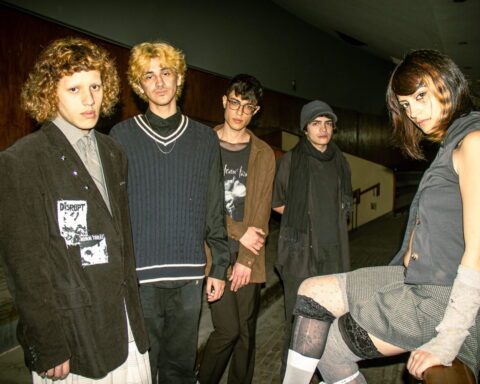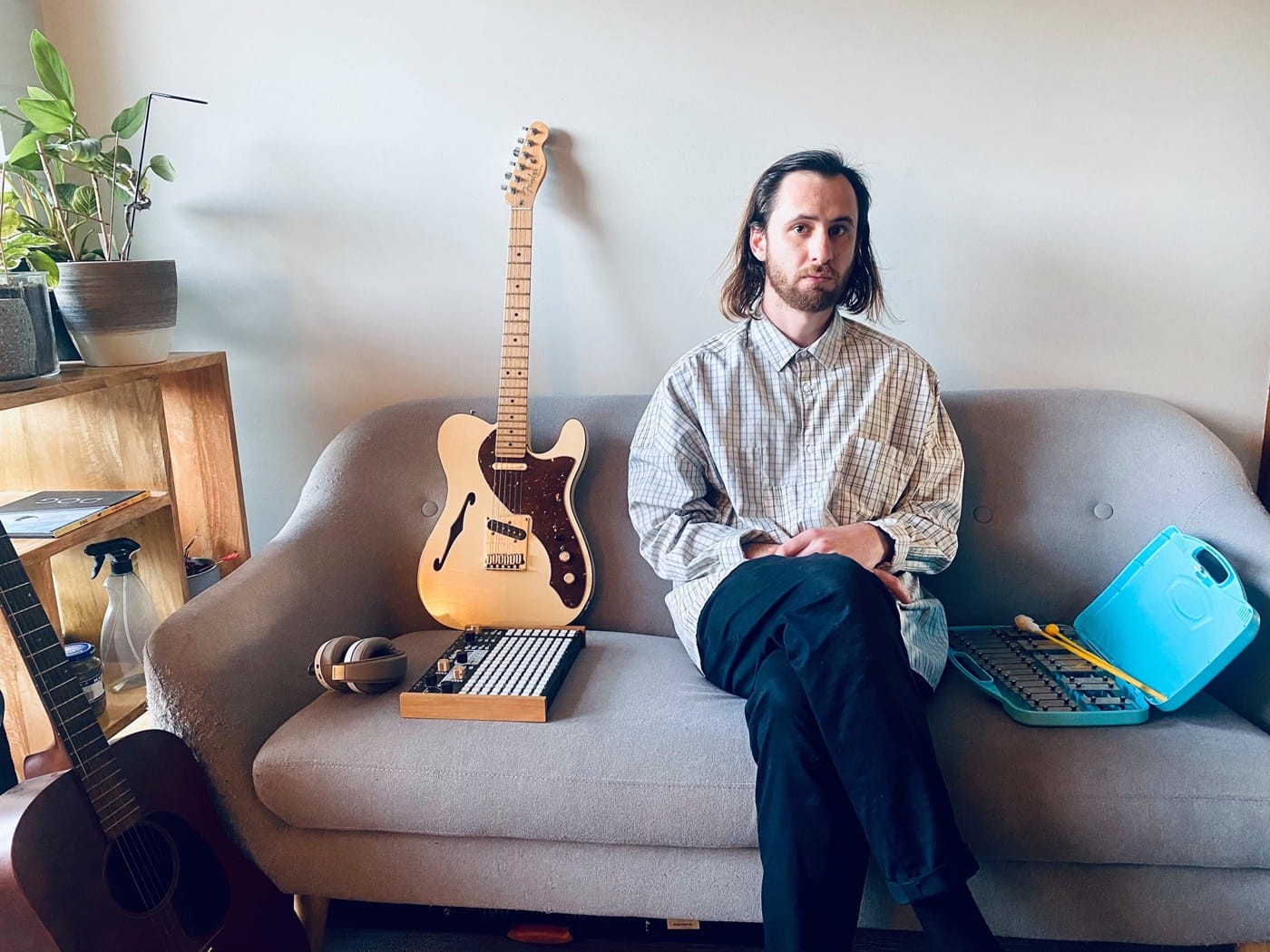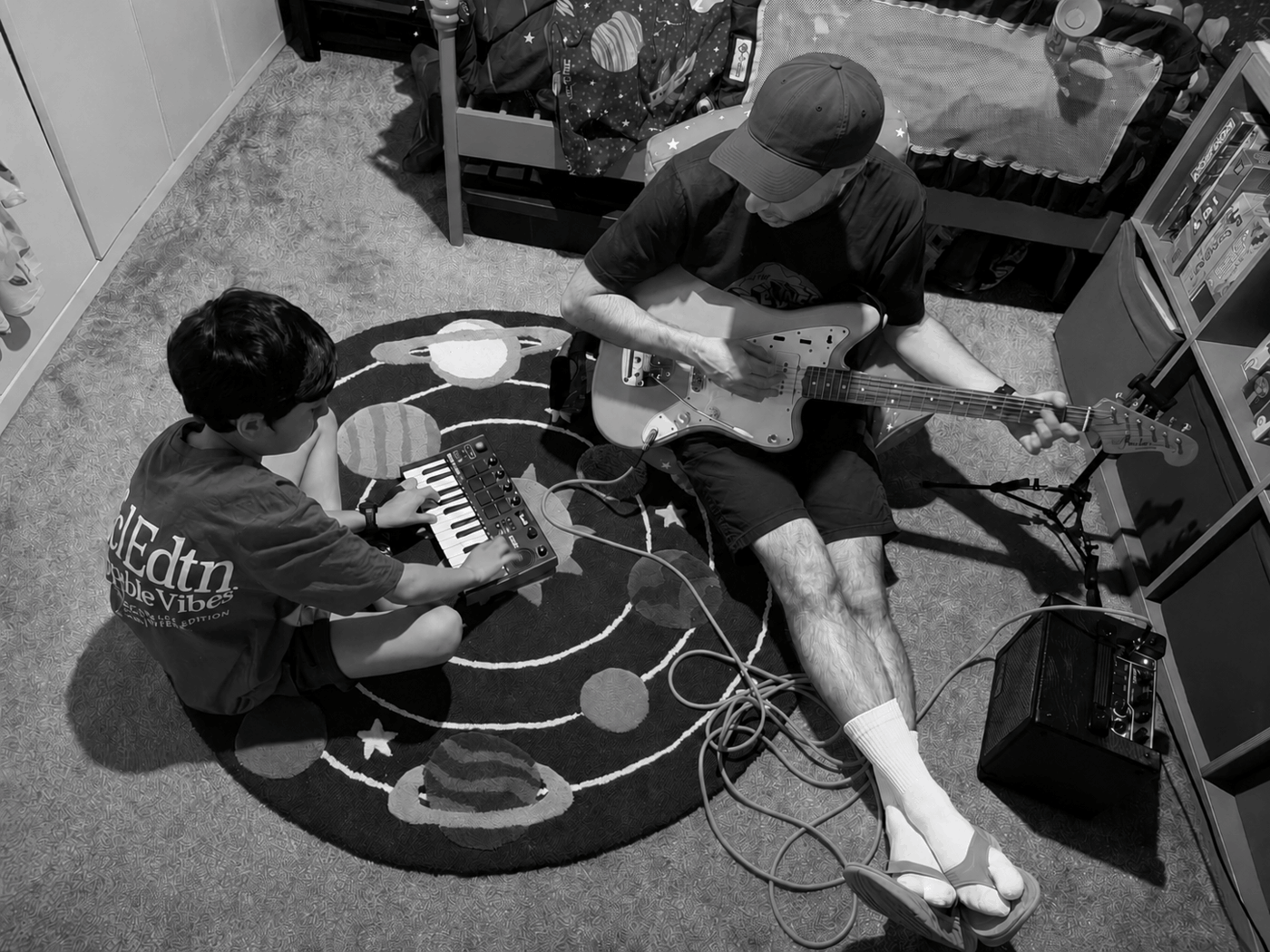


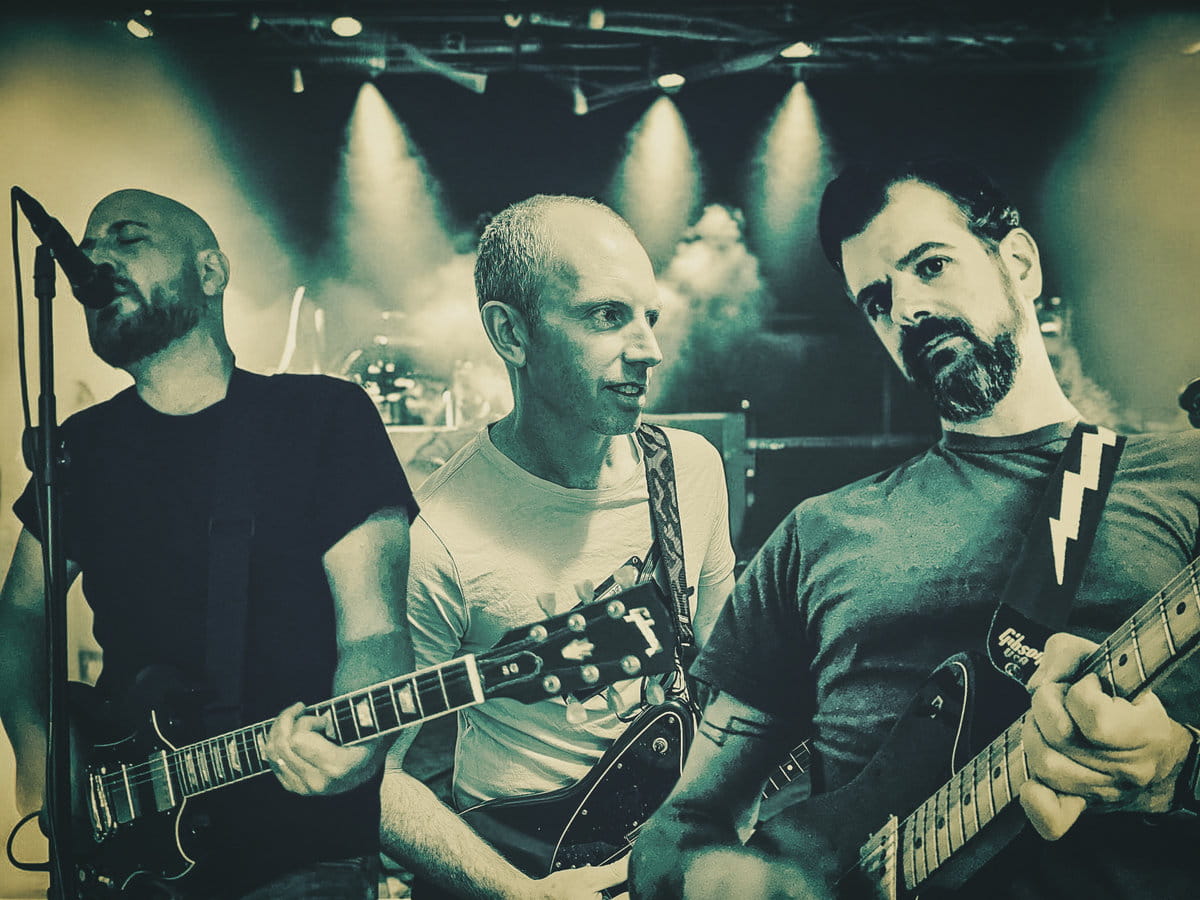
Break To Broken still carry plenty of the clipped guitars, restless rhythm and punk economy that first connected them through Fugazi and the wider Dischord orbit. On “The Hope Experiment“, that shared vocabulary has produced a 12-song LP made across three home setups and now being distributed by four independent labels in four countries.
The three people responsible for it still have never occupied the same rehearsal room. By now, that is barely the interesting part.
When we first spoke with them in 2022, the unusual part was obvious. Australian musician Clinton Maher had gone looking for collaborators through a Fugazi Facebook group in 2020. Eli Nowak and Justin Rauschkolb answered from the US, and a band slowly took shape through messages, home recordings and exchanged files. Eli and Justin came out of the 1990s New Jersey punk scene, while Justin has also long been based in Virginia. Break To Broken‘s Bandcamp currently gives Richmond as their location, but the normal hometown shorthand has never been especially useful here.
Six years later, their second full-length, “The Hope Experiment“, arrives August 14 with 12 songs and roughly 35 minutes of music. Its transparent green 12-inch vinyl edition is being handled by Engineer Records in the UK, Scene Police Records in Germany, Pasidaryk Pats Records in Lithuania and Coffin Curse Records in the US.
The four-label arrangement is probably a better way into Break To Broken in 2026 than telling the remote-band origin story all over again.
“For us, it really came down to working with others who align with the DIY and community aspect of what we do, along with just the practical efficiency of it,” Justin says. “By partnering directly with a few indie labels, we were able to press the vinyl collectively for a fraction of what it would cost to do it all ourselves and handle distribution after the fact.”
The idea developed through conversations with their friend Craig Cirinelli and then David Gamage of Engineer Records. David had experience with cooperative releases of this kind and introduced the band to the other labels.
“Coordinating across four different labels naturally took a lot of back-and-forth and communication, but we all generally operate from a similar headspace so it came together nicely,” Justin continues. “Everyone was engaged, supportive, and aligned in their vision. It was an incredible experience, and we’re honored to partner with labels that share our exact spirit.”
Strip away the romantic language commonly attached to DIY and the practical system is pretty simple. Several independent labels share the expense of manufacturing a record, stock ends up in different territories without one band having to solve worldwide distribution alone, and existing personal relationships hold the arrangement together.
Engineer Records already had history with Break To Broken through “The War on Sparrows”, “White & Gray + 2” and “No Care + 2”. What has changed is the size of the network surrounding a band that still insists on making the actual recordings itself.
Wyświetl ten post na Instagramie
Back in 2022, Justin described their early songwriting in almost improvisational terms. An idea arrived and nobody was meant to become too precious about it. Members played outside fixed instrumental jobs and learned what everyone else could do while the band itself was still taking shape.
They are asked about working remotely all the time. Apparently, they are not bored with the subject yet.
“We get asked about this a lot, but don’t ever get sick of talking about it because it really is in the DNA of this band,” Justin says. “Collaborating in person can be tough enough, so the fact that we’ve never all been in the same room together feels pretty remarkable.”
The mechanics have become much clearer over six years.
“I’d say the foundation of it all comes down to trust, mutual respect, and willingness to let go of your ego,” he says. “None of us are obsessed with controlling the direction of a song or anything like that.”
Wyświetl ten post na Instagramie
A new song can enter their group chat as a rough skeleton, a couple of riffs or something close to completed. The other two are expected to interfere with it. A guitar part might change. Somebody adds a bassline. A scratch vocal might point the song somewhere else.
“Once shared, the expectation is that the others will dive in and add whatever they feel elevates the song, whether that’s a new guitar part, a bassline, or a scratch vocal.”
This fairly open system has gradually produced recognisable finishing roles. Justin normally records the final bass tracks. Eli records the finished drums. Eli and Clint handle most of the vocals, and all three members play guitar across much of the band’s work.
Once they agree on an arrangement, whoever brought in the original song usually takes charge of the lyrics. Final vocals and drums are exchanged along with re-amped guitar files. Clint mixes and masters everything.
“This is all coordinated via back-and-forth and file-sharing in our group chat,” Justin says.
There is no dramatic technical breakthrough hiding in there. It is a group chat, file transfer, three home setups and enough trust to let somebody rewrite the thing you started. The interesting change since those first IDIOTEQ conversations is how ordinary it has become for them.
“The Hope Experiment” collects “Over & In”, “Scofield”, “John’s on the Money”, “Eyes Black Out”, “The Tightrope”, “Sine | Cosine”, “Breaking”, “American Ghosts”, “Marching West”, “My Best Friend”, “Impossible Colors” and “Cognitions”. “Over & In” was the first song released from it in June.
The band’s own shorthand still points back to the post-punk and punk records that first connected them, particularly the economy and rhythmic movement associated with 1990s Dischord releases. Their release notes describe the new songs as controlled, angry and groove-heavy. Fugazi remain an obvious common reference, although six years of Break To Broken history have made the family tree much wider than that one name.
The title is where “The Hope Experiment” starts doing some work of its own.
Clint has long been interested in social events, movements, ideologies and historical experiments. Those interests have now supplied the names of both Break To Broken albums.
“I’ve always had a fascination of sorts with social events, movements, ideologies… experiments etc,” he says. “I find there’s much to be learnt from looking back through these things, and it turns out they’ve been the inspiration behind both of our album titles so far.”
“The Hope Experiment” refers to research associated with Johns Hopkins psychobiologist Curt P. Richter. The popular internet retelling is much cleaner than the actual work.
“‘The Hope Experiment’ is of course referencing the infamous ‘science’ experiment of the same name,” Clint says, putting “science” in quotation marks himself, “and it’s something unfortunately that I feel has a lot of parallels within modern society.”
Richter’s 1957 paper was called “On the Phenomenon of Sudden Death in Animals and Man“. It dealt with extreme stress, restraint, sudden death and the physiological response of animals placed in situations from which they apparently could not escape.
The viral version commonly turns it into a tidy lesson about rats being rescued, acquiring hope and then swimming vastly longer because they believed somebody might save them again. That is a heavy simplification. Richter did report that animals which repeatedly experienced brief restraint followed by release, or immersion followed by removal, subsequently behaved differently and continued trying to escape for much longer. “The Hope Experiment”, however, was not the name of his paper, and the familiar inspirational version came later.
That messier history actually sits closer to what Clint is talking about.
“Song #3 on the album, ‘John’s on the Money‘, explores some of this further, looking at how and why some of the themes and lessons from The Hope Experiment are still highly relevant today.”
He does not specify a single institution, government or social problem as the song’s target, and there is no reason to invent one for him.
“Ultimately whether you take the results of that experiment as a positive or a negative it’s still highly interesting and I can’t help but feel there’s a direct correlation with today’s world and the fact that still today resilience can only get you so far.”
That final sentence is a long way from the motivational version of Richter’s story. Endurance is useful until the conditions demanding endurance keep winning.
There is another history running through Break To Broken’s records, one they have assembled through covers.
Their name comes from “Break to Broken” by One Last Wish, the short-lived Washington, DC band featuring Guy Picciotto, Brendan Canty, Edward Janney and Michael Hampton. Break To Broken later recorded One Last Wish’s “My Better Half”. They have also taken on Jawbox’s “Breathe”, Fastbacks’ “We Tried” and Heatmiser’s “Wake”.
“You’re right, our band name and those covers aren’t random choices,” Eli says. “When considering covers, we pick songs we genuinely love, but also ones that reflect the sound and spirit that brought us together as a band. We enjoy putting our own spin on them, rather than simply recreating the originals.”
Their version of Jawbox’s “Breathe” uses all three voices. “My Better Half” and “Wake” gave Eli and Clint room to trade lead vocals.
“While each of us brings different musical influences to the table, we always find common ground in the bands, era, and scene that continue to inspire us.”
It makes the covers useful as an unofficial map of Break To Broken’s ancestry. Fugazi sit in there, obviously, but so do One Last Wish, Jawbox, Fastbacks and Heatmiser. Screamfeeder enter from another direction entirely.
The story behind “Wake” is particularly personal for Eli.
“Wake” had already appeared as a standalone single on April 17, 2026, several months before “The Hope Experiment”. The Heatmiser cover was released across streaming platforms, while the band directed listeners towards Bandcamp, where 100% of purchase proceeds go to the Patient Access Network Foundation to help people facing serious illness with treatment costs.
“Elliott Smith has long been one of my favorite artists, and I fell in love with Heatmiser after discovering them decades ago,” he says. “I’d wanted to cover their song ‘Wake’ for years, and Break To Broken finally felt like the right band to do it.”
They recorded its basic tracks a couple of years ago and then left it unfinished.
In September 2025, Heatmiser drummer and producer Tony Lash was diagnosed with cancer. Around the same period, Eli learned something about Lash’s life outside music that he had not expected. Lash had become a mental health therapist. Eli works in the same profession.
“Earlier this year, Heatmiser announced that drummer Tony Lash was battling cancer. Around the same time, I learned that Tony had become a mental health therapist, a profession I share. As a longtime admirer of both his drumming and production work, I reached out to introduce myself. He responded immediately and couldn’t have been kinder.”
That exchange gave the unfinished recording another reason to exist.
“Inspired by that connection, we completed our recording of ‘Wake’ as a tribute to Tony and Heatmiser.”
Break To Broken released it through Bandcamp on April 17, with purchase proceeds donated to the PAN Foundation, an organisation that helps people facing serious illnesses with treatment and medication costs.
“We hope Heatmiser and Elliott Smith fans enjoy our interpretation.”
The path towards Mike Watt was even more old-fashioned.
“Mike Watt has been one of my musical heroes for decades,” Eli says.
He had been reading Watt’s online tour diaries, which Watt calls his “hoot page”, when he noticed a postal address.
“After reading some of his tour diary entries on his website (‘hoot page,’ as he calls it), I noticed his P.O. box and decided to mail him our record along with a letter thanking him for the incredible music he’s made and sharing a bit about our band.”
Eli added that if Watt ever wanted Break To Broken on “The Watt From Pedro Show”, they would gladly do it.
A few weeks later Watt emailed him. He had received the record and invited the trio onto the show.
“We had a great time sharing our story and getting to know him. Afterward, I thanked him again and asked if he’d ever consider contributing to one of our songs. He enthusiastically agreed, and the rest is history.”
Watt eventually played bass on “No Care“, released in 2025. Break To Broken have since appeared on his programme again.
“It’s been a privilege to collaborate with someone we’ve admired for so long, and we’re honored to call him a friend of the band.”
The whole chain could almost have happened decades earlier. Somebody reads a musician’s diary, finds a PO box, posts a record and a letter, gets invited onto a radio show and eventually asks the same person to play on a song. It just happened to a group whose everyday songwriting depends on digital files crossing an ocean.
Tim Steward’s involvement came from a much older relationship.
“I’ve been a fan of Screamfeeder since the mid 90’s when I got into ‘proper’ music,” Clint says. “Ever since hearing them for the first time Tim has been one of my favourite singers, and Screamfeeder one of my favourite bands.”
Clint played in a band with his brothers during the 1990s and 2000s, and they supported Screamfeeder a couple of times. He continued seeing the band and stayed loosely in touch with Tim through occasional emails and texts.
“I’d long wondered if he might consider playing on a song of mine, and once Break To Broken had a couple of releases under our belt it felt like the time to finally ask, and luckily Tim agreed.”
The result was “White & Gray“, which we covered when Break To Broken released “White & Gray + 2” in 2024. Clint and the band did not simply hand Tim an existing part.
“We tried to deliberately pen a song that had elements of both Break To Broken and Screamfeeder, and the process even included me singing a demo version of Tim’s part and putting on my ‘Tim voice’.”
He is still pleased they got to do it.
Those connections make the band’s relationship with DIY a little more interesting than self-sufficiency for its own sake.
Eli’s version is mostly about finding a system that keeps working and noticing who has accumulated around it.
“Looking back, it’s been really rewarding to see what we’ve built together over the years. We found a creative process that just clicks, and it’s led to music we’re all genuinely proud of.”
He points to connections with musicians they once listened to from a distance, small labels and radio supporters as one of the things keeping the project alive.
“We’re always open to new ideas and pushing ourselves creatively, but we also believe there’s something to be said for sticking with what works.”
Clint comes at the same question from a slightly harder DIY position.
“Honestly for me the DIY element is perhaps the most important element of the band. We set out to do things that way initially and it’s been very rewarding to stick to.”
They write the songs themselves, record them, mix and master them. Promotion stays largely inside the band, even if operating remotely makes that side of things slightly unusual. They run their own social media, make the artwork and arrange releases.
“I can happily say that the DIY line so to speak hasn’t really been tested so far. We’ve been able to do essentially everything ourselves.”
He knows the obvious question is sitting there. Another engineer might mix a song differently. Outsourcing parts of the process could produce a cleaner or technically “better” result.
“It might be easy to have that thought of ‘would things turn out better if we got other people involved?’ ie having someone else mix our songs etc but I feel this is a bit of a unique band and doing everything ourselves contributes to that.”
That slight difference between Eli and Clint is probably worth keeping. Clint talks about protecting a method. Eli talks about the relationships that method has allowed them to build. Neither requires Break To Broken to operate alone.
Their history makes the distinction pretty concrete.
In 2020, three strangers met through a shared interest in Fugazi and started trading files. By “The War on Sparrows” in 2022, they had decided the result was a band, whether or not anybody had stood next to anybody else while recording it. “My Better Half +2” pulled One Last Wish directly into their catalogue. Tim Steward appeared on “White & Gray”. A record mailed to Mike Watt eventually led to him playing bass on “No Care”. An unfinished Heatmiser cover became a benefit after Eli contacted Tony Lash. Now four independent labels are dividing the cost and physical distribution of their second LP.
Break To Broken have therefore become less isolated as their DIY method has become more settled.
The creative part remains inside three home studios. The structure around those rooms keeps filling up with other people.
Perhaps that is the more interesting Break To Broken experiment in 2026. They already know three musicians can make a band without sharing a room. Six years later, they are finding out how large the circle around that band can become without giving away the things they still want to do themselves.
“The Hope Experiment” arrives August 14 on transparent green 12-inch vinyl and digitally.
🔔 IDIOTEQ is ad-free, independent, and runs on one person’s time. If you want it to stay that way: DONATE via PayPal or SUPPORT via Patreon.
NEW: IDIOTEQ Explore 🗺️ Browse 15+ years of our archive by city, country, and style. Find artists on the world map or trace related sounds through the styles map.
Stay connected via Newsletter · Instagram · Facebook · X (Twitter) · Threads · Bluesky · Messenger · WhatsApp.