

San Francisco-based musician Christian Molenaar has made plenty of difficult, noisy and unpredictable music over the years, but his new album, “Jeremiah XVII“, also goes into some territory I personally love. There’s jazz, soul, gentler passages with an almost chillout feel, touches of classical music, and some lovely country guitar playing. Then the electronics start misbehaving, the fuzz kicks in, or a rhythm turns up that you probably wouldn’t expect from the previous song. It’s a wonderfully eclectic record, and we’re pleased to premiere all eleven tracks here on IDIOTEQ.
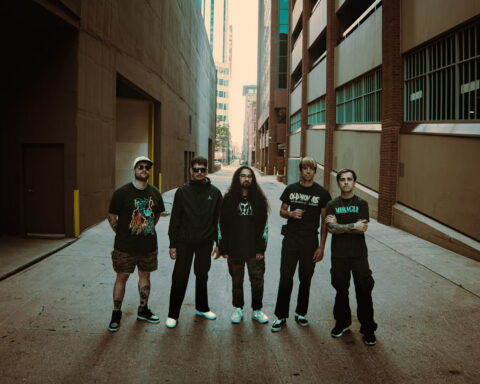
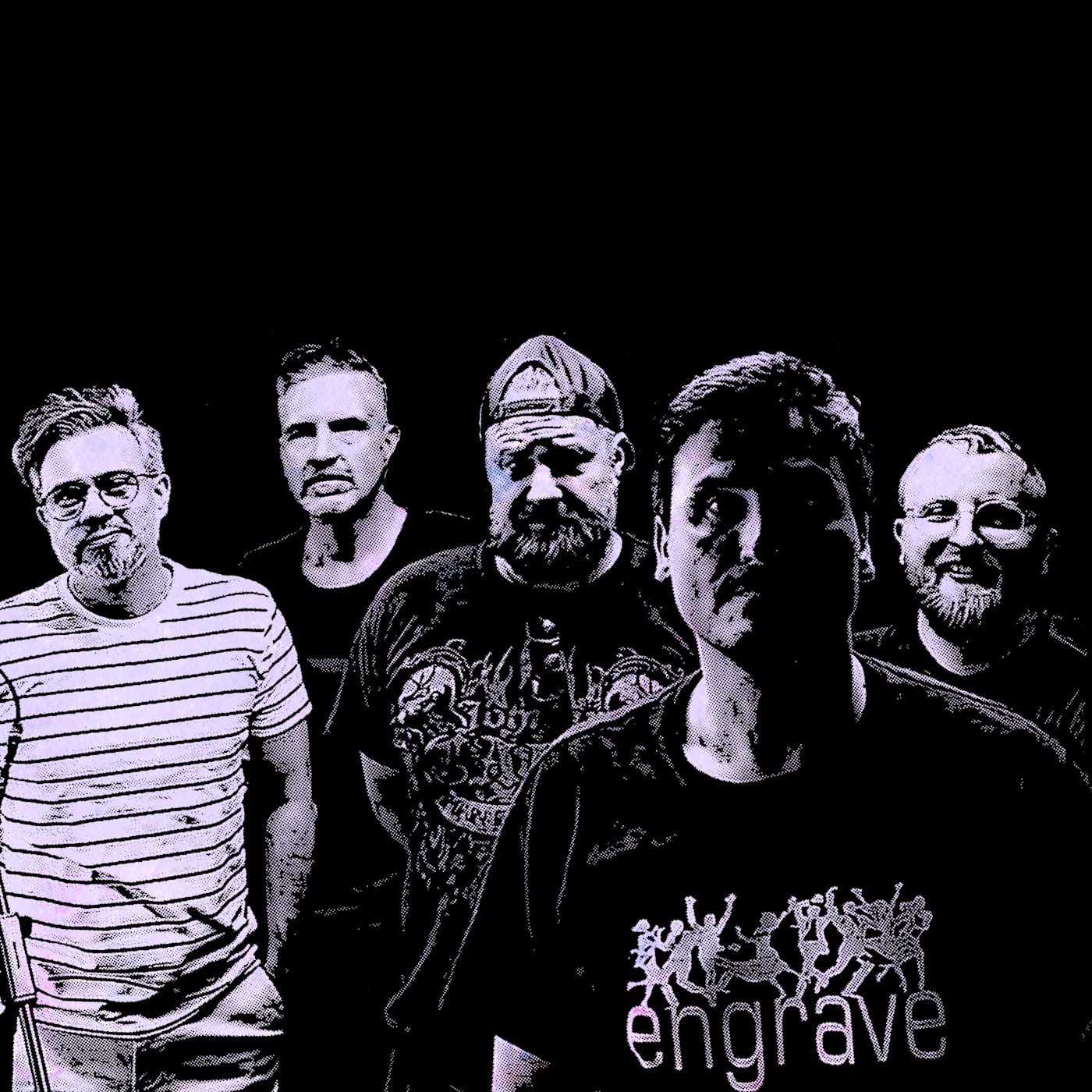
Some of that range will make sense if you’ve followed Christian’s work through Executioner’s Mask, Crowhurst, Those Darn Gnomes or Round Eye, all acts we’ve covered on these pages.
His own records give him even more room to wander. “Jeremiah XVII” takes his interest in experimental rock, country, home-built synthesizers and soulful guitar music into a collection of surprisingly direct songs about relationships, loneliness and some difficult personal decisions. Christian has spent most of 2026 working on music, making films and travelling, and the album grew out of what happened to his life along the way.
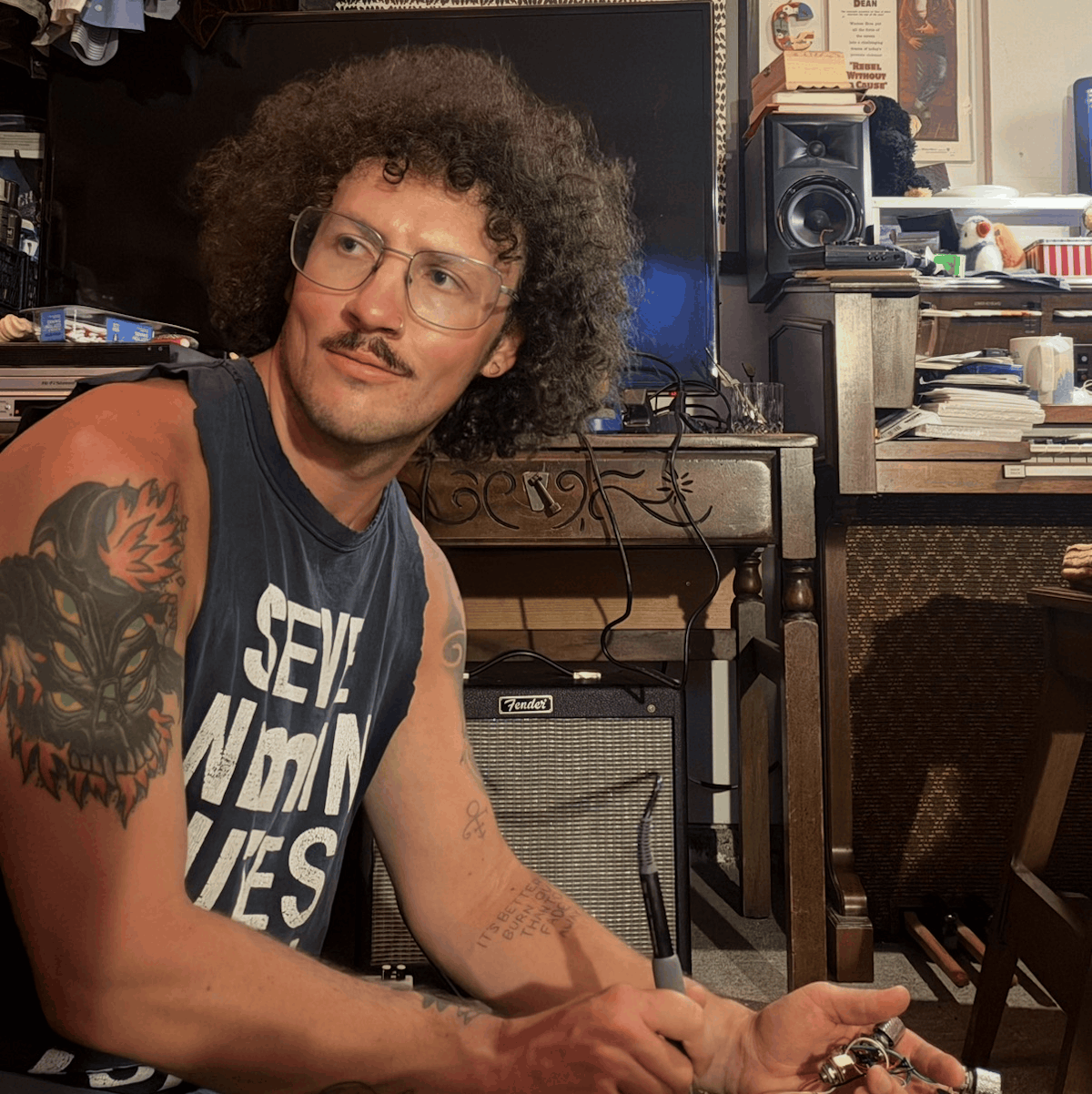
He’s been calling it his “Year of Yes”, a period of taking almost every creative opportunity that came his way. In February, he released “Musaceae Equinox”, an ambitious orchestral prog album on which he played every instrument, moving through chamber music, post-punk, math metal and country. There was also “Further Into the Corner”, his avant-garde jazz trio recording with cornetist Dan Clucas and drummer Nathan Hubbard, and “no toques las megarhyssa”, a hip-hop record he produced with rapper Tall Can.
Between those releases, he toured with Berkeley hardcore veterans Fang and Shanghai punk band Round Eye, travelling across multiple coasts with musicians from China and the US. He also continued making films. His experimental short “Strophische Gedichten”, inspired by the life and writing of the thirteenth-century Flemish mystic Hadewijch of Brabant, premiered through the University of London’s Religion & Art series, while his filmmaking reached festivals across Europe.
It’s a remarkable amount of work for one year, even by Christian’s standards. Originally from San Diego, he’s played on nearly 200 recordings and has worked across free improvisation, harsh noise, metal and experimental music. His collaborators have included Xiu Xiu, Kazumoto Endo, Locrian and members of Ramleh, Deafheaven and Full of Hell, while his live work has brought him together with musicians including Patrick Shiroishi, Tatsuya Nakatani and Martín Escalante. He also led Those Darn Gnomes between 2013 and 2022.
“I’ve been calling it my ‘Year of Yes,’ in which I take up every opportunity that comes my way, and it’s paid off massive creative dividends,” Christian says. “Artistically speaking, it’s the most fulfilling year I’ve had since Covid first locked us down. On a personal level, I’ve been an absolute mess.”
The travelling and constant attention to his work have cost him close friendships, romantic relationships and regular employment. He spent long stretches sleeping on strangers’ sofas, stopping at truck stops and driving between cities, often with little company besides his own thoughts.
“I don’t mean to romanticize the loneliness of the long distance rocker,” he writes, describing time spent in truck stop bathrooms and on strangers’ couches. “Quelle surprise: I started writing songs about it.”
Those songs accumulated without any particular album plan. By the time he had enough to make another record, he had also found a title in Jeremiah 17:9, the biblical passage about the heart being deceitful and almost impossible to understand.
Back in February, around the release of “Musaceae Equinox“, Christian had suggested he might take a break from making music under his own name. A few months later, there was another full-length. The earlier album had been written during a period of falling in love, and its arrangements leaned heavily on piano, strings and horns. “Jeremiah XVII” followed the relationships that came apart afterwards, with crackling electronics and heavily distorted guitars playing a much larger part.
“If Musaceae Equinox was the sound of falling in love, this broken transmission is the sound of its doomed fallout.”
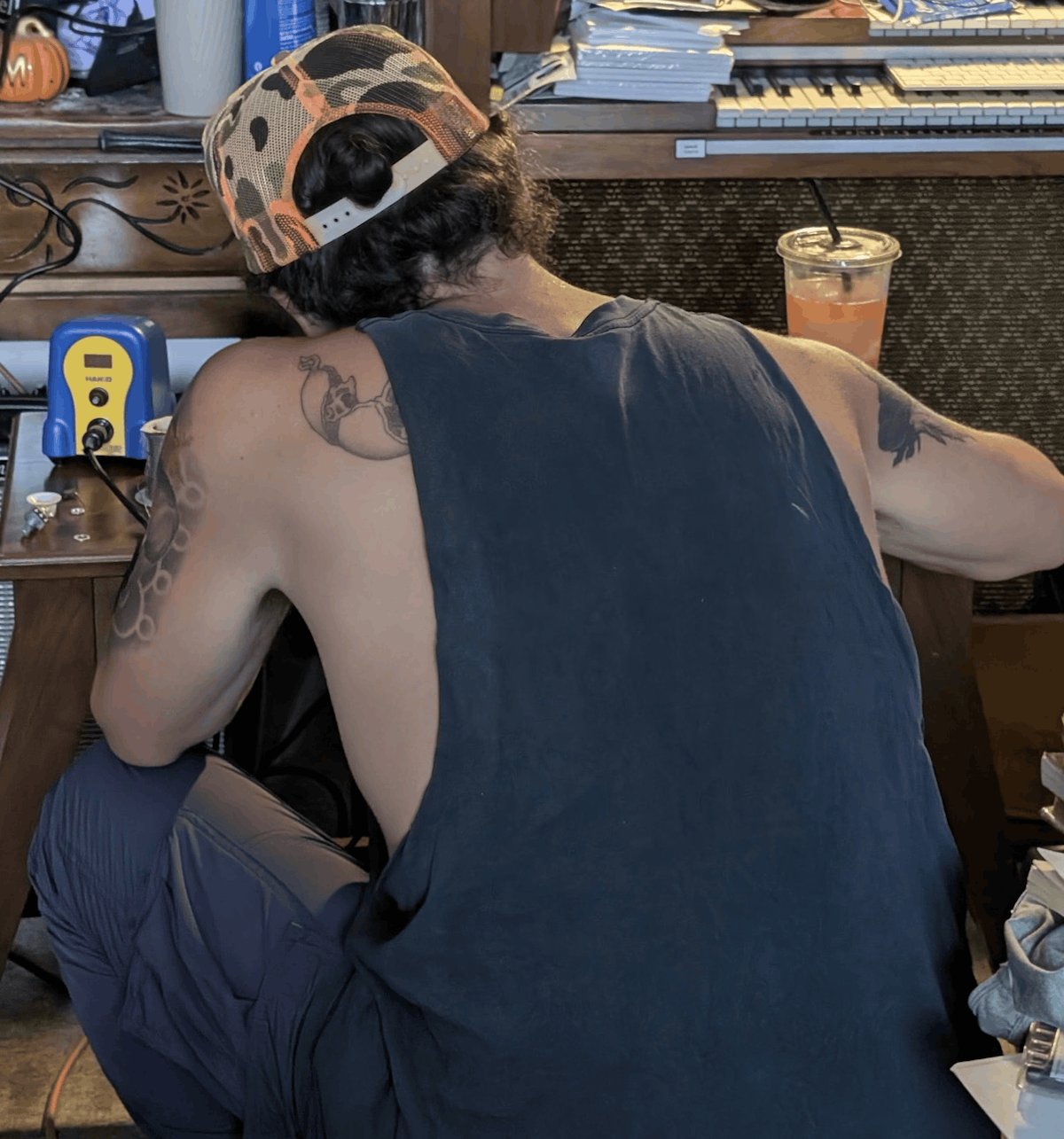
The new album also gave him an excuse to spend a lot of time with a soldering iron.
Christian has been building and modifying his own musical equipment for years, but he wanted considerably more control over the sounds on these songs. Between tours, he stayed home making microphones, synthesizers and guitar pedals, often starting with salvaged parts and designing a particular device around the sound he needed.
“I needed to get further inside the sound,” he says, “to really inhabit the process.”
One of his main guitars was a Yamaha Stratocaster copy with the neck pickup bypassed and the tone control replaced by a reverse avalanche oscillator. Switching to that pickup position activates a crude sawtooth synthesizer, with the knob providing loose control over the pitch. Changing the capacitor changes the speed of the oscillation. It’s a relatively simple circuit, and Christian has already thought about taking it further, possibly putting three or four oscillators into something like a Gibson ES-5.
Another set of homemade devices gave the record some of its strangest recording artefacts. He assembled electret microphones from salvaged components, held them together with duct tape and used them on much of the album. The results weren’t always clean. There are pops and crackles that Christian compares to an old, worn-out LP, along with occasional digital screeches that ended up staying in the recordings.
On “Your Big Mistake“, the distortion comes from a germanium fuzz circuit running at an unstable voltage. Christian enjoys the spluttering quality that results when the transistors are incorrectly biased. He had used a similarly pretty melody on “Bound” from “Musaceae Equinox”, and once again decided that a gentle song needed a thoroughly damaged guitar sound.
“I have a special weakness for tones with ‘character,’ especially ones that sound like they’re rotting away,” he says.
He had fallen heavily into Afghan Whigs while recording, particularly their soulful 1990s alternative rock and use of slide guitar. There’s also Converge in the song’s closing bridge, specifically “Axe to Fall”, although Christian reckons his version ended up closer to Smashing Pumpkins.
The song came from a recurring problem in his relationships. Some had continued for far too long, even when he knew they weren’t going anywhere. The hardest were the ones involving someone he genuinely cared about.
“This song is about realizing, due to circumstances completely unrelated to either of you, that you could never be with the person to whom you want to completely give yourself. I guess that’s always my big mistake.”
Something similar runs through “Older”, which was the first song Christian started for the album and the last one he managed to finish. He couldn’t work out what to do with its second verse until he realised he’d be happier replacing it with a long David Gilmour-style guitar solo, drenched in reverb.
The chords owe something to Sticky Fingers’ “Where I’m From” and Jeff Buckley’s “Lover, You Should Have Come Over”, particularly their use of the flat-five chord. Elsewhere, he was thinking about 1990s country bands such as Shenandoah and the dream pop of Cocteau Twins. Emmylou Harris’s “Wrecking Ball” is one of the few records he knows that brings those two styles together in quite the way he likes.
“Older” is among the more straightforward songs on “Jeremiah XVII”, although Christian couldn’t resist changing the rhythmic subdivision between verse and chorus.
“I’m a prog guy!”
That combination of accessible songwriting and peculiar technical decisions is what he means when he talks about “Jeremiah XVII” as a pop record. Country songs can have metric modulation. A melody with a strong emotional pull can be covered in malfunctioning fuzz. A circuit-bent keyboard can supply the foundation for a song that ends up dealing with something deeply personal.
“Hallway” is one of the more aggressive examples. Christian calls this his least metal solo album in years, joking that his mother finally gets a record without blast beats, but he still wanted one particularly heavy track. A modified Casio supplied the bassline, and he recorded several layers of screeching optical theremin for the solo section.
Both the theremin and guitars went through the Despiser, a fuzz pedal he built for his friend Lucas Broyles. Its name comes from Philip J. Cook’s film “Despiser”.
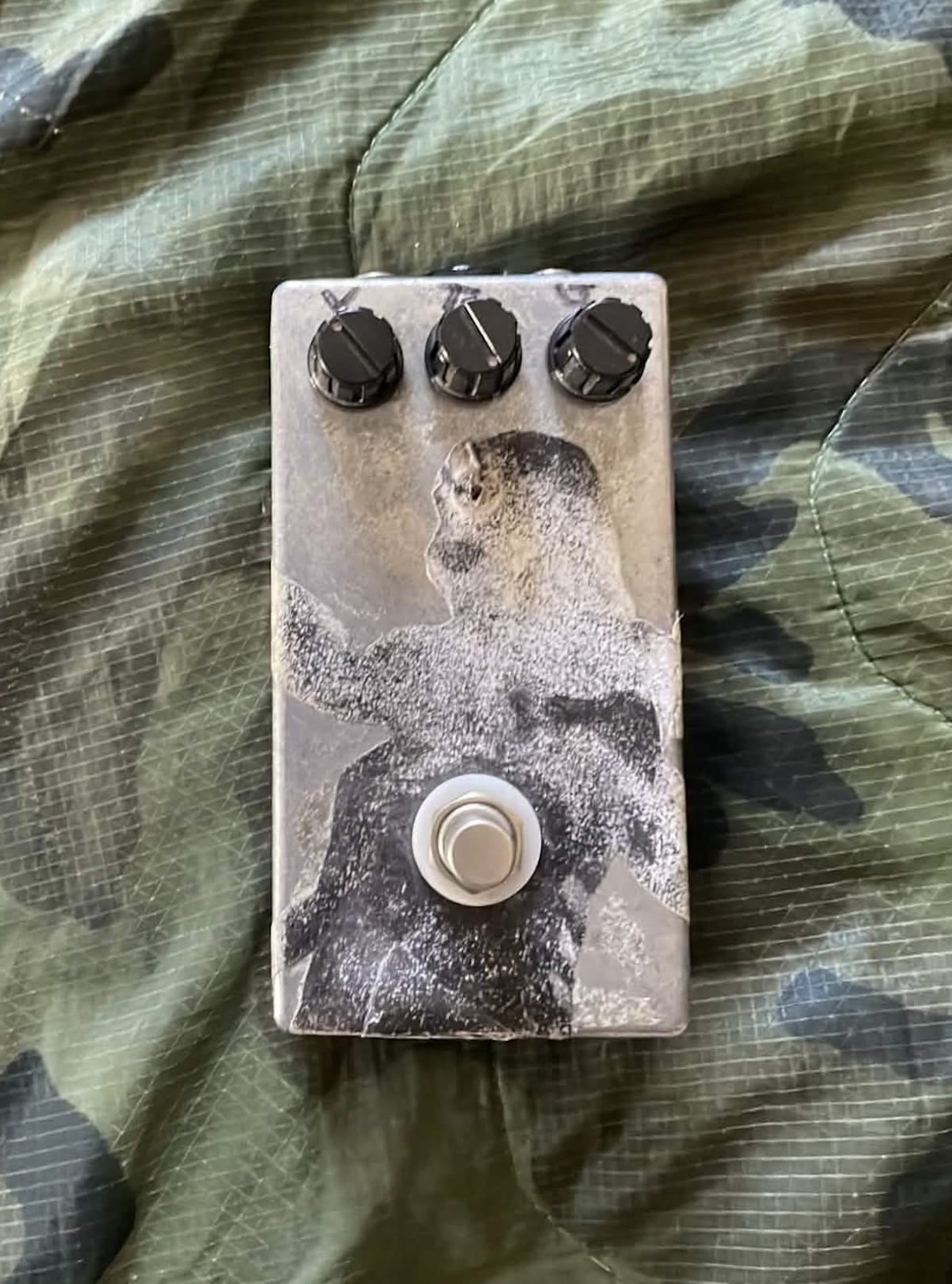
A fair bit of Christian’s writing also comes from books and films he’s lived with for years. He’s quite happy to follow an idea from a philosopher into a recording session, or use a scene from a film to think through something happening in his own life.
The opening track, “Right Now, Wrong Then”, takes its title from Hong Sang-soo’s film about filmmaker Ham Cheon-soo and painter Yoon Hee-jeong. One of its uncomfortable exchanges involves Cheon-soo criticising Hee-jeong’s work for being too concerned with comforting its creator. Christian is interested in that awkward honesty, and in Hong’s willingness to examine himself through the people in his films.
He connects Hong’s approach with Roland Barthes, particularly the idea that releasing a work risks fixing an artist’s identity in the public mind. Once an audience has decided what kind of artist someone is, continuing to change becomes its own challenge. Christian’s constant movement between bands, film, improvised music and solo songwriting makes that a fairly familiar concern.
Hong has directed roughly 35 features over three decades, often making films about his own experiences and about filmmaking itself. Christian places him in the company of directors such as Caveh Zahedi and Ross McElwee, who also bring their personal lives directly into their work. He admires the way Hong’s self-criticism avoids the self-pity he associates with some of Woody Allen’s filmmaking.
The practical side of Hong’s method interests him just as much. The director frequently writes his scripts on the morning of a shoot, arriving with little advance planning and giving the actors almost no rehearsal time. Christian connects this to Edmund Husserl’s idea of attending to “that which is given”, working from what is present instead of making assumptions about things beyond immediate experience.
Thoreau appears in the film too, through an encouragement to keep discovering things in everyday life and remain attentive to the present moment. Christian brings all these references into his thoughts about making art while events are still happening around him.
That might sound like a lot to fit behind a pop song, but “Achilles and the Tortoise” goes considerably further.
Its title refers to Zeno’s paradox, in which Achilles can never quite overtake a tortoise that has been given a head start. For Christian, it connects with William Gaddis’s writing about art, public recognition and the position of artists in society.
His 2025 album “Folies Meurtrières” had already drawn on Gaddis’s final novel, “Agapē Agape”, in which a dying narrator discusses how technology, particularly the player piano, helped mechanise artistic production. Christian finds obvious parallels in today’s streaming economy and the arrival of AI-generated music.
He also takes an idea from Gaddis about the futility of pursuing fame in a society that places relatively little value on art. The artist can remain outside the race for dominance, watching how power works and finding something useful in what gets left behind.

The lyrics bring in several poets Christian has been reading, including Yehuda Amichai, Aharon Shabtai, Dahlia Ravikovitch, Meir Wieseltier and Natan Zach. He connects their Hebrew-language writing with opposition to the occupation of Palestine. Polish poet Czesław Miłosz is another important reference, particularly his poem “Longing”, which Christian draws on in the first verse. Miłosz’s experience of political opposition, exile in France and eventual move to the United States also interested him.
Yet the actual recording of “Achilles and the Tortoise” happened almost by accident. A circuit-bent keyboard provided the bassline, Christian added a simple guitar part, and he pressed record intending to improvise a rough melody. The lyrics came out straight away.
“I never planned to write this album, and I almost feel like I didn’t; this track in particular feels like it was given to me in a trance.”
His long-standing interest in experimental cinema comes through particularly clearly on “The Dead”. In San Diego’s Balboa Park, a carousel still contains an old military band organ that functions well enough to produce some rather uneven performances. Christian recorded it and used the stuttering sound beneath a passage of Stan Brakhage talking about vision and lines from James Joyce’s short story of the same name.
Wyświetl ten post na Instagramie
Joyce and Brakhage have been important to him since adolescence, when he discovered “Ulysses” and Brakhage’s “Dog Star Man” around the same time. He later played gigs with films such as “Dog Star Man” and “Begotten” projected behind his bands. His more recent filmmaking continues to use direct animation inspired by Brakhage, including working directly with film imagery.
It’s also where Christian’s work as a filmmaker, musician and reader comes together quite naturally. He’s spent years returning to the same artists through different media, taking an idea from one and trying it somewhere else. On this album, the carousel recording becomes part of a song alongside voices from Joyce and Brakhage.
By the time “Wander” arrives, the arrangements have become much sparser. The song was inspired by Machado de Assis’s “Life”, a dialogue between Ahasverus and Prometheus at the end of time. Christian was thinking about the experience of growing older and watching people drift in and out of his life. In Machado’s story, an almost impossibly long existence gives that experience a much larger scale. The song uses comparatively bare instrumentation to accompany those thoughts.
Another Latin American writer appears in “Ingeborg“. Christian adapted the opening passage of Roberto Bolaño’s novel “The Third Reich”, whose holidaying couple gradually find themselves caught up in something deeply unsettling. He also hears a connection to J. G. Ballard in the story. The song uses one guitar, a scratchy viola, a little piano and pedal steel, taking its time with a small number of instruments.
“Blue Eyes” goes in a different musical direction. Handmade and modified electronics had appeared in almost every previous track, with “The Dead” the exception, but here Christian pushes them to the front. The song initially has no acoustic instruments. Later, an adaptation of a poem by e. e. cummings gives way to returning trombones, recalling the orchestral writing of “Musaceae Equinox”, before heavily altered synthesizers dominate the arrangement again.
His work with Executioner’s Mask also makes its way back onto the album. “Ultraviolet” returns to a kind of post-punk songwriting he had been developing with that band, although there’s a particular story behind the rhythm.
John Darnielle of the Mountain Goats once praised early Executioner’s Mask for how faithfully they played old-school goth, a style with fairly strict musical conventions. Christian joined the group and subsequently helped introduce a reggaeton beat into the reverb-heavy post-punk of “Things Fall Apart”.
“I guess I’ve never been a rules-based guy,” he writes, joking that reggaeton rhythms suddenly seemed to appear in every fashionable goth band’s music after that release.
With Executioner’s Mask currently on a break as attention turns towards a new Crowhurst record, “Ultraviolet” gave him another chance to write in that general style. Its drums were taken from his earlier track “Spellvexit” on “Folies Meurtrières“, which itself had been inspired by Korean rapper Haon.
That kind of recycling happens throughout Christian’s work. An older beat becomes the basis for another song. An effect designed for a friend’s guitar turns up on his own album. The trombone writing of “Musaceae Equinox” returns in a record made under very different circumstances. Even with the enormous range of music he’s been involved in, there are plenty of connections between the projects.
For most of “Jeremiah XVII“, Christian handles the vocals, guitars, drums, viola, trombone, piano and synthesizers himself. He produced the entire album and wrote ten of its eleven songs. The exception is the closing “Please Come to Boston”, originally written by Dave Loggins.
Years ago, Christian wanted to start a country band with his brothers. Erik would play fiddle, Joe would handle fretless or upright bass, and Christian would play pedal steel and fretless guitar. They would sing harmonies together and work in just intonation, tuning their instruments according to pure intervals. “Please Come to Boston” was one of the songs he had always imagined them playing.
The band never quite happened, but his version here comes close to the music he had in mind. Lucas Broyles plays guitar and Russell Case contributes bass, while Christian takes the song into a pedal-steel country arrangement.
There’s a very personal reason he chose it. Loggins’s original follows a musician moving from place to place and asking someone to come along. Christian has spent the year travelling for gigs, recording opportunities and other projects, often far away from the people he wanted to be close to.
The recording was made live in Sequim, Washington, hundreds of miles from home. After everything that happened during his “Year of Yes”, the old song had become painfully relevant.
“Dave Loggins’s dirtbag rocker-on-the-road anthem has always spoken to me, but as someone who’s spent all year traversing the globe pursuing artistic opportunities at the cost of every one of my personal relationships it hits especially hard today.”
“Jeremiah XVII” arrives October 16, 2026, through Christian’s Bandcamp.
🔔 IDIOTEQ is ad-free, independent, and runs on one person’s time. If you want it to stay that way: DONATE via PayPal or SUPPORT via Patreon.
NEW: IDIOTEQ Explore 🗺️ Browse 15+ years of our archive by city, country, and style. Find artists on the world map or trace related sounds through the styles map.
Stay connected via Newsletter · Instagram · Facebook · X (Twitter) · Threads · Bluesky · Messenger · WhatsApp.