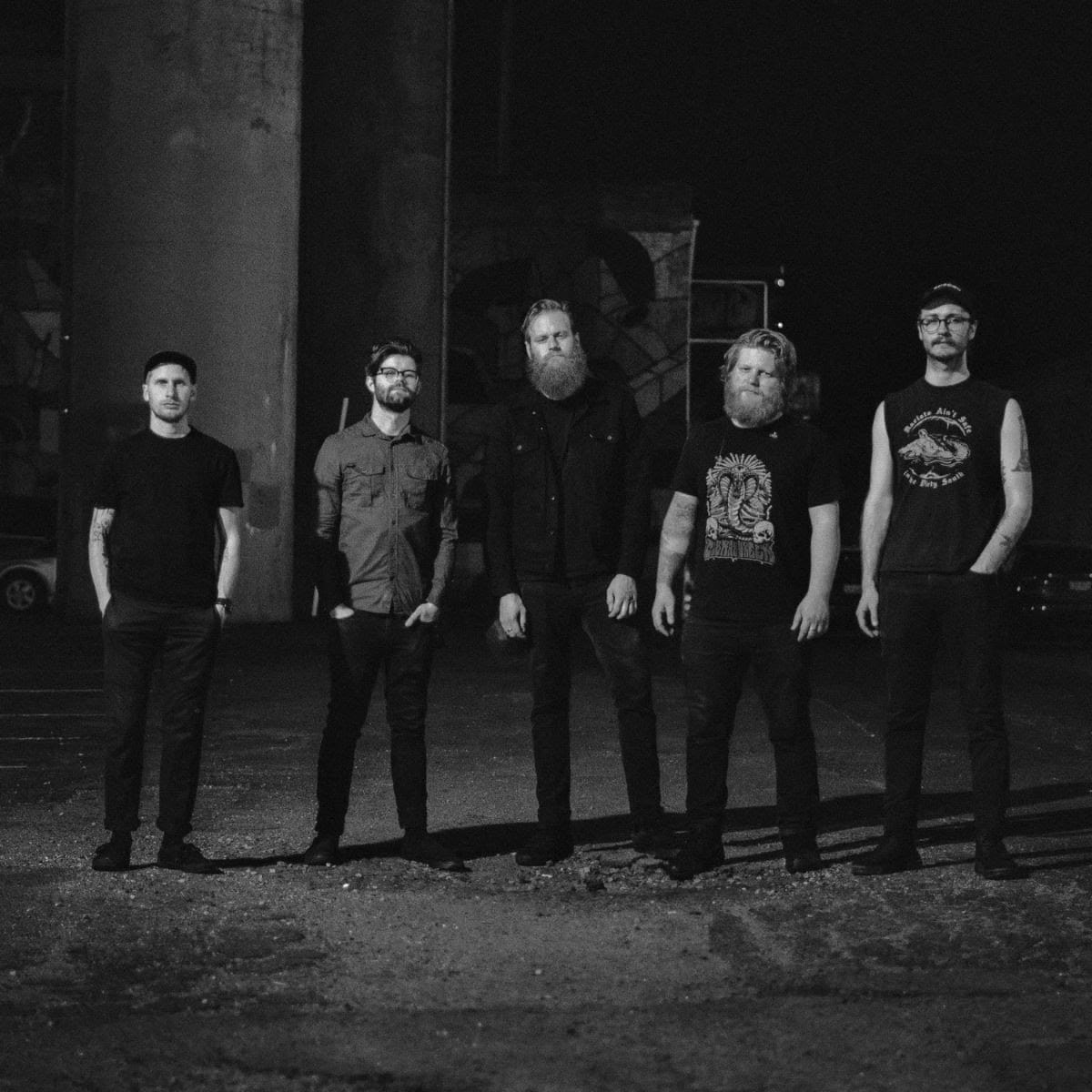


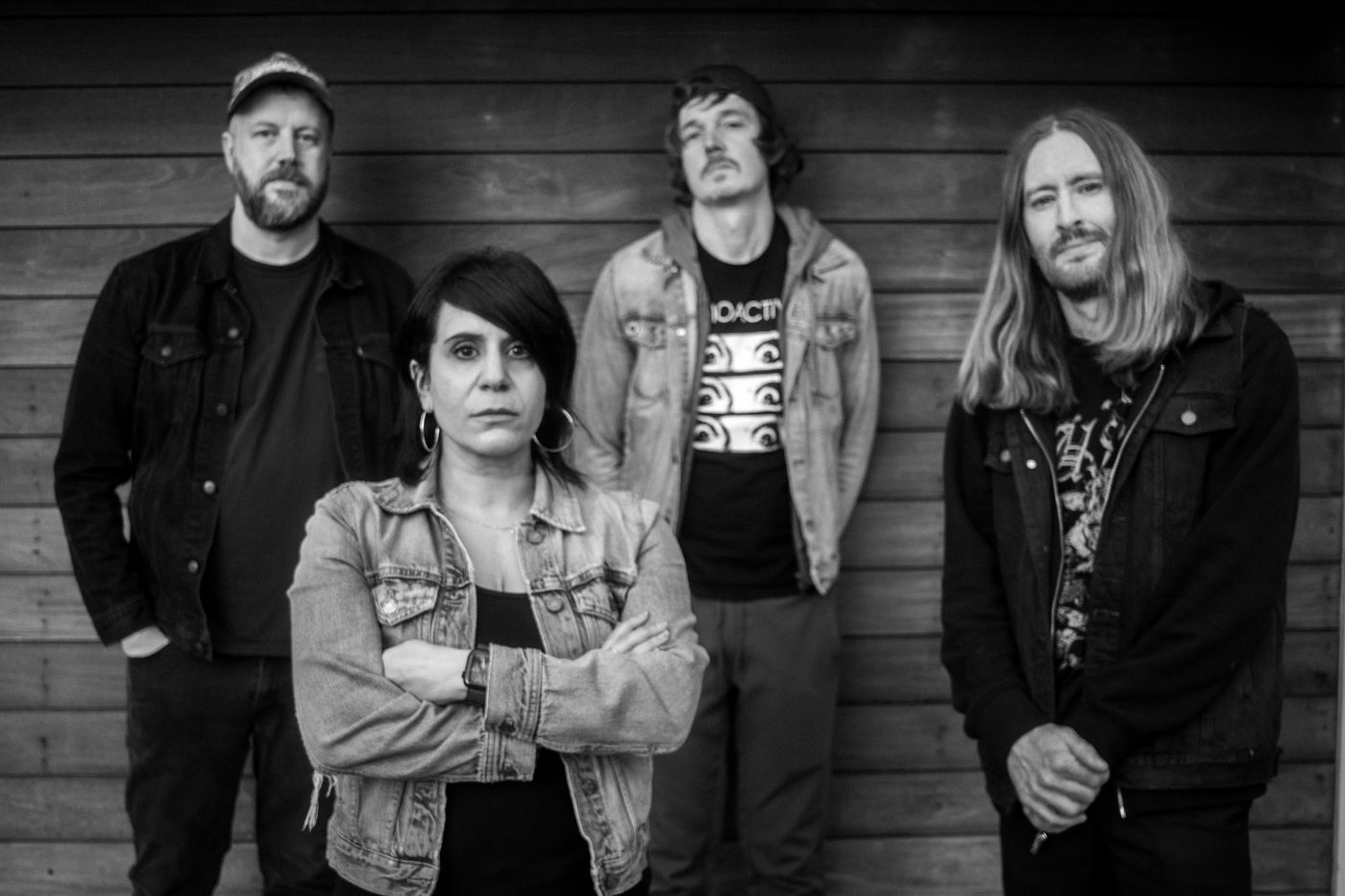
About halfway through NØ MAN‘s fourth full length offering, “Between the Sword and the Neck“, the Washington, DC hardcore band give over part of their music to Palestinian friends and relatives reading the names of people they have lost. “They Have Names” moves from fast, sludge-heavy D-beat into a long, repetitive post-metal ending. The people speaking over it recorded themselves separately and sent their voices to the band. One woman sent more than 200 names.
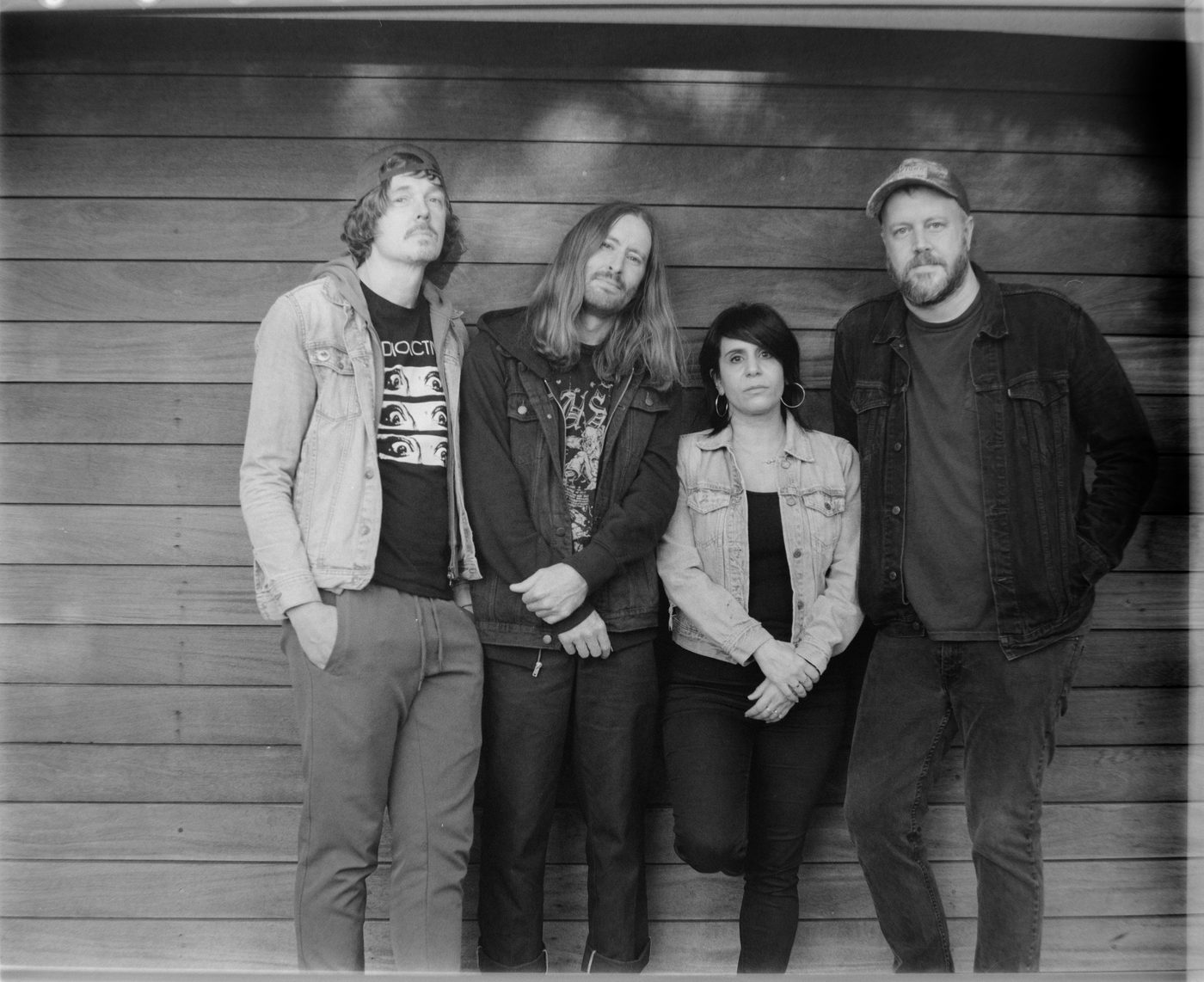
In other parts of the record, we hear vocalist Maha Shami’s mother reading her own poetry in Arabic, her daughter singing, and words by Palestinian writers Ghassan Kanafani, Fadwa Tuqan and Mahmoud Darwish. There’s a lot going on in these 26 minutes. Guitarist Matthew Michel, bassist Kevin Lamiell and drummer Pat Broderick take NØ MAN’s furious hardcore into slower, industrial territory, while Maha brings some of the most personal writing of her family’s history into the songs.
Released through Iodine Recordings on October 30th, “Between the Sword and the Neck” builds on the musical directions of “Erase” and 2024’s “Glitter and Spit“. It also brings us back to a conversation we had with Maha two years ago about growing up as the daughter of Palestinian refugees. This time, much of our conversation concerns the people whose lives and words are part of the actual recordings.
“For context, ‘They Have Names’ honors Palestinians we’ve lost over the past 75+ years living under military occupation, highlighting that the genocide didn’t start in October 2023,” Maha tells IDIOTEQ.
“The lyrics reference my dad’s brothers – Faheem (age 11), Kareem (age 10), and Haleem (age 7) — killed by a bomb left behind in their yard.”
All three boys died before Maha was born. Their names appear in the song alongside Hind Rajab, the six-year-old Palestinian girl killed in Gaza City in January 2024 after pleading for rescue over the phone. An investigation by Forensic Architecture and Earshot identified 335 bullet holes in the car in which Hind was trapped with her relatives. The figure appears in Maha’s lyrics.
Wyświetl ten post na Instagramie
She also remembers Shireen Abu Akleh, the Palestinian-American journalist shot dead while covering an Israeli military raid in Jenin in May 2022, and Shaban al-Dalou, a 19-year-old Palestinian university student who died alongside his mother, Alaa, after an Israeli strike set fire to tents sheltering displaced families at Al-Aqsa Martyrs Hospital in Deir al-Balah on October 14th, 2024. Shaban had already been injured in an earlier attack.
The title of “They Have Names” comes from a banner NØ MAN made carrying the names of hundreds of infants and children killed during the first months of Israel’s war in Gaza after October 2023.
When Matthew first put the music together, he had an idea for an extended ending based on a kick drum programmed on a drum machine and a repeating loop. The band kept playing the last section louder and making more noise whenever they rehearsed it. Reading Maha’s lyrics gave Matthew the idea of asking their friends and family to contribute their own recordings.
“The song ends with our family and friends reading names and memorializing loved ones they’ve lost. If you know a Palestinian, we’ve all lost someone. So it was as straightforward as leaving a voice memo. We then took those voice memos and mixed them together hoping to include at least one from each person. Some people have lost hundreds of family members so it was impossible to include them all.”
“One friend shared a recording that was several minutes long with over 200 names she’s lost from the last 3 years. Hearing the last name repeated over and over again was gutting, realizing that entire families are being erased.”
In his September 2026 interview with Michael Whiteside for Fecking Bahamas, Matthew recalled that one of the submissions was six minutes long. He struggled to get through the recordings as he worked on the song.
“I had to keep taking breaks while mixing because it made me sick.”
Wyświetl ten post na Instagramie
Those voices are now heard at NØ MAN’s gigs as well. Maha has seen people respond to the ending of “They Have Names” in very different ways.
“We use the same track from the record live as a sample and may expand on it as we play the song more. It’s been an extremely heavy and connecting part of our set with a range of responses… sometimes complete silence, sometimes a room moving as one, all that grief with nowhere else to go.”
Earlier on the album, on “Moan“, Maha writes about trying to sleep while people are dying elsewhere. There’s a line towards the end of the song about calling her mother when she struggles to find the words. On the last two tracks, we get to hear some of those words from her mother herself.
“Kamelah Jadallah Shami is my mother. She was born in Jaffa, Palestine, in 1944, to Abdulhaleem Jadallah and Gazalah Abu Zaid. Her father was a newspaper printer.”
Wyświetl ten post na Instagramie
Kamelah was four years old when her family fled Jaffa during the Nakba, the mass displacement of Palestinians in 1948.
“When her family realized what was happening to the people and the land, massacring Palestinians and destroying villages, they fled to Gaza, where her grandparents had room for them. From there they crossed by sea to Lebanon and ultimately landed in Jerusalem. While her father eventually found a job, the pain from displacement and the occupation took a major toll and he was never the same. She and my father, Dr. Jamil Shami, made a life in Virginia, where she spends much of her time reading and writing.”
Maha’s father came from Beit Ur al-Tahta, a village outside Ramallah in the West Bank. He travelled to the United States to pursue his education and was subsequently prevented from returning to Palestine. Maha grew up in the Washington, DC suburbs and spent parts of her childhood visiting relatives in Palestine.
During our May 2024 interview, she spoke about invasive searches and hours of interrogation during those visits. Back at school in the US, she remembers other kids pointing at a map and telling her that Palestine didn’t exist. At the time of that chat, she hadn’t been able to get back to Palestine since 2011, despite still having close family there.
Kamelah has been writing about her own life for decades and has published several books of poetry in Arabic. The piece that ends up on NØ MAN’s fourth album was already written before the band began working on it.
“The poems poured through me onto the page,” Kamelah says. “As a Nakba survivor, life moves you through the pain. It has to find a way through to be expressed.”
Maha had read some of her mother’s poetry to the crowd before NØ MAN played a benefit show in Washington, DC. Afterwards, she suggested using a translation of the poem for the band. That idea eventually became the two closing tracks of the new LP, with both mother and daughter taking part in the recording.
Maha has spent her life around Kamelah’s writing and knows just how wide the emotional range of her poems can be.
“My mom has such an incredible way of writing. Her range goes from sorrow to pure joy, and even her heaviest pieces land somewhere empowering. Her words and the imagery they invoke feel otherworldly and almost supernatural. Like they’re connected to the universe and to nature, to something much bigger than us. That’s how my mom exists in the world, too. She seems tuned in to something beyond what the rest of us can see.”
Together, they chose “نزيف على الورق”, meaning “Bleeding on Paper”. The poem appears in its original Arabic on the ninth track, read by Kamelah. The final song, “Blood and Paper”, uses Maha’s English interpretation of the same piece. A complete English translation of the original poem has never been supplied for publication, so the adaptation should be understood on its own terms.
“We chose this poem together because it captured how we both feel about our necessary processing and expression through words. The vibe also felt more haunting than her typical poetry, like something I would have written.”
There’s a passage in the poem where a stranger comes into the narrator’s life. With the narrator struggling to breathe, unable to sleep and feeling trapped, this person offers comfort and encourages her to write. The encounter was one of the things Kamelah wanted to talk about when the two of them were choosing the poem.
“Despite surviving severe hardships, she always chooses to live in the light. When we discussed this very heavy piece, she highlighted the beauty of how a stranger or a passerby may enter your life briefly, rescuing or redirecting your path.”
In “Blood and Paper”, the narrator eventually reaches a point where she can begin to reclaim what has been taken from her. Over four minutes long, the song gives those words more room than the short bursts of hardcore that make up much of the beginning of the record.
Maha continues:
“‘Blood and Paper’ is the english translation with some interpretation of her track. It’s about violation, suffocation, and catharsis through writing. It’s about turning personal pain into something that belongs to all of humanity and reclaiming what’s yours. I didn’t approach it differently at all. It’s the same voice, the same intent. Because we chose it together and it says what we both feel, singing it felt like singing my own.”
For Kamelah, hearing the experiences she had written about finding their way into her daughter’s music was deeply moving. Maha describes her mother as a constant source of support.
“She’s my rock and unwavering support so collaborating on our record is a dream.”
Kamelah tells her: “I see my pain intergenerationally through my daughter’s words. That she felt the same was so touching. I am excited for others to hear them.”
The youngest member of the family appears just before those two songs. Maha and Matthew’s daughter, Kami, sings at the end of “In Tongues”. Listed in the album credits as Kamelah Michel, she was named after her grandmother.
Much of “In Tongues” is concerned with what happens to people after death and the possibility of keeping their memories alive through words. Three Palestinian writers whose work Maha has come to know at different points in her life are quoted directly in the song.
“Mahmoud Darwish was iconic and one of the most celebrated poets in the Arab world. I first knew of Ghassan Kanafani as a prominent figure advocating for Palestinian liberation who was assassinated, along with his 17 year-old niece, by a car bomb planted by the Mossad. I learned about his writing later. I discovered Fadwa Tuqan’s poems more recently and I’m drawn to how she holds loss and renewal together, moving from grief toward survival – a theme I see in my mother’s work as well.”
Kanafani’s contribution appears at the beginning of “In Tongues“, questioning strength, weakness and people’s claims to truth. Tuqan’s words about the echoes left behind by a person’s life appear later in the song, while the closing lines credited to Darwish imagine somebody being brought back to life by speaking of them over their grave.
By the end of the track, it’s Maha’s own daughter who is singing.
“This is about resurrecting them through stories and memories that live forever. The song ends with my daughter singing my lyrics, placing the legacy in her voice – she’ll speak of me after I’m gone, and in speaking, keep both me and the words alive.”
Matthew’s connection with Kamelah goes back through much of his own adult life with Maha. In that same Fecking Bahamas conversation, he spoke about her importance to their family and the choice they made when naming their child.
“Our daughter Kami is named after her.”
Wyświetl ten post na Instagramie
All three generations of these Palestinian women are now heard within the final three tracks of a hardcore record.
Ghassan Kanafani was also the source of the album’s title. In a televised interview with Australian journalist Richard Carleton on October 16th, 1970, the Palestinian writer challenged the premise of entering peace talks with an occupying power. He compared the proposed conversation to an exchange between a sword and a neck. Kanafani was assassinated in Beirut less than two years later.
“‘Between the Sword and the Neck’ is pulled from a well-known Ghassan Kanafani interview in 1970 highlighting the absurdity of negotiations or so-called peace talks with your occupier. It’s a metaphor to illustrate the power imbalance between colonizers (the sword) and displaced people fighting for liberation (the neck). We chose it as the album title because it frames the whole record.”
NØ MAN have also connected the album with the Palestinian concept of sumud. Translated from Arabic as steadfastness or perseverance, the word has come to describe the determination to sustain Palestinian life and culture under occupation and displacement. Matthew sees the presence of Palestinian voices, names and literature on the record as part of that determination.
It’s there from the first minute of the album, although “In Spite” comes at the subject from a different place. Kat Hidalgo of Denver political hardcore band FAIM and Jenna Pup of The HIRS Collective join Maha on the opening track. Conceived as a love letter to both friends, the song borrows from the lyrics of their respective bands and deals with being excluded from the telling of your own history.
There are some pointed, funny lines in there about women in bands and the age at which people think they should stop playing. Within less than two minutes, Maha and her guests take on tokenism, revisionist accounts of punk history and the expectation that the people being written about should quietly accept somebody else’s version of events.
The connection with FAIM and The HIRS Collective goes back beyond this record. NØ MAN previously appeared on The HIRS Collective’s “Sweet Like Candy” in 2023, and their friendship with the Philly band came up when we spoke to NØ MAN for our Dilly Dally Fest feature in November 2024.
“We have a decades-long relationship with Philadelphia, ranging from road trips from DC for shows at the First Unitarian Church, friends moving there, and bands we consider family like HIRS.”
Back in 2024, NØ MAN turned all of their “Glitter and Spit” release shows into benefits for Palestine, using gigs to raise money for UNRWA, Gaza Soup Kitchen, Palestinian Youth Movement and mutual aid efforts. They’ve continued doing benefit shows while touring the new stuff.
The summer of 2026 took them to New Friends Fest in Toronto, with dates alongside Reversal of Man also announced for Montreal and Burlington. They opened for Ink & Dagger in New York just before the fourth LP’s release and were booked for a Gaza Soup Kitchen benefit in Alexandria, Virginia, on November 12th.
When we first talked to Maha about “Glitter and Spit“, she told us about a PR firm asking them to remove mentions of Palestine from their band biography. The company worked with smaller punk bands and considered Palestine too controversial. Casey and the folks at Iodine supported NØ MAN in ending that relationship. Two years later, the band’s new LP includes Maha’s family history, Palestinian political writing and the names of Palestinians killed across generations.
“In Spite” leads straight into “Zoo“, another short, fast hardcore song about the abuse of power. Maha takes ideas from George Orwell’s “Animal Farm”, bringing Mr Jones and the pigs into a song about how people are encouraged to follow their leaders, repeat slogans and turn on each other.
Speaking to Andrew Sacher around the release, Maha called it “a metaphor about hierarchy, abuse of power, and slogans that numb people into marching into complicity.” The band released an official video for “Zoo” ahead of the album.
That same preoccupation with words and who gets to decide their meaning continues on “Pregnant Hearts“, where political language is used to make violence sound like rescue. There are other elements of Maha’s writing throughout the LP, though, and some of them get pretty strange.
“Murmur“, with its slower, industrial-metal direction, gets into body horror. Heart valves stiffen, blood flows backwards and the narrator becomes increasingly distorted. Maha brings together paranoia, daydreams, pleasure and the fear of physical deterioration, before turning some of that grotesque imagery into something she appears to welcome.
“Run Faster” takes love and mortality into the space of a two-minute hardcore song. Hades, Persephone, weddings and funerals all appear in the lyrics, with Maha writing from the perspective of somebody desperate to hold on to a loved one while already worrying about their death. Even amid the more directly political songs, there’s a recurring fear of losing the people closest to her.
The variety within the songs gave Matthew a chance to try something different during recording. On this album, he worked on each song individually, finishing its mix before moving on and using different instruments and recording choices along the way.
Finding time to record was a little more difficult than it had been on some of the band’s earlier records. Kevin had a newborn, and with the members living in different parts of the country, they got stuff done whenever they could. Matthew travelled to New York so Kevin could record his bass parts without having to be away from home.
Wyświetl ten post na Instagramie
Most of the album was recorded at Matthew’s Viva Studio in Fairfax, Virginia, with bass recorded by Matthew and Oscar Albis Rodriguez at Studio G in Brooklyn. Joey Hidalgo handled additional vocals for “In Spite” at Skull Cavity in Tacoma, Washington. Matthew mixed the LP, Brad Boatright mastered it at Audiosiege, and Zach Hobbs created the artwork.
The histories of NØ MAN’s members go back through Majority Rule and the Washington, DC hardcore scene of the ’90s. The new band began in 2017, around the time Majority Rule were playing reunion shows. Pat was staying with Matthew and Maha, and they started writing some new songs together for fun. Matthew, Pat and Kevin had already spent decades playing music together. NØ MAN have now put out four full-lengths of their own.
Matthew has watched Maha write and rewrite her lyrics over the years, often beginning with abstract, loosely connected thoughts and gradually finding a balance between imagery and more straightforward writing. The fourth LP contains both, sometimes within the same song.
Wyświetl ten post na Instagramie
“Between the Sword and the Neck” is available in full through Bandcamp, with vinyl, CD and cassette editions from Iodine Recordings.
We leave the final words to Maha, who wanted this stated plainly about the record:
“‘Between the Sword and the Neck’ is about refusing erasure and being reshaped into something more palatable. It’s about survival and memory as acts of resistance.”
🔔 IDIOTEQ is ad-free, independent, and runs on one person’s time. If you want it to stay that way: DONATE via PayPal or SUPPORT via Patreon.
NEW: IDIOTEQ Explore 🗺️ Browse 15+ years of our archive by city, country, and style. Find artists on the world map or trace related sounds through the styles map.
Stay connected via Newsletter · Instagram · Facebook · X (Twitter) · Threads · Bluesky · Messenger · WhatsApp.
Social add-ons
Instagram / Facebook