


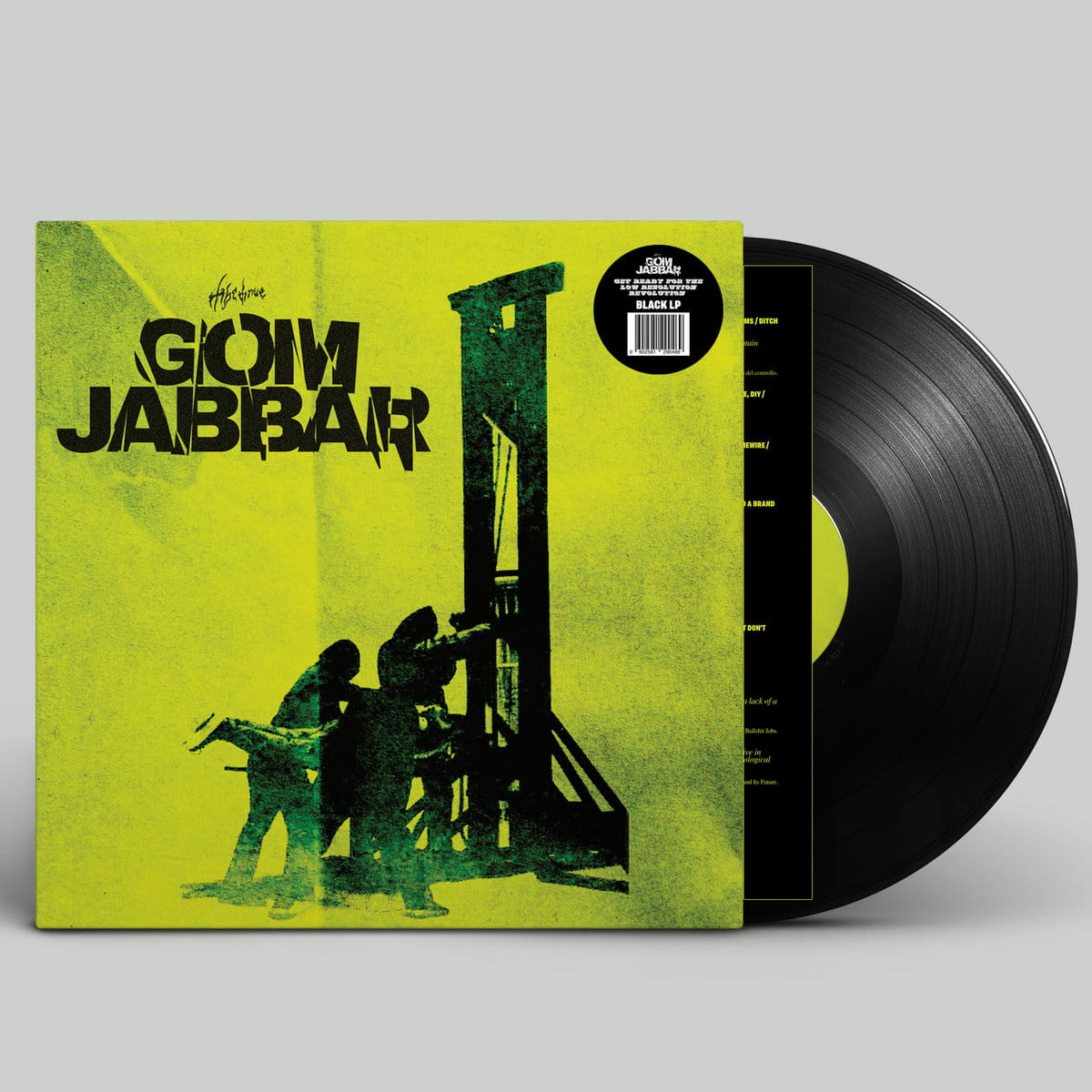
Gom Jabbar, the chiptune-punk duo of Stormo’s Federico Trimeri and Kenobit’s Fabio Bortolotti, share self-titled debut on Subsound RecordsOn the self-titled debut from Gom Jabbar, the Game Boy isn’t a sample or an emulator.
It’s the actual 1989 hardware, four monophonic channels of square wave running live while the band plays, plugged directly into the mixer with no software in between. The result is bright, dirty, and impossible to replicate on the most expensive synths money can currently buy. Next to it: a distorted guitar. Eight tracks of low-resolution violence, intercut with ambient passages that let the room breathe before the next one hits.
The duo is Federico Trimeri of Stormo and Fabio Bortolotti, who records and performs as Kenobit. The album arrives June 26 via Subsound Records on LP and digital, recorded, mixed and mastered by Riccardo Gamondi of Uochi Toki, and released under a copyleft license. Ahead of tomorrow’s drop, IDIOTEQ is hosting the full album premiere.
Bortolotti is approaching the Game Boy on stage the same way he approaches it on the record. “Working with four monophonic channels with very limited waveforms and processing power is very special. Honestly, it’s refreshing.
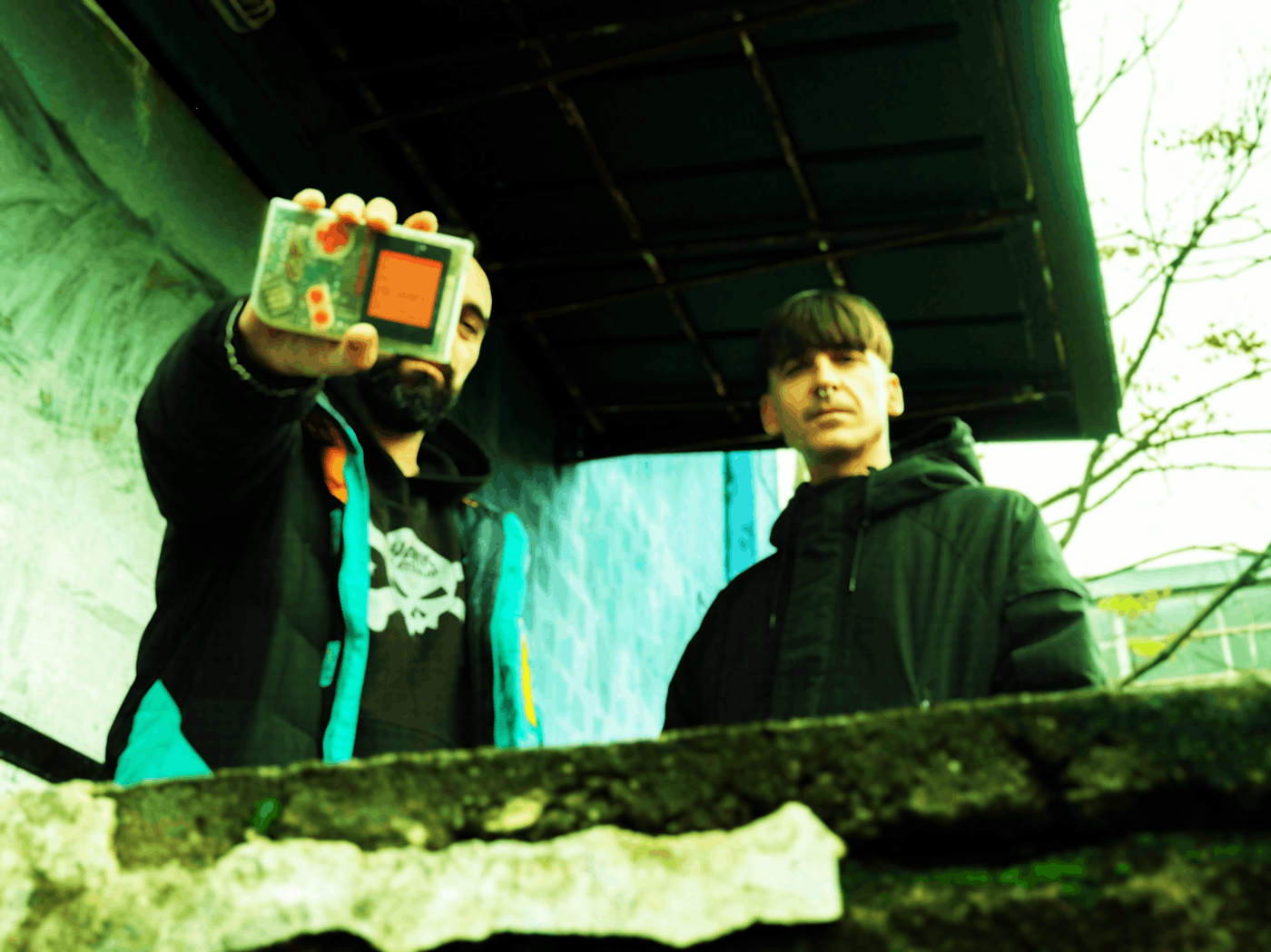
Yes, it has a lot of limits, but those limits are what it’s all about. Making the game boy sound ‘big’ is a constant challenge, but by trying to trascend the hardware limitation of a toy from 1989 often leads to surprising results. It’s a sort of musical serendipity.” The hardware sits at the centre of the live setup as a physical object, not a stand-in.
“I use a Game Boy plugged directly in the mixer, so the music is actually happening in the machine while we play. It’s not a recording, it’s not a software emulator, it’s not a laptop. Soundwise the difference is minimal, but the crowd feels something different and alive. I think of the Game Boy as member of the band.”
Wyświetl ten post na Instagramie
The constraint is also the point. “There is creativity in limitations, and I find this poetic, because I think we do the same in the underground, as a community. We don’t have much and we try to do beautiful things with few resources. In this sense, I see a straight line connecting chiptune and punk.” The hardware adds character too. “The square waves of the Game Boy are dirty and raw, but their inherent shittiness is what makes them unique. It’s something you can’t emulate, even in the era of DAWs and expensive synths.”
Hacking a toy from 1989 also reads as a political act. “We see the choice of playing with an old machine, by hacking the specific way it had been manufactured, as a revenge against planned obsolescence.”
For Trimeri, Gom Jabbar isn’t a side project so much as a logical next step. Stormo’s last album “Sogni che invadono il cielo” leaned hard into electronics, with synths, modules, and percussion processed through synths.
“And ever since ‘Tagli | Talee’, there’s been a greater presence of electronics and a more developed industrial aspect. I’ve been hanging out in the noise/ambient and experimental scene for years now, and 8bit and chiptune have been genres I’ve always appreciated, even though I’ve never deeply explored them.” Gom Jabbar pulls those threads together. “I’d say that Gom Jabbar is, for me, almost a natural musical evolution, a band whose other half is deeply rooted in the experimental scene and deeply grounded in a punk approach, politically, lyrically, and musically.
And punk in a ‘Sid Vicious way’ too, since the first time I picked up a guitar was in the rehearsal room with Keno, who in turn had never really sang before.”

The record was tracked by Riccardo Gamondi of Uochi Toki, and the duo describe the session in family terms.
“Rico (Riccardo Gamondi) is a truly special person and holds a special place in our hearts. He welcomed us into his home and studio like brothers and gave us complete creative freedom. As the producer of Uochi Toki, he knows full well the potential of a Game Boy cranked up to 9000 on a rave party sound system, and he did everything he could to capture that same approach on the record.” Gamondi’s previous work with OvO, Nadja and Le singe blanc gave him the right vocabulary for what the duo wanted. “He has very clear ideas when it comes to the improper and reckless use of guitars, pedals, and microphones. And the stranger the band, the better he seems to work. And for us, he was crucial.”
The ambient passages between tracks aren’t a softening device. They’re part of the duo’s DNA. “We like weird sounds and distorted ambient soundscapes. It’s part of our DNA, maybe at some point we’ll make a dungeon synth release. I especially like the contrast between a slow ambience and a sudden grindcore intro.”
The copyleft license isn’t decorative either. It comes from the same root as the Game Boy on stage and the lyrics that run across the record. “The copyleft position emerged from the beginning and is also a running theme in the lyrics. It is both ideological and practical. We believe a copyleft release aligns with our values, and that makes us happy.
At the same time, we’re betting it is also the most sensible thing to do. Instagram and TikTok are shit for promotions. Even though many bands say ‘they need it’, they really don’t. Even huge bands have abysmal engagement rate on the platforms. Spotify ‘has all the music’, but it’s getting diluted with AI slop and 90% of the songs uploaded never do more than a thousand streams. This is not even ideology, this is data. Commercial social media is designed to make money out of all the entities they touch, not to promote a healthy underground.”
The duo also reject the personal-brand economy that the platforms ask of underground musicians. “At the same time, curating a ‘personal brand’ takes a lot of time. Time you have to take away from the actual things you want to do (music), and that will put you and your band through the misery of chasing engagement numbers instead of actual fans that show up at gigs. It doesn’t work as advertised and is quite literally unpaid labor. And we hate labor.”
Where they’ve moved instead is the Fediverse. “It might create friction with the industry expectations, but we think it’s much wiser to invest our communication energies elsewhere. On one side, we are on the Fediverse, the free, self managed and decentralized social network where you can actually talk and interact with people. It allows us to share our music in an environment without advertising, without ‘for you’ pages, where we can just be what we are without extra work. On the other side, we want to be active and play as much as we can to meet people and create connections. Even if it might seem crazy to launch a band and not have an instagram or spotify profile, we think in the long run we’ll be proven right. And if we’re not, we’ll still have had a lot more fun than if we had to dance to please the algorhythm. We don’t want followers, we want accomplices.”

The name comes from Dune.
“We really like Dune and we formed the band while we were both reading the books. Gom Jabbar is such a beautiful name and it summons the image of this horrifying test where a human has to resist pain to prove themself.” There’s a reading that lines up cleanly with the lyrics, although the band stop short of overdrawing it. “The Bene Gesserit’s Gom Jabbar test in Dune can also be seen as a major dichotomy between man and machine, the rise of AI that replaces humans, the pain that represents the evils of digital capitalism and how we can resist and prove to be something more, but that would be pretentious. We like Dune and we liked the name. And Frank Herbert was an undisputed genius.”

Across lyrics, licensing and live setup, the duo see all of it as one position rather than three separate decisions. “I think it’s all connected and it stems from our ideas. We think in a way, so we act in that way. It translates in choices in publishing, lyrics, venues. This is not about ideological purity, which is really not the point, but more about choosing things that are meaningful to us. Our goal is not to be rich and famous, but to have fun, make music and say something meaninful to someone and it would be harder to have fun if we were tied to some of the music industry rules. We think it’s really worth it to be independent and to build our project on stuff we own and control. We don’t want to ask for permission. We don’t want to build on something that one day might be taken away. We have all the technology and the will to be independent. We think the underground is gifting its beauty to capitalist platforms that will only try to turn into a product. We want to do things differently in the hopes of finding more and more people that will join the fight.”
🔔 IDIOTEQ is ad-free, independent, and runs on one person’s time. If you want it to stay that way: DONATE via PayPal 𝗈𝗋 SUPPORT via Patreon.
Stay connected via Newsletter · Instagram · Facebook · X (Twitter) · Threads · Bluesky · Messenger · WhatsApp.